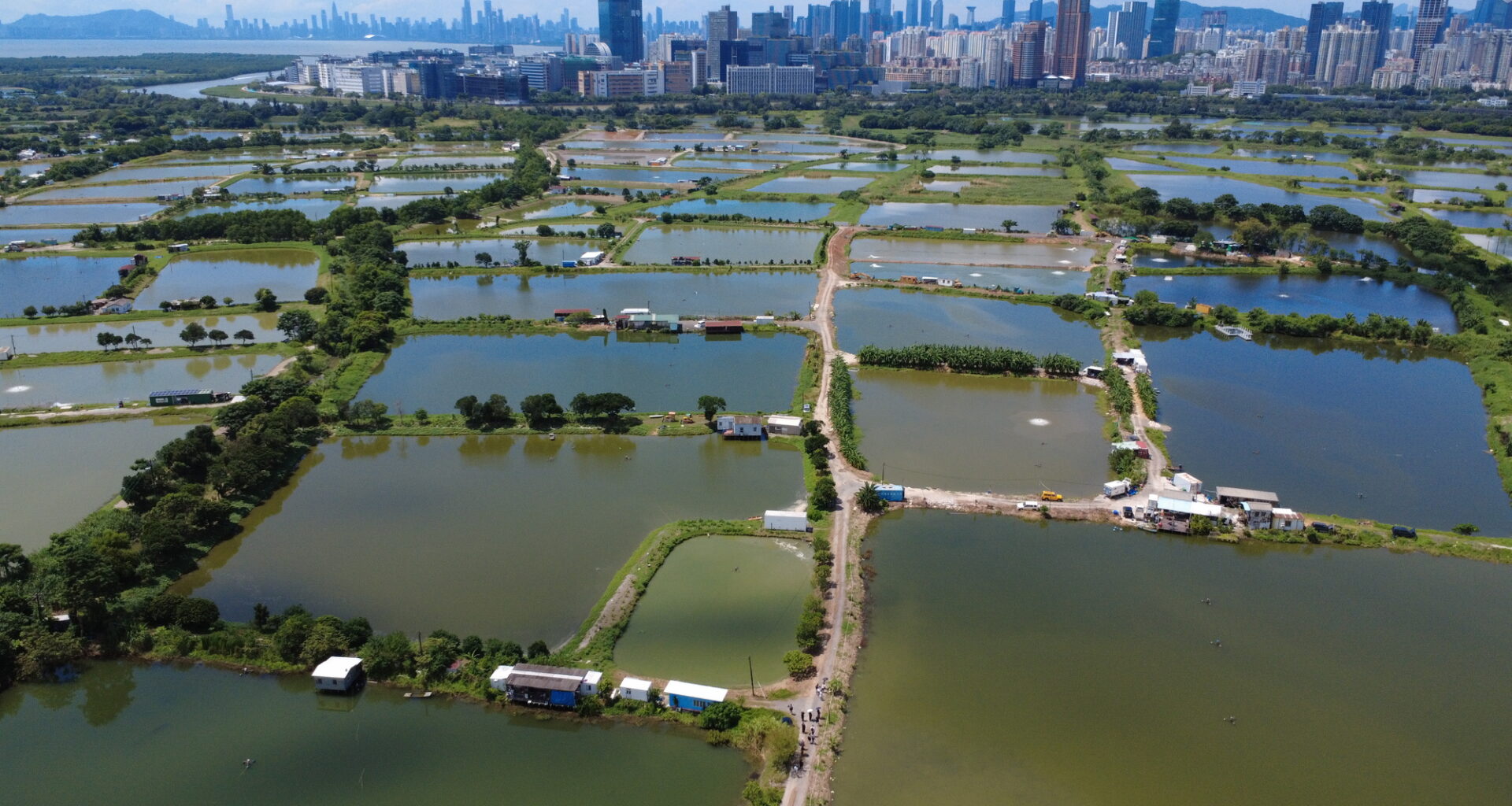
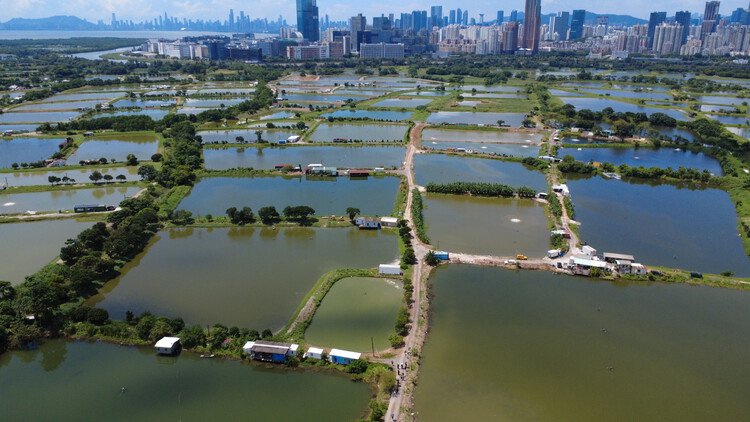
 San Tin Tidal Ponds, Hong Kong SAR, with Shenzhen in the background. Image © Jonathan Yeung
Share
Or
https://www.archdaily.com/1039481/from-cloud-to-coast-the-physical-cost-of-ai-in-hong-kongs-borderlands
Amid the rapid build-out of data centres and AI economies across the Greater Bay Area—and alongside the celebration of AI as a tool and “author,” as featured in 2025 Hong Kong–Shenzhen Bi-City Biennale of Urbanism\Architecture (Hong Kong)—a parallel question becomes unavoidable: how do the planning and construction of AI infrastructure actually begin to shape everyday life? Many of the facilities already built remain intentionally distant from daily experience. The “cloud” may be marketed as immaterial, but its architecture is profoundly physical: high-power, high-heat, service-heavy environments that are often sited in remote or low-density areas to take advantage of lower land costs and to minimize friction with nearby communities. Security and risk management further reinforce this logic. Data centres hold sensitive, privileged information—corporate assets, legal records, government and institutional data—and remoteness becomes part of their operating model, keeping the infrastructures of AI both spatially and socially out of sight.

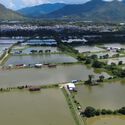
Yet Hong Kong’s current development trajectory suggests that this separation may not hold. San Tin is being positioned as one of the next I&T hubs of Hong Kong SAR and the Greater Bay Area, anchoring a major redevelopment agenda. While often described as “on the outskirts” or reduced to a border zone adjacent to Shenzhen, San Tin is also a living landscape—shaped by long histories of village settlement, lineage-based stewardship, and locally sustained economies. Its geographic conditions, particularly extensive low-lying tidal land, have supported a durable ecology of fishponds and tidal ponds, including shrimp cultivation, forming not only livelihoods but also a distinctive wetland fabric that has structured the region’s spatial and environmental identity. Even if one argues that fishpond and shrimp economies have become less commercially competitive—gradually losing ground to larger-scale agricultural systems across the border—this does not diminish the significance of the landscape itself, nor the cultural practices and forms of knowledge embedded in its maintenance over time.