
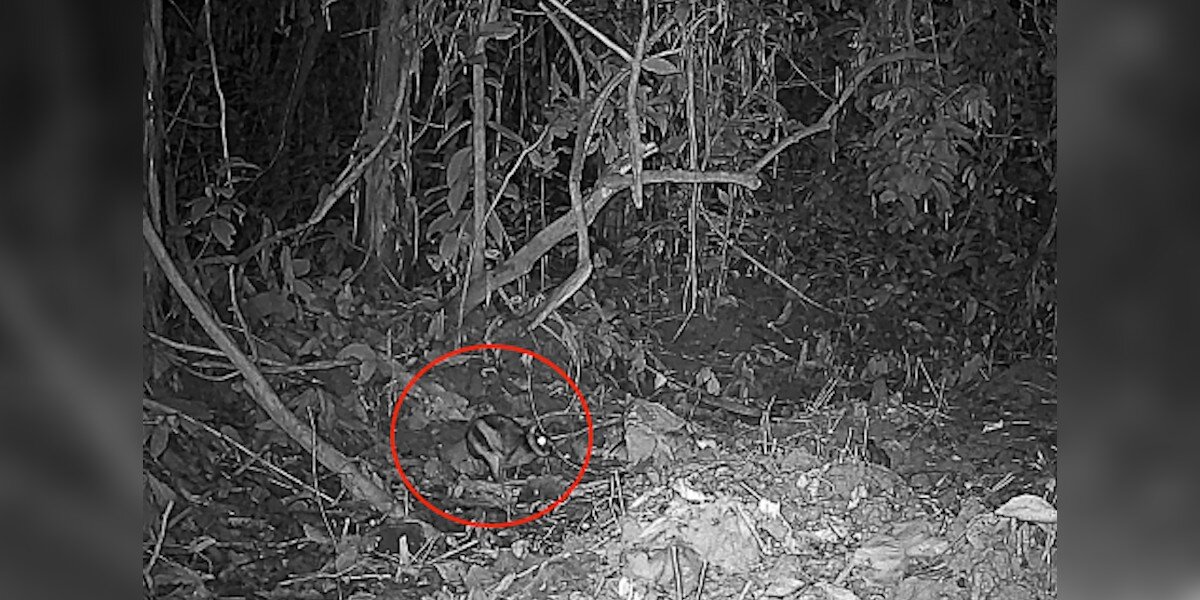
Last year, several environmental groups took on an enormous conservation project in the Annamite Mountains, a dense range in Southeastern Asia often called the “Amazon of Asia” for its varied wildlife. The charity leading the effort, Fauna & Flora, placed trail cameras throughout the 680-mile range to learn about the wildlife living there.
After months of gathering footage, the remarkable images were released in February.
Conservationists were shocked — and delighted — by the results.
“[The images] confirmed for us the biodiverse richness of these sites,” Gareth Goldthorpe, Fauna & Flora’s senior technical advisor for the Asia-Pacific region, told The Dodo. “They confirmed the presence of some quite interesting species.”
Among those species caught on camera was the Annamite striped rabbit. This animal was unknown to scientists and the wider world until the mid-90s, and quite possibly the world’s rarest bun.
 Fauna & Flora
Annamite striped rabbits are small, with brown fur, black stripes and white bellies. They are nocturnal and so rarely seen that any photographic evidence of one is a huge deal.
Nearly identical in appearance to Sumatran striped rabbits, often said to be the rarest rabbits on Earth, Annamite striped rabbits are a separate species, but no less elusive — or adorable.
 One of the few images scientists have of an Annamite striped rabbit. | Wikimedia Commons/Jokuyken15
According to the International Union for Conservation of Nature (IUCN), Annamite striped rabbits are endangered, and their population is dwindling, thanks in large part to poachers and the exotic wildlife trade.
They also live in lowland areas, where a lot of development is taking place.
“Pretty much all of these protected areas have communities living around them,” Goldthorpe said, “and some even within them … Where there’s a lot of people, there’s not a lot of other species.”
 Phong Nha Ke Bang National Park near the Annamite Mountains in Vietnam. | mihtiander/Getty Images
But Goldthorpe remained hopeful, especially after seeing the trail camera images, because they gave conservationists evidence to act on.
“We also need to be working with the communities,” he said. “We need to be supporting their livelihoods to try and reduce any future impacts they may have on these more densely occupied species.”
Species like the serow, known as the “phantom of the forest” because they’re so rarely seen, was also captured by the trail cams.
 Fauna & Flora
Picture an antelope’s body with a goat’s head (including the horns) and a tufted mane of hair similar to a warthog. That’s a serow. They forage in rocky areas in small groups, and the IUCN classifies them as a vulnerable species.
“[Serows are] there in very small numbers,” Goldthorpe said. “We only found it, I believe, in one site.”
Like Annamite striped rabbits, spotting a serow at all is considered a win — not to mention the Asian elephants, Sunda pangolins and stump-tailed macaques who showed up on film.
 A baby stump-tailed macaque with her mother. | Fauna & Flora
Sadly, since completing their trail cam research in 2025, Fauna & Flora lost funding for this particular project after the UK government made budget cuts.
But that doesn’t mean conservationists like Goldthorpe have given up.
“There’s still hope,” Goldthorpe said. “There’s plenty of species out there, plenty of reasons to pull those resources into protecting them.”
If you would like to support Fauna & Flora’s conservation efforts, you can donate to their work via their website. Rare Family Caught On Camera For First Time Leaves Conservationists BreathlessThat many babies is unheard of.