
Imagine catching a single raindrop and realising it fell from a storm on the other side of the Universe.
That’s roughly the scale of what happened on 13 February 2023, when a detector submerged in the depths of the Mediterranean Sea registered the passage of something almost impossibly energetic, a neutrino carrying around 220 PeV of energy, smashing through the previous record by more than an order of magnitude.
Neutrinos are the ghost particles of the Universe. They have almost no mass, carry no electric charge, and interact so weakly with ordinary matter that several billion of them will have passed through your body since you started reading this article without you ever knowing.
Detecting even one at extreme energy requires enormous effort, which is why the KM3NeT/ARCA detector exists, anchored to the seabed off the coast of Sicily, using the Mediterranean Sea itself as a detection medium.
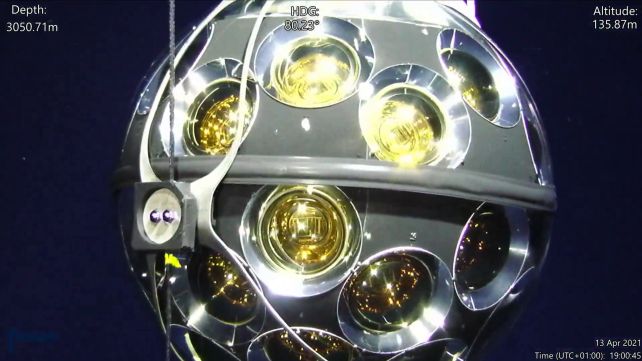 One of the KM3Net detectors, with photodetectors optimized for the faint light of neutrino events. (KM3Net)
The signal stopped physicists in their tracks. Nothing in our catalogues of known events seemed a comfortable fit for a particle this energetic.
So the KM3NeT collaboration did what any good detective would do, worked backwards from the evidence, building simulations and testing hypotheses until something matched.
Their leading suspect, outlined in a new paper in the Journal of Cosmology and Astroparticle Physics, is a class of objects called blazars.
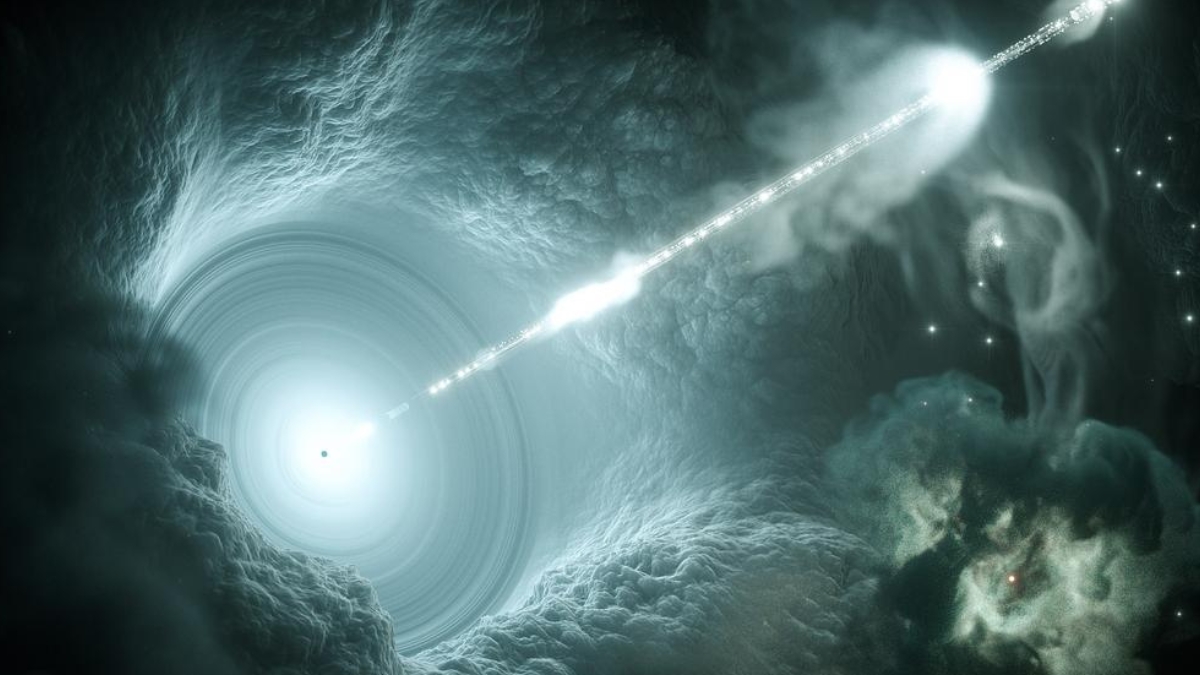
A blazar is an active galactic nucleus, essentially a galaxy with a supermassive black hole at its heart, devouring surrounding material and blasting out a jet of plasma at close to the speed of light.
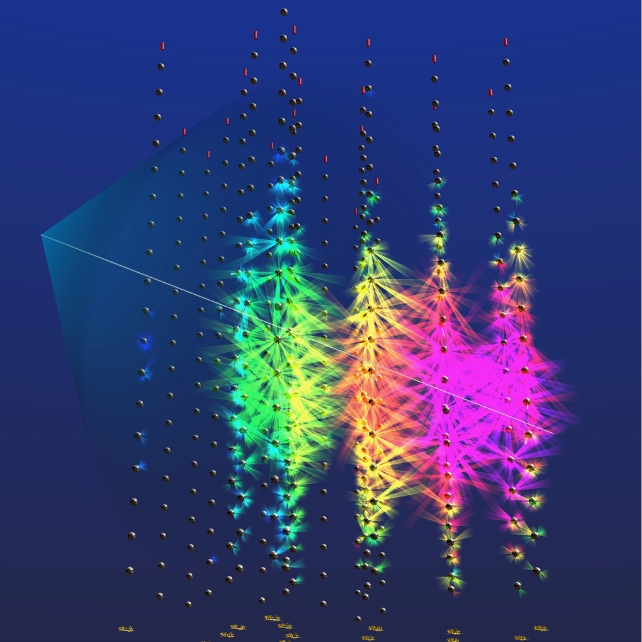 Visualization of the ultra-high-energy neutrino event detected by the KM3NeT/ARCA detector in the Mediterranean Sea. The colored tracks show the Cherenkov light produced as secondary particles travel through the water and are recorded by the detector’s optical modules. (KM3NeT)
What makes blazars special is their orientation; the jet is pointed almost directly at us, making them among the brightest and most extreme objects visible in the sky.
The team simulated a realistic population of blazars and calculated the neutrino flux such a population would produce, then compared those predictions against actual observations, not just from KM3NeT, but from IceCube in Antarctica and the Fermi Gamma-ray Space Telescope too.
Crucially, they also paid close attention to what those instruments hadn’t seen. The absence of comparable ultra-high-energy neutrino events elsewhere places tight constraints on any viable explanation, and the blazar model satisfies them.
One important clue points away from a single dramatic source. When something catastrophic happens in deep space, such as an explosion or a flare, it tends to produce a burst of light across multiple wavelengths simultaneously.
No such electromagnetic counterpart was found alongside the 2023 event, which nudges the explanation toward a diffuse background, not one object doing something extraordinary, but many objects collectively producing a steady trickle of extreme energy particles, one of which happened to arrive at exactly the right moment.

When the record-breaking neutrino was detected, KM3NeT was running on just 21 detection lines, roughly 10 percent of its eventual full size. With the complete detector operational and years of data ahead, the team expects far more powerful analyses to follow.
Related: Ghost Particles Interacting With Dark Matter Could Solve a Huge Cosmic Mystery
For now, blazars remain the prime suspect. And if it turns out they really are capable of accelerating particles to energies like this, it would fundamentally rewrite what we thought we knew about the most extreme engines in the Universe.
This article was originally published by Universe Today. Read the original article.