
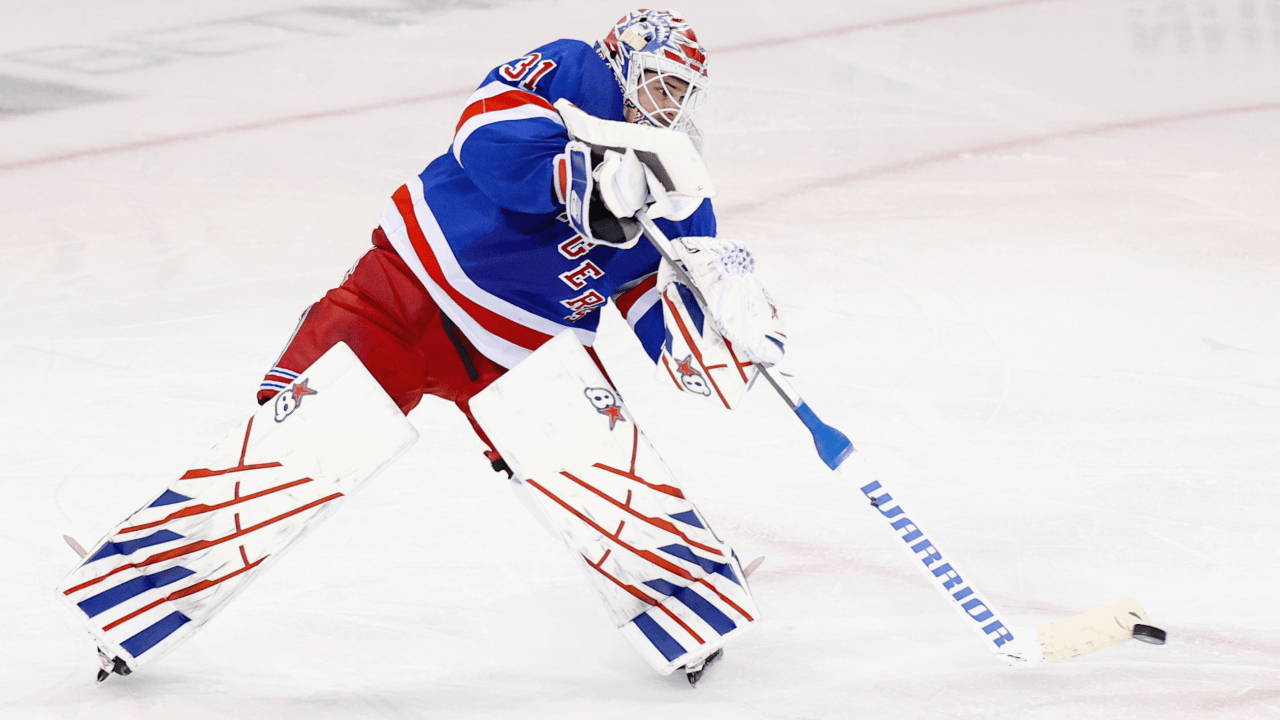
They may not make the highlight reels, but shorter passes to get the team cleanly out of the defensive zone are a big part of being an effective puck-handling goalie.
“In today’s game, it’s a good 10-to-12-foot pass with the ability to do something else once in a while,” said New Jersey Devils goalie Jake Allen, who is in his 13th NHL season.
Allen and Nedeljkovic each stressed that the ability to “something else,” including making the longer passes, means nothing unless all their teammates are on the same page.
Just as goalies rely on learned anticipation to make saves, the ability to read a forecheck is a big part of being able to make the right passes when you’re standing behind the net you are supposed to be guarding. That requires knowing where teammates are going to be as opponents barrel down on you, knowing when to leave it behind the net for them to skate onto and when to chip it past a forechecking forward and into a corner knowing your defenseman will peel off for that pass.
There’s nothing worse as a goalie than waiting to make a pass and having both the opponent and your teammate skate right at you. Communication is key, with a series of calls designed around simple plays like a “leave,” “up” or “over” to keep goalies and defensemen on the same page in the face of a forecheck.
“You can’t be a good puck handler unless you have a good group around you,” Allen said. “It’s a team sport and that aspect of the game is ultimately you giving it to someone else on your team, so everyone’s got to be connected and cohesive and predictable, especially with how fast the game is now, how fast the forecheckers are on top of your defensemen now, and the time and space. It’s about trying to make their job as easy as you can, and I think it’s a good 10- to 12 -foot pass and the ability just to communicate well too.”
Just being good at shooting or passing the puck isn’t enough. You need to be able read a forecheck and trust that your teammates are on the same page with that read.
“I can shoot the puck really high and really hard, but I am trying to make more short passes, cut off one player, maybe two players, and that’s reads and learning,” said Yaroslav Askarov, who is in his first full NHL season in San Jose. “I would say the great stick handling, that’s not only from the goalie, it’s all the time communication with the [defensemen] too.”
Of course, it all starts with a willingness to get out behind the net and stop a dump-in, as well as knowing which ones to leave. The general rule is not to leave the net on pucks up along the glass, lest it hit a seam or stanchion and bounce out front, but even then, there are goalies more adept at getting out to stop pucks behind their net, whether it’s to make one of Allen’s short passes or a simple leave that allows a defenseman to skate onto the puck cleanly rather than trying to pull a moving puck off the wall under pressure.