
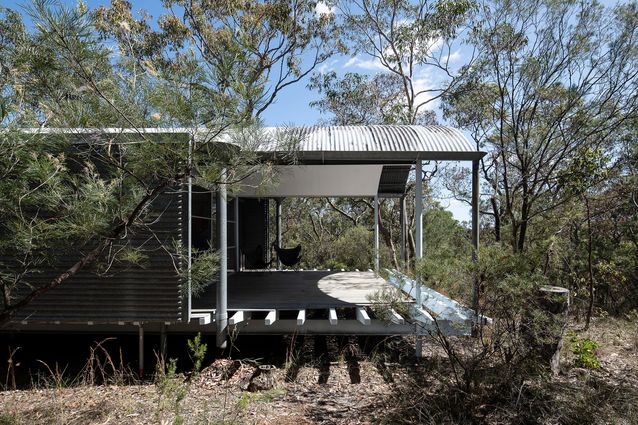
The Ball-Eastaway House, a celebrated 1983 residence by Glenn Murcutt for artists Sydney Ball and Lynne Eastaway, has been placed on the market following its recent addition to the New South Wales state heritage register.
Eastaway first met Ball, a leading figure in Australian abstract painting, while studying at the National Art School in Sydney in the early 1970s. In 1976, the pair purchased a 10-hectare bushland property an hour north of Sydney in Glenorie, seeking a secluded retreat to live and paint. Together, they explored and camped on the bush block many times before commissioning Murcutt, then early in his career, to design a home that could accommodate this.
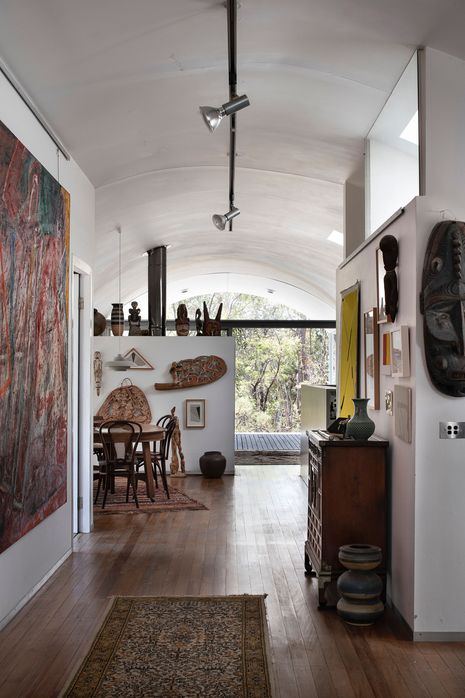
Commissioned with what he would later describe as one of the tightest budgets of his career, Murcutt was tasked with designing a home that could double as a gallery. The resulting dwelling is carefully considered, with a recessed porch that leads directly to a broad central corridor for displaying artworks.
View gallery
In a 2025 article published in Houses as part of the Revisited series, author Peter Salhani describes the home as reflecting Murcutt’s philosophy of “touching the earth lightly,” an ecological approach that places humanity within nature rather than above it.
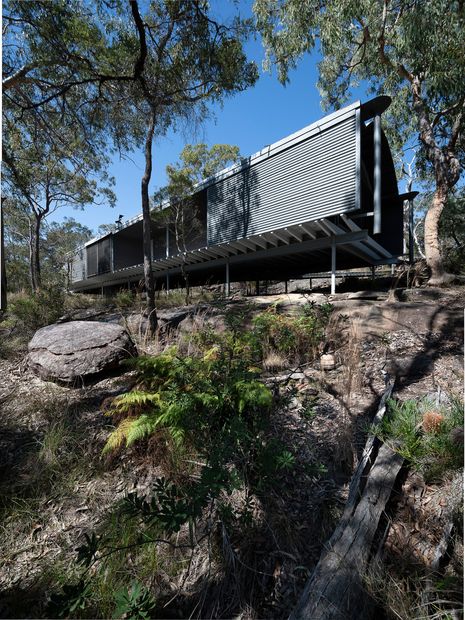
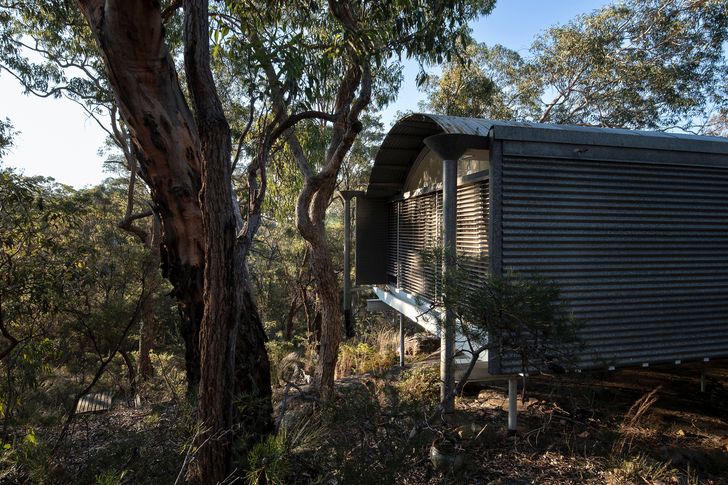
The dwelling, a simple orthogonal structure, barely disturbs the landscape. Raised above a sandstone shelf in an open pocket of bushland, the home is supported by 14 slender circular columns drilled into the bedrock, allowing rainwater to pass freely beneath it. No trees were removed to build the home, and even the drill holes for the columns were filled in with a cement-and-natural-rock mix, so that if the house were ever to be removed, its former presence would be difficult to detect.
View gallery
It is clad entirely in galvanised steel – some corrugated, some folded into protective flaps over the timber frame – a material chosen for its lightness, economy and fire resistance. Fire safety shaped several design decisions: the house occupies a less wooded section of the block and uses tallowwood – a very dense timber – for all essential timber framing.
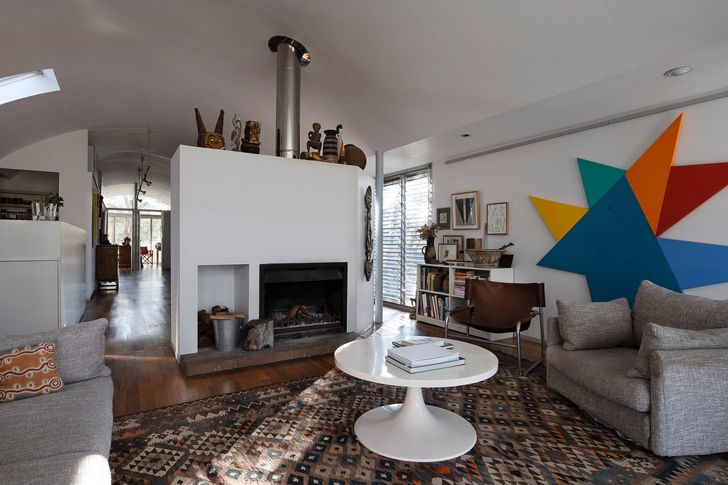
The home is modest at 100 square metres, accommodating just two bedrooms, a living and dining area, a kitchen and a bathroom skylit from above and two verandahs – one tucked away for privacy, the other intended for communal use. White walls and a curved ceiling create a serene gallery-like atmosphere, as was intended. “Paintings and artefacts adorn the walls, the long white curved ceiling funnelling light around them,” observes Salhani in his review. “Each room offers a framed view of the landscape.”
View gallery
To support the couple’s artistic practice, two prefabricated industrial sheds of corrugated steel were also placed on the site – one before the house was built. Eastaway’s shed sits perpendicular to the house, Ball’s studio is parallel, and both adopt the same curved roof as the main dwelling, visually linking the three structures.
Ball and Eastaway moved into the house in 1983, separating a year later. They remained friends, with Eastaway continuing to use the property and Ball living there until his death in 2017. Afterwards, Eastaway engaged architecture firm Downie North to carry out sensitive repairs and restoration in keeping with the original design. The bathroom was renewed, retaining its original tiling pattern while introducing a new circular basin and cabinets that match the kitchen joinery. Much of Downie North’s other work is virtually invisible, including replacing worn timbers, repairing aluminium shutters and updating plumbing systems.
View gallery
The dwelling has become an important example of Murcutt’s environmentally responsive approach to architecture. In 1984, the home won the Wilkinson Award for Residential Architecture – Houses (New), presented by the Australian Institute of Architects New South Wales chapter. In February 2026, the Minister for Environment and Heritage, Penny Sharpe, announced that the house and its entire 10-hectare site would be state heritage-listed, following a major campaign led by Lynne herself.
After realising the house, Murcutt later received the Royal Australian Institute of Architects’ Gold Medal in 1992 and the Pritzker Architecture Prize in 2002.
The Ball-Eastaway House is now listed for sale. For details, visit here.