
Let’s flash all the way back to Thursday, March 5.
In one of the more enjoyably competitive games at Target Center during this 2025-26 season, the Minnesota Timberwolves dispatched a dogged and disciplined Toronto Raptors opponent for its fifth straight victory, moving the Wolves up to third in the typically tight Western Conference playoff chase with less than 20 games left to play on the schedule.
After the game, Wolves coach Chris Finch exuded what amounts to a nirvana state for a man in his position at this point in the season: He was suffused with satisfaction while taking pains to curb his joy away from careening ecstasy.
When I noted that early foul trouble among his starters the past two games had been eased by his ability to insert two recent roster acquisitions, guard Ayo Dosunmu and forward Kyle “Slo Mo” Anderson, into the game, Finch replied, “Yeah for sure. We’ve got options and depth and versatility; we are super-blessed right now. Again, our front office did a great job of rounding out this roster with exactly what was needed.”
But the 2025-26 Timberwolves refuse to be blessed. They’ve been season-long junkies who inevitably need to mainline some haughty incompetence and corrosive narcissism to resurrect disorder before teamwork can become too dependable.
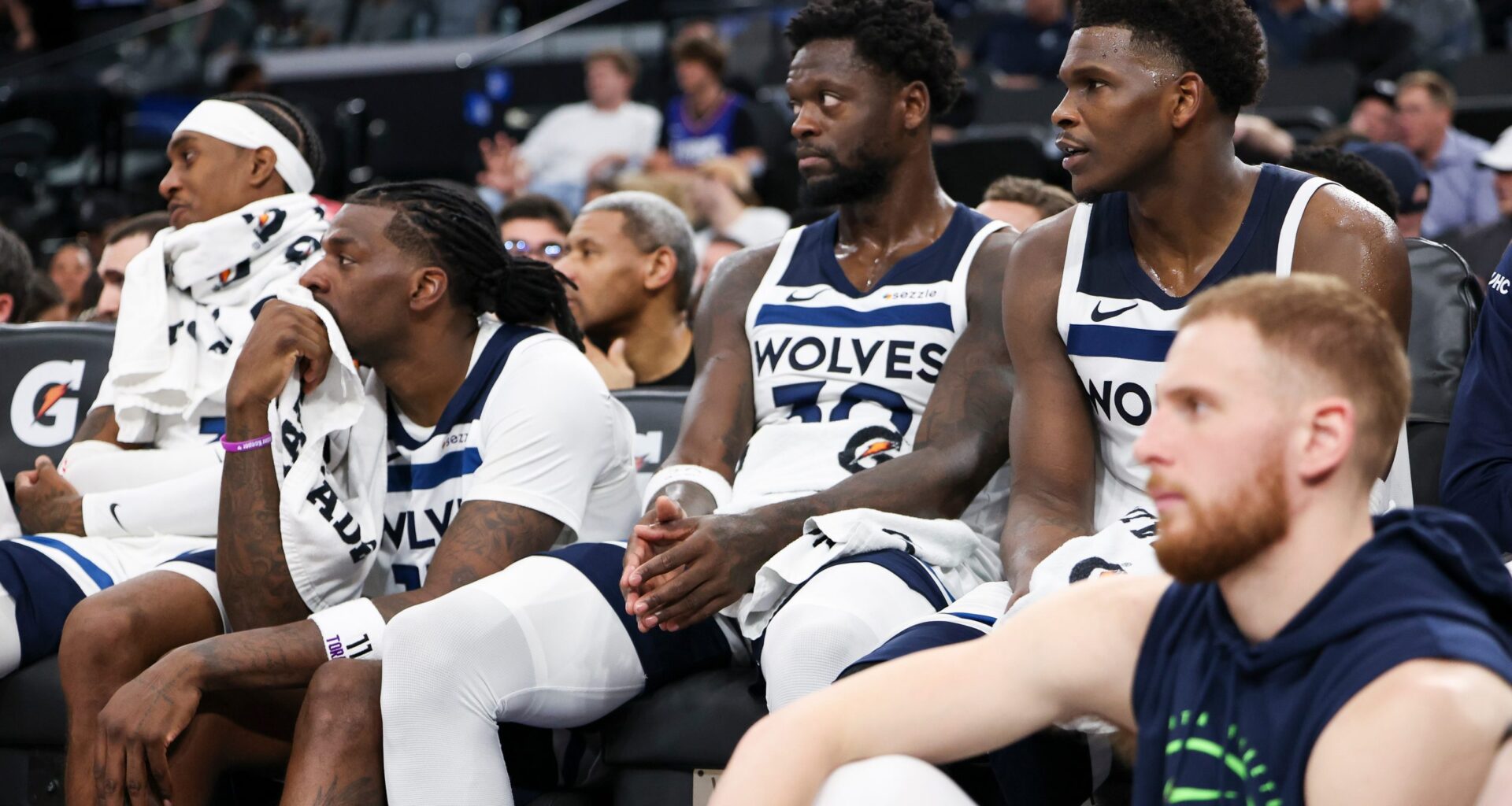
In a five-day stretch from March 7 to March 11, the Wolves executed their most ignominious series of pratfalls thus far this season — no mean feat, given the caliber of a half-dozen previous stumbles. They ended their winning streak with a 27-point loss to the Orlando Magic to close out the homestand on Sunday, then travelled to Los Angeles for a double-dip of embarrassment, falling to the Lakers by 14 points on Tuesday and then to the Clippers by 25 points on Wednesday.
It turns out the Wolves also have options, depth and versatility when it comes to losing. Their offense was dreadful in the defeats to Orlando and the Lakers, and their defense was execrable in the shellacking administered by the Clippers. Tote it up and you get a team that over the past three games, as of Thursday morning, ranked third-to-last (28th) in points scored per possession, second-to-last (29th) in points allowed per possession, and dead last (30th) in net rating — points scored minus points allowed.
It is the latest thud in a seesaw season. The Wolves will be riding high on the weight of their crisp execution, prolonged adherence to the game plan, prioritization of teamwork, physical rigor and mental stamina. Then, at the point when you begin to believe these crucial ingredients are being baked into the prevailing culture, the team siphons away enough of that due diligence to hollow out the formidable skill sets assembled on the roster. Fairly suddenly, there is not enough weight to keep riding high.
Related: The plus/minus experience of the Anthony Edwards superstardom
There is a credible devil’s advocacy against this doom-and-gloom portrayal. Ardent followers of at least a half-dozen other competitive teams in the NBA can sing the same lament about the capricious fortunes of their club’s formula for success and the seemingly insufficient tenacity that sabotages their higher hopes. In a modern NBA where roster construction is hemmed in by more punitive salary caps, and tilts in momentum (both within games and from game to game) are magnified by a greater reliance on aggressive pressure on defense and long-range shooting on offense, the majority of playoff contenders have flaws and flows that create slumps and spurts with vexing regularity.
In other words, the Wolves are in the same boat as a full handful of other Western Conference teams — the Nuggets, Rockets, Lakers, Suns and Clippers — in that their peaks are intoxicating but elusive, while their valleys thus feel more malignant than simply competitively circumstantial.
On top of that dynamic, the Wolves have a higher bar of unfulfilled expectations. They have made it to the Western Conference Finals the past two seasons — a high-water mark in franchise history — but never the next steps into either falling in the NBA Finals or hoisting the championship trophy. Followers of the team have savored the now-precedented goodness of the Anthony Edwards-Chris Finch era, but by now that has only whetted their thirst for the greatness of the final two steps.
But there are also legitimate pushbacks against this argument that the Wolves are in the same position as many other contenders. First off, they have benefited from extraordinary luck in terms of health. Their preferred starting five have logged 196 more minutes together than any other quintet in the NBA and their seven different starting lineups this season is easily the fewest in the league.
Second, the Wolves have played one of the easiest schedules in the league thus far. According to ESPN and NBA.com (the latter as of March 9), Minnesota has had the easiest overall slate of opponents, while basketball-reference.com puts them at 28th in the 30-team league.
Third, the Wolves themselves were, and are, acutely aware of the consistency of effort required to take the difficult final steps denied them the past two seasons. They specifically mentioned how the positive habits and steady momentum developed by the Oklahoma City Thunder last season created a big disadvantage for them in last year’s conference finals and pledged to narrow or eliminate that gap. During the preseason back in October, they cited the continuity of personnel on their roster and avowed a season-long commitment to teamwork as the way to generate the rugged resilience required to meet their lofty goals.
Related: Wolves flex versatility, show readiness for the stretch run in win over Denver
The Wolves have teased the legitimacy of their championship contention throughout the season. Their ceiling of performance is impressive — especially their winning of two out of three games apiece against the dominant two teams in the Western Conference, OKC and the San Antonio Spurs. And as recently as last week, I leveraged their inspired win over the Denver Nuggets as a means to point out how the Wolves have improved this season, encouraging readers not to “dawdle in despair” and to instead “enjoy the rides of March.” I suggested that the headline reflect the Wolves “readiness for the stretch run” this month and into early April.
One of the reasons for that optimism has been the team’s consistent pattern of improvement after the All-Star break during Finch’s five-year tenure. It has been a hallmark of his primary virtue, his big-picture ability to coach-up the team so they are at their best when it matters most.
But after winning six of their first seven coming out of the break, the Wolves’ decisive three-game losing streak has punctured some of that mystique. A record of 6-4 itself isn’t a bad composite record thus far, and if you include a pair of wins before the break, Minnesota is 8-4 over their last dozen contests.
But this latest pratfall continues a season-long pattern of stops and starts that occurred despite the health of the roster and the wealth bestowed by the schedule-makers in the first few months. If you telescope the team’s performance back since February 1, the Wolves are 9-7, falling further behind the Thunder (13-4) and the Spurs (16-1) as well as the Lakers and the onrushing Clippers (both 11-7).
Because a majority of their seven losses during that stretch have been blowouts, the analytical numbers are ugly. The team ranks 14th in offensive rating (points scored per possession) and 21st in defensive rating (points allowed per possession) since February 1. They are 17th in defensive rebounding percentage and 21st in offensive rebounding percentage. They are 18th in three-point shooting percentage, 21st in assists per game, 24th in turnovers per game and thus 24th in assist-to-turnover ratio.
Put bluntly, the Wolves are running out of time to establish even a small semblance of the kind of traction and positive momentum they envisioned for themselves back in October. They have fallen to 6th place in the West, just a game-and-a-half ahead of the Suns for the final guaranteed playoff spot (avoiding the play-in), with the Suns owning the tie-breaker should it come to that.
Can they rally? Absolutely. The talent is still there, the ongoing incorporation of Ayo and SloMo will continue and a more competitive schedule may rouse their interest and intensity to a level not always present against lesser opponents. But every time the seesaw thuds back down, the odds rise against a genuine resurrection and the more sustaining the team’s vices become instead of their virtues.
Orlando and the two Los Angeles teams preyed on those vices with increasing ferocity during the debacle of contests last week. Defenses have learned to pressure the Wolves playmakers, Ant and Randle, with double-teams and gap-filling helpers, stifling isolation plays and stagnating easy ball movement. Gobert is too often a screen-setting ornament on offense and an overburdened bulwark on defense.
It is becoming obvious that Finch needs to exercise more than soft power to compel his leaders to lead. Ant and Randle need to make quicker decisions on offense and demonstrate more concerted effort on defense. The numbers indicate that heavier reliance on both playmakers is detrimental to offensive efficiency. The numbers and the eye test tell us that their care factor on defense has been deficient for too long and requires greater accountability.
Leaning into positive, tried-and-true habits like pushing the pace after turnovers and defensive rebounds, and emphasizing quick decision-making to stimulate ball movement and movement without the ball, will foster better breadth and teamwork in the offense and establish more of the “fly-around” mentality that has been a boon to a more opportunistic defense. My eye test bias is that three-point shooting is better executed out of player- and ball-movement rather than kick-outs out of stagnant isolation possessions.
More than Ant and Randle need to get better. Naz Reid followed a sterling January with 27.1% shooting from three-point range since February 1, along with an 11-for-21 performance at the free throw line, requiring improvement in both frequency and accuracy, especially since his two-point bag of tricks remains deep and relatively successful. Jaden McDaniels needs to keep his frustration in check and channel that aggression back into more active playmaking—he remains one of the better interior passers on the roster.
Sixteen games remain, beginning Friday night on the road against and injury-ravaged Golden State Warriors team, followed by a nationally televised matchup with the Thunder Sunday afternoon, a regular season reprise of last year’s conference finals. Four other games involve a pair apiece against two of the most rugged squads in the NBA, the Detroit Pistons and the Houston Rockets.
I have little doubt that the Wolves will truncate their current freefall very soon. They generally have had the skills and the confidence to respond well to challenges. No, as we enter this final month of the 2025-26 season, the issue has been how rarely they have really challenged themselves.
Related