
Oil price shock likely to ‘push the UK economy into recession’
The oil price shock hitting the global economy could push the UK into recession, Tomasz Wieladek, chief European macro economist at investment managent firm T. Rowe Price, is warning this morning.
Wieladek says the UK’s economy’s failure to grow in January show that it was weak even before the oil shock, which is likely to hit consumer spending and create more cost of living pressures.
Following today’s weaker-than-expected GDP report, Wieladek writes:
double quotation markUK GDP growth stagnated in January, far weaker than market expectations of a 0.2% month-on-month pickup. The weakness was driven by services, the main part of the UK economy, and can be partially explained by tight monetary policy and the fiscal policy consolidation the UK is currently experiencing. Both of these policies are reducing demand, and the data is beginning to show it. Furthermore, AI is likely reducing hiring in the services sector, which in turn is leading to higher unemployment and softer demand. Overall, the UK economy has been weak ahead of the most recent oil shock.
The war in the Middle East and the consequent oil price rise will raise inflation and reduce consumer spending. The associated tightening in financial conditions we have seen in the bond market will exacerbate these effects. There will be significant demand destruction going forward.
The UK has been one of the weakest advanced economies in terms of recent growth performance. Therefore, the current oil price shock will most likely not just lead to inflation, but also push the UK economy into recession, raising unemployment and reducing GDP. Stagflation is just around the corner.
This puts the Bank of England (BoE) into a difficult position, he adds:
double quotation markOn the one hand, the BoE’s inflation-target credibility has weakened, as UK inflation has been higher and more persistent than elsewhere. On the other hand, a recession is likely. What should the BoE do? The key to easing financial conditions and supporting the recovery from the recession is to ease the current financial tightening. The best way to achieve this is to keep policy tight and publicly commit to reaching the 2% target at all costs.
A hawkish approach to monetary policy can kill two birds with one stone in this situation. Inflation credibility can be restored, and financial conditions will ease, as inflation risk premia get priced out. The BoE should keep rates on hold and prepare the public for the prospect of further hikes.
Key events
Show key events only
Please turn on JavaScript to use this feature
US economic growth revised down
Newsflash: The US economy only grew half as fast as initially estimated in the last quarter of 2025.
US GDP rose at an annual rate of 0.7% in October-December 2025, new data from the US Bureau of Economic Analysis shows. That’s the equivalent of less than 0.2% growth in the quarter.
The BEA had initially estimated annualised growth of 1.4% in Q4 2025, which was already a slodown after 4.4% growth in Q3.
Today, the Bureau says it has revised down its estimate of US exports, consumer spending, government spending, and investment in the quarter.
Although this data is somewhat historic, it shows the American economy had less momentum than we thought as it enters the energy shock caused by the Iran war.
Updated at 08.55 EDT
Hopes of UK mortgage rates steadily easing have “collapsed”, with at least 530 homeowner mortgage deals having vanished from the market since Monday, according to a financial information website.
Moneyfacts said the number of mortgages disappearing from the market since then represents about 7.5% of deals, PA Media reports.
Some average mortgage rates have already broken through the 5% mark amid changing financial markets, and Moneyfacts said earlier this week that mortgage deals have been withdrawn at the fastest pace since the 2022 mini-budget.
Adam French, Head of Consumer Finance at Moneyfacts, explains:
double quotation mark“At least 530 residential mortgage products have been withdrawn since Monday 9 March, representing around 7.5% of the market, although the pace of withdrawals has slowed as the week has progressed.
“Borrowers are now seeing the effect as these changes feed through to pricing, with the average two-year residential mortgage rate rising to 5.10%, up from 4.87% on Monday and now at its highest level since July 2025, while the average five-year rate has climbed to 5.19%, up from 4.98% and at its highest since April 2025.
“Even the very cheapest deals are shooting higher, with the lowest available mortgage rate climbing from 3.51% at the start of March to sit at 3.78% today, its highest level since April 2025.
“It’s unwelcome news for borrowers, as hopes of steadily falling mortgage rates have collapsed and given way to a much more uncertain outlook. The destination is now heavily dependent on how global markets and inflation expectations evolve in response to the conflict the Middle East.”
Updated at 08.17 EDT
Oil prices are now dipping slightly, following reports that an Indian tanker has sailed out of the Strait of Hormuz.
Brent crude is now down 1% today at $99.50 a barrel, having earlier today traded as high as $102.75 a barrel.
An Indian government official said that an India-flagged oil tanker – the Jag Prakesh – had moved out from the east of the Strait of Hormuz carrying gasoline bound for Africa.
Neil Wilson, Saxo UK investor strategist, says:
double quotation markCrude oil prices dipped by around -2% after India stated it has an oil tanker moving out of the Strait of Hormuz. Brent slipped below $99/barrel.
Too early to comment or speculate on what this means but markets are still very much trading the headlines and keen to latch on to any shred of good news. Expect this to be faded.
My LSEG screen shows the Jag Prakesh was moving south at 8.6 knots last night, the last time its position was recorded.
Photograph: LSEGShareOxford Economics: $140 oil could trigger mild UK recession
Oil would probably have to rise higher, and stay there, to push the UK into a recession.
Consultancy Oxford Economics have calculated that if oil rises to $140 a barrel, then UK inflation could top 5% in Q4 2026. This could cause the Bank of England to hike interest rates again, and the UK would likely suffer a mild recession.
“Given the significant uncertainty around how the conflict will evolve, we’ve published two alternative scenarios,” says their chief UK economist Andrew Goodwin, adding:
double quotation mark“The first assumes oil and European gas prices rise more than we anticipate in Q2, with oil averaging $100 per barrel. The second sees oil hitting $140 a barrel along with a bigger spike in gas prices.”
“In both scenarios, the main transmission channel to the economy is through higher inflation.
Daily data from RAC suggests petrol prices have already risen sharply over the past two weeks. Domestic energy bills would also rise substantially in July, when the next change in the energy price cap comes into force.”
European factories also entered the energy crisis in poor shape, new data shows.
Eurozone industrial production decreased by 1.5% in January from the previous month, the European Union statistics agency Eurostat reported this morning.
All major sectors of manufacturing contracted; eurostat reports that production:
decreased for intermediate goods by 1.9%,
increased for energy by 4.7%,
decreased for capital goods by 2.3%,
decreased for durable consumer goods by 1.9%,
decreased for non-durable consumer goods by 6.0%.
Swiss bank UBS believe the current energy crisis should be less damaging for Europe than the Russia-Ukraine experience in 2022.
Mark Haefele, chief investment officer at UBS Global Wealth Management, explains:
double quotation mark“While the situation is obviously concerning, we view the current risks from Iran as manageable for Europe’s economic growth outlook and equity markets, and we recommend staying invested through this period.
Still, we think one major sector change is warranted: we have reduced our rating on European banks to Neutral (from Attractive), while also closing our “Global banks” theme given less compelling valuations and rising macroeconomic uncertainty.”
ShareUK longer term inflation expectations were sticky before Iran war
The UK public already believed inflation would be over target in five year’s time, even before the oil shock hit the economy.
The latest opinion polling on the public’s inflation attitudes, from the Bank of England and Ipsos, found that people expect inflation to be 3.7% in the longer term, matching the reading last November.
People had been more confident that inflation would fall in a year’s time. Median expectations of the rate of inflation over the coming year were 3.2%, down from 3.5% in November.
However, that was before the oil shock hit – this polling ended on 24 February, just before the Iranian war began.
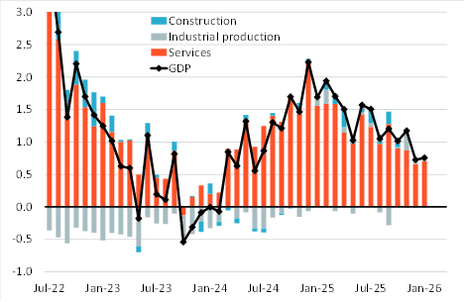
There is no question that UK economic growth is soft, reports Andrew Wishart, senior uk economist at Berenberg:
double quotation markThe 0.2% 3m/3m gain in output this January was softer than the comparable rate in most years since the pandemic.
The quarterly gain was entirely driven by a tick up in output in November, which the economy has merely maintained since.
The data suggest that the early-year growth spurts of 2024 and 2025 will not be repeated. As a result annual GDP growth, which is immune from seasonality issues, remains weak.
 A chart showing UK GDP Photograph: ONSShareHousebuilder Berkeley flags risk from Middle East crisis
British homebuilder Berkeley Group has warned that the Iran war could hurt the UK economy.
Berkeley reaffirmed its pre-tax profit guidance for the year this morning in a trading update, before flagging that it hasn’t yet seen the impact of the crisis on the housing market.
It told shareholders:
double quotation markThe trading environment over this period has remained constrained by the impact on consumer confidence of geo-political events and macro-economic uncertainty. However, sales enquiries remain good and the value of underlying reservations has been recovering towards the levels seen over the summer prior to the pre-Budget hiatus.
The emerging situation in the Middle East is weighing heavily on risk sentiment and we await to see the impact of this on the market. While reaffirming guidance, we are aware of the risk of a further deterioration in macro conditions with the potential for higher inflation in the near term and for interest rates to remain higher for longer.
Berkeley’s shares are down 3% this morning, putting it among the top fallers on the FTSE 100 index.
ShareUK assets falling
The pound, and the UK stock market, are both falling this morning.
Sterling is down three-quarters of a cent against the US dollar at $1.3263, approaching the three-month low set last week.
The FTSE 100 index of blue-chip shares is down too – losing 58 points or 0.56% at 10,247 points.
The more domestically focused FTSE 250 index is down 0.7%.
Matt Britzman, senior equity analyst at Hargreaves Lansdown, says:
double quotation mark“UK markets opened lower this morning, weighed down by a softer‑than‑expected GDP print and ongoing tensions in the Middle East. The economy failed to grow at all in January, suggesting activity was already subdued even before the recent jump in energy prices began to bite.
That’s starting to force a rethink of this year’s outlook, with previous 1.0% growth expectations now looking optimistic – with some scenarios pointing to closer to 0.6%, 0.4% or even 0.1%, depending on how long elevated energy costs stick around.
ShareIoD: Stalling UK economy vulnerable to fallout from conflict in the Middle East
The outbreak of conflict in the Middle East hits an “already troublingly fragile UK economy” and sharpens the need for action to lift growth prospects, says Anna Leach, chief economist at the Institute of Directors.
double quotation markEnergy prices have already risen sharply, and unprecedented damage to supply capacity in the Middle East will have uncertain effects on energy prices longer term.
This risks driving up costs for businesses and consumers at a point when inflation was only just heading back to target, and could cause a further slump in confidence and impetus to spend. It is right that the government stands ready to intervene and support the economy once again.
But short-term agility must not distract from the UK’s longer term growth needs. From an energy strategy which takes a realistic approach to the transition to net zero, to workers’ rights that avoid overburdening employers, a laser focus on growth is urgently needed.”
ShareOil price shock likely to ‘push the UK economy into recession’
The oil price shock hitting the global economy could push the UK into recession, Tomasz Wieladek, chief European macro economist at investment managent firm T. Rowe Price, is warning this morning.
Wieladek says the UK’s economy’s failure to grow in January show that it was weak even before the oil shock, which is likely to hit consumer spending and create more cost of living pressures.
Following today’s weaker-than-expected GDP report, Wieladek writes:
double quotation markUK GDP growth stagnated in January, far weaker than market expectations of a 0.2% month-on-month pickup. The weakness was driven by services, the main part of the UK economy, and can be partially explained by tight monetary policy and the fiscal policy consolidation the UK is currently experiencing. Both of these policies are reducing demand, and the data is beginning to show it. Furthermore, AI is likely reducing hiring in the services sector, which in turn is leading to higher unemployment and softer demand. Overall, the UK economy has been weak ahead of the most recent oil shock.
The war in the Middle East and the consequent oil price rise will raise inflation and reduce consumer spending. The associated tightening in financial conditions we have seen in the bond market will exacerbate these effects. There will be significant demand destruction going forward.
The UK has been one of the weakest advanced economies in terms of recent growth performance. Therefore, the current oil price shock will most likely not just lead to inflation, but also push the UK economy into recession, raising unemployment and reducing GDP. Stagflation is just around the corner.
This puts the Bank of England (BoE) into a difficult position, he adds:
double quotation markOn the one hand, the BoE’s inflation-target credibility has weakened, as UK inflation has been higher and more persistent than elsewhere. On the other hand, a recession is likely. What should the BoE do? The key to easing financial conditions and supporting the recovery from the recession is to ease the current financial tightening. The best way to achieve this is to keep policy tight and publicly commit to reaching the 2% target at all costs.
A hawkish approach to monetary policy can kill two birds with one stone in this situation. Inflation credibility can be restored, and financial conditions will ease, as inflation risk premia get priced out. The BoE should keep rates on hold and prepare the public for the prospect of further hikes.
ShareMarkets expecting UK interest rates to rise next
Despite the lack of growth in January, and fears over the outlook for the year, hopes that the Bank of England might cut interest rates to support the economy have faded.
Since the Iran war began, the odds of a rate cut next week have collapsed from 80% to single figures. This morning, the money markets say there’s a 96.5% chance that the BoE holds rates at 3.75% next Thursday.
Looking ahead, there’s more chance of a rate rise than a cut by Christmas. The markets are predicting a 20 basis point (0.2 percentage point) rise in rates by December, which suggests there’s more than 80% chance of a quarter-point rise in rates by then.
A rate cut is fully priced in by June 2027.
Bank policymakers will need to judge the wisdom of sitting on their hands and allowing the energy shock the wash through the economy (higher rates won’t get more oil through the strait of Hormuz!), versus the risk of letting inflation expectations to jump.
The Iran war is a “growing downside risk” to the UK economy, warns Andrew Hunter, associate director and senior economist at Moody’s Analytics:
double quotation mark“The latest monthly GDP data suggest that the U.K. economy was continuing to struggle at the start of the year, with GDP experiencing no growth in January after only marginal gains in previous months.
The improvement in the PMI surveys suggests growth should pick up over the coming months and we expect growth over the first quarter as a whole to be slightly stronger, but there is a growing downside risk that the conflict in the Middle East will drive a sharper rise in inflation and deal a renewed blow to consumer and business confidence.”