
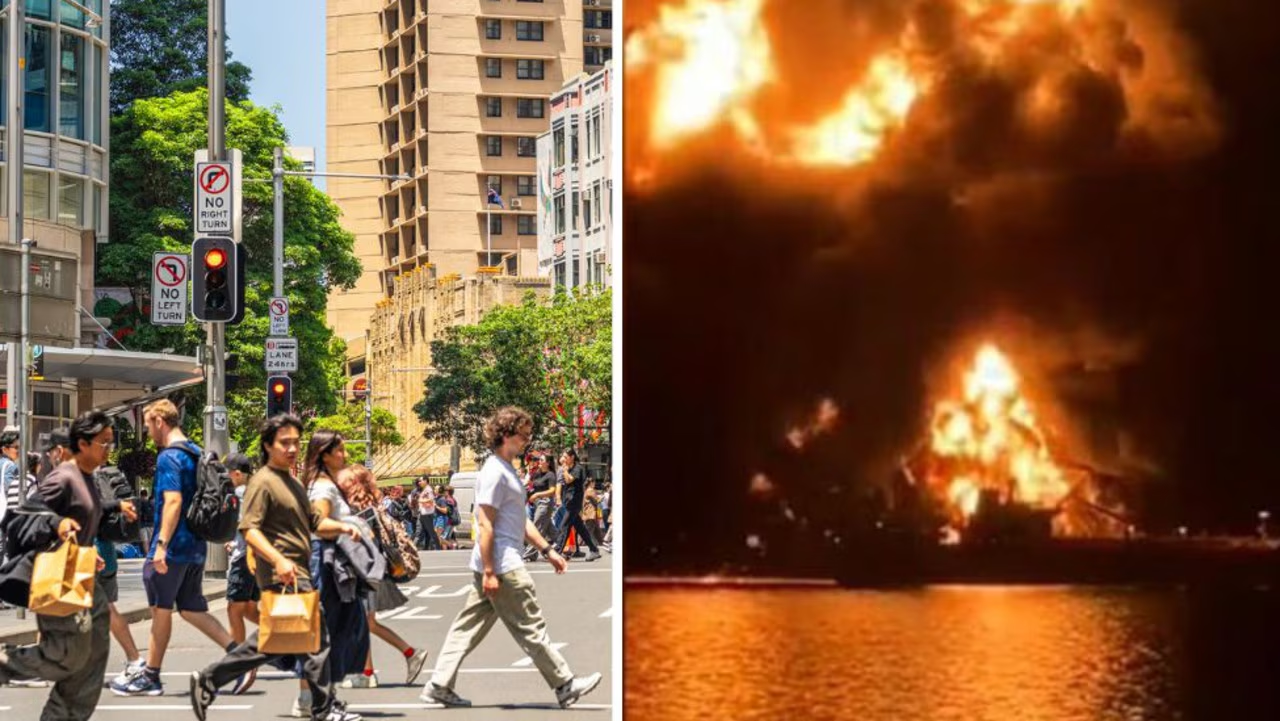
The Iran war is getting out of hand fast.
Overnight, Iranian drones hit oil infrastructure in Oman.
Early this morning, Iranian attack boats hit two Iraqi oil tankers, which are ablaze as I write.
This follows weekend attacks by Iran on Israeli oil facilities.
Iran has changed its tactics and is now targeting critical oil infrastructure across the region.

Asymmetric warfare
Anyone who has been paying attention to the Ukraine war for any period of time knows that modern wars are now fought with asymmetric weaponry.
Cheap drones, improvised explosive devices (IEDs) and exploding vehicles are all part of the new arsenal.
All of these can be assembled in a garage; many can be fired by one man from a car, and they are almost impossible to stop with large, impressive conventional assets like aircraft carriers and/or tanks.
MORE:Warning: Major bill for petrol ‘panic’ buyers
Iran is the master of these weapons, having supplied many to counter Ukraine’s success against Russia.
Iran can hide and use these weapons to harass and blow up oil tankers in the Strait of Hormuz incessantly.
Which raises the prospect that it is not actually Israel or the US that is in control of this war; it is Iran, and it will decide when it ends.
Dark scenario
It does serve Iranian interests to keep this war going for a while longer. It draws its restive population back to the government, and it humiliates Donald Trump and Israel.
But it is a delicate balance. All such guerrilla wars are fought over hearts and minds, not arms. They provoke that occupying power into overreach, which angers the local population and creates sympathy for the defenders.
In this case, Donald Trump may not respond well to public humiliation. He could be goaded into doing something really stupid, such as seizing Iran’s main oil terminal, Karge Island.
Iran would respond by raining hell on every oil asset in the Gulf it could reach, and the current choking of Gulf supply could turn chronic.
Australia the stupid
Overnight, there was also good news: the International Energy Agency (IEA) had co-ordinated a 400 million barrels per day strategic oil release. It sounds impressive, but in reality, it is not.
The additional oil flow per day will be around 1.4 million barrels per day, leaving 15 million barrels per day offline in the Gulf.
Australia has 33 days of stored fuel, but please consider the following.
When Iran does reopen the Strait of Hormuz after some deal, which is nowhere distant yet, it will take weeks to resume production at shut-in oilfields, two more weeks (at least) to ship any oil to Asia’s refining hubs, and another week to ship it to Australia.
This estimate assumes the Strait simply reopens. If Iran mines it instead, it will take six weeks to clear the shipping lanes, presuming no attacks occur during this period.
No shipping will traverse the Strait while drones and fast boats are targeting it.
Assuming there is no panic hoarding, Australian fuel inventories would be fine for two to three weeks from the start of the closure. We are nearly at the end of week two.
We will start to see material shortages in three to four weeks after the war starts, as shipments from Asian refineries begin to taper off. Then the strategic reserve will run down quickly.
If we assume an equal share of the Middle East oil reduction, we can expect a 15 per cent reduction in Australian fuel supplies after about six weeks.
Economic shock
Australia has an oil intensity of about one-quarter of every $1000 of gross domestic product (GDP).
This is likely a severe underestimate, given the large spillovers from energy.
If, six weeks after the start of the closure, Australia has a 15 per cent reduction in fuel supplies (petrol, diesel and jet fuel), the immediate impact will be 3.7 per cent of GDP.
Considering spillovers, the impact could be twice as much, as folks can’t get around, and 15 per cent of machinery just stops.
In short, unless something changes very fast in the Strait of Hormuz, Australia is about a month away from the Great Australian Oil Depression of 2026.
It doesn’t bear thinking about what it means if we are forced to reduce our fuel consumption by the full 30-40 per cent of our fuel supply that traverses the Strait. Let’s just assume we can buy it elsewhere and keep the damage to 15 per cent.
We should immediately ration fuel supplies to take a little pain upfront and extend the timeline to Armageddon.
City drivers should be rationed now. The army should control diesel in the bush. Offset it with free public transport.
It would prevent hoarding, allow people time to adapt, and extend the timeline of national fuel depletion.
David Llewellyn-Smith is Chief Strategist at the MB Fund and MB Super. David is the founding publisher and editor of MacroBusiness and was the founding publisher and global economy editor of The Diplomat, the Asia Pacific’s leading geopolitics and economics portal. He is the co-author of The Great Crash of 2008 with Ross Garnaut and was the editor of the second Garnaut Climate Change Review.