
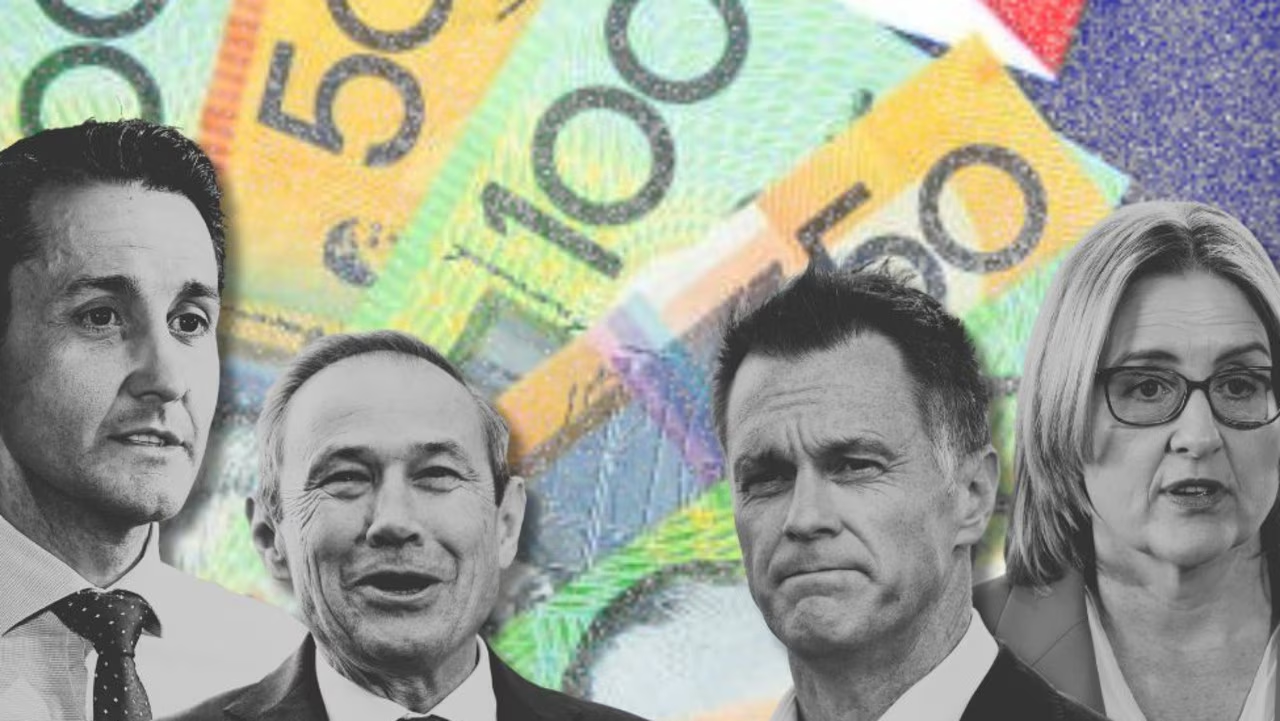
Lower coal and iron ore prices have delivered Queensland and Western Australia a big win in the annual carve-up of Goods and Services Tax revenue, while the much-criticised no-worse-off payments deal will cost the federal government $5.49bn, about $400m less than in the mid-year budget update.
Lower commodity prices are seen by the agency that distributes GST revenue – the Commonwealth Grants Commission – as a hindrance to these states’ governments being able to raise revenue and provide the required standard of services for their populations, therefore attracting a higher relative share of the GST revenue.
Queensland is estimated to receive $18.4bn in GST payments in the 2027 financial year, up from $16.5bn in the 2026 financial year, while Western Australia is estimated to receive $9.3bn, up from $7.8bn.
‘Still short-changed’: Qld
Queensland Treasurer David Janetzki said the allocation was still “short-changing” his state.
“Queensland has received a headline GST lift in 2026-27, but a recovery from the record-low share of GST in 2025-26 should not be confused as a GST gain,” Mr Janetzki said.
“Despite the national pool increasing by almost 20 per cent over the past three years, Queensland will be the only state or territory allocated less GST in 2026–27 than 2023-24.
“Queensland should be getting its fair share of the GST pie, not playing second fiddle to a second-rate distribution model designed to dud us.”
NSW is estimated to receive $26.1bn in GST payments, slightly up in dollar terms on $25.4bn but lower in overall share. Victoria gets $27.9bn in GST payments, slightly up in dollar terms at $26.1bn, but lower in terms of overall share.
These states go backwards because of the increased share to Queensland and Western Australia.
“The value of mining production, particularly for iron ore and coal, has declined,” the commission said. “This has reduced the amount of revenue the main mining states (Queensland and Western Australia) can raise in royalties. This means these states need more GST than before, and consequently the other states receive less.”
The commission also noted that while a spike in spending on Covid-19 health and business support in 2021–22 dropped out of the three-year assessment period used to estimate the GST distribution, some states such as NSW, Victoria, ACT spent more than other states on those items. That meant they would receive less GST.
The most controversial aspect of the GST carve up is the so -called no-worse-off payments to states.
Such payments came in at $5.49bn, slightly lower than the mid-year budget estimate of $5.8bn.
Under legislation introduced in 2018 by the Morrison government, states receive a minimum 75 per cent of their per-capita share of the overall national GST revenue pool. This advantages WA due to its lower state-based GST collection.
This year WA will receive a $5.49bn top-up payment plus a pool payment of $1.1bn. Under new rules no state’s relativity can fall below the weaker of NSW or the 75 per cent minimum.
Corinna Economic Advisory’s economist Saul Eslake said on Friday that the deal he considers the worst public policy in history just got worse.
“Today we see the protection money for WA is $5.49bn,” Mr Eslake said.
“The blowout in cost of the Western Australia GST deal of $9bn over eight years to close to $60bn in 11 years is the biggest blowout in any single policy decision outside the NDIS,” Mr Eslake said.
The Productivity Commission is currently reviewing the GST distribution system and is due to hand down an interim report in June and another final report in December.
‘Lowest since introduction’: NSW
In NSW, the Minns government said it would receive its lowest GST relativity share since the GST was introduced, leaving Australia’s largest state with $1.4bn less GST revenue in 2026-27 than Victoria, despite having 1.5 million more people.
Acting Treasurer Courtney Houssos called for a better formulation of GST distribution.
“This decision again demonstrates the need for a fairer allocation of how the GST is distributed across the states and territories,” Ms Houssos said.
“Successive NSW governments have identified the need for reform. We will continue to engage with the commonwealth and work towards a more transparent system which can deliver NSW our fair share.”
‘Unfair’: Tasmania
The Tasmanian Liberal government said the current GST arrangements were unfair and a return to the full horizontal equalisation measures of the past were critical.
“The current GST distribution arrangements continue to disadvantage smaller states like Tasmania,’’ said its Treasurer, Eric Abetz. “A return to full horizontal fiscal equalisation is essential to ensure every Australian, no matter where they live, has access to comparable services.
“All Australians deserve a fair go and a fair playing field, which is why Tasmania will continue to advocate strongly for equality to be restored.”
WA Treasurer Rita Saffioti said other states couldn’t complain.
“Western Australia has done the work to become the economic powerhouse of the nation, creating the wealth that benefits all Australians.
“The claims other states are worse off under the current deal are simply incorrect,” she said.
“The estimates released by the Commonwealth Grants Commission today are in line with the 2018 GST deal.
“We’re fighting to retain the 2018 reforms and WA’s fair share of the GST, so we can continue to invest in and grow the industries that support our nation’s prosperity and create valuable jobs.”