
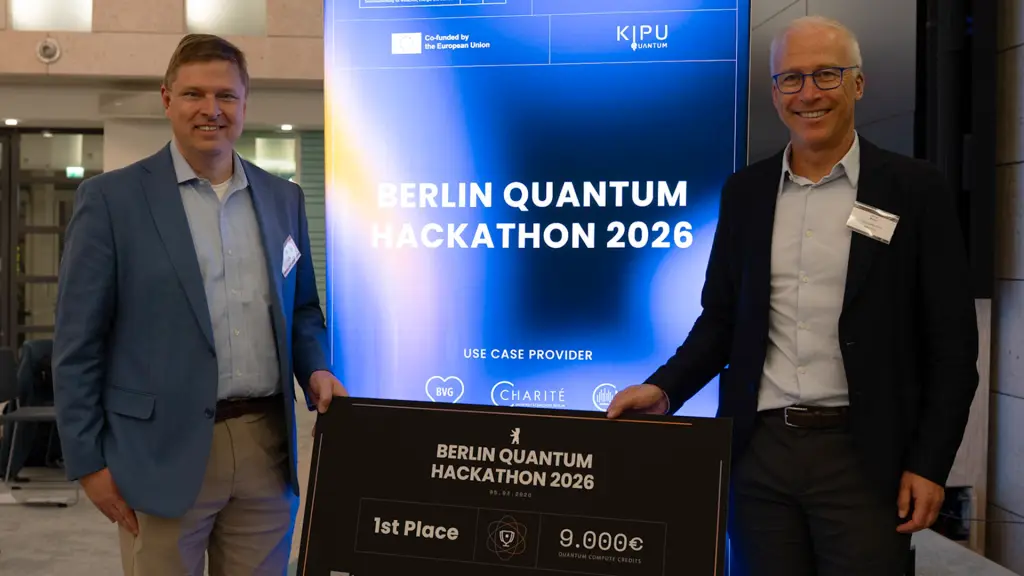
 Dr. Rickey Carter (left) and Dr. Charles Bruce (right) hold a first-place sign after Mayo Clinic’s team won the Berlin Quantum Hackathon on March 5, 2026. Photo by Hugo Paquin, Kipu Quantum.
On a global stage in Berlin, surrounded by leading scientists and engineers in quantum computing, a Mayo Clinic team earned first place at the Berlin Quantum Hackathon 2026.
The five-week hackathon challenged six finalist teams to prove that quantum computing — one of science’s newest and most complex frontiers — can solve meaningful problems beyond theory. More than 180 teams applied to compete. The awards were presented on March 5.
The Mayo team built a novel quantum-powered model capable of detecting movement intention directly from brain activity.
Code, circuits and possibility
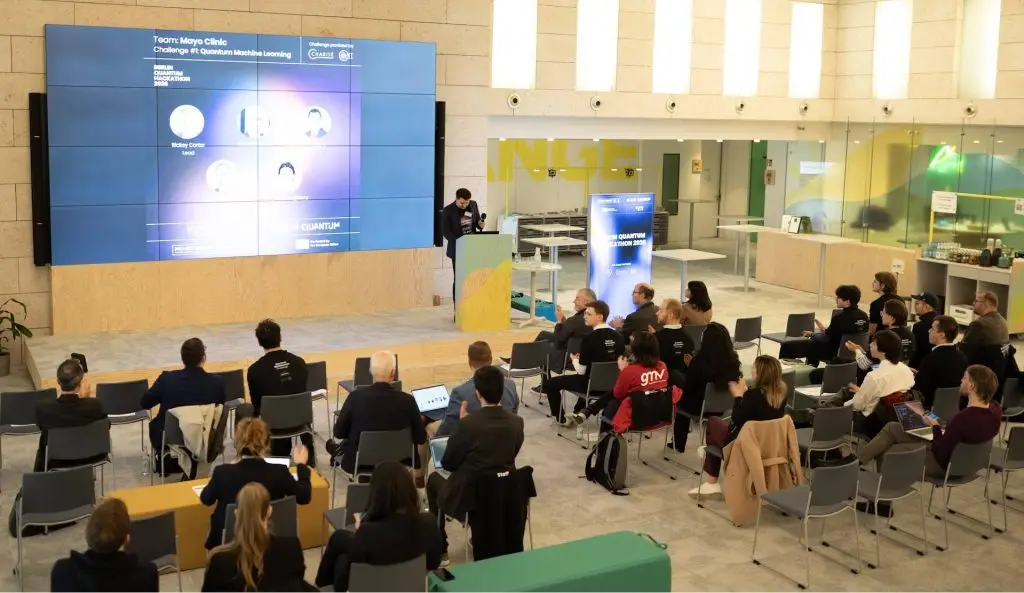 Attendees watch a team presentation during the Berlin Quantum Hackathon 2026. Photo by Hugo Paquin, Kipu Quantum.
Inside the competition hall, conversations unfolded in the language of quantum science — qubits, circuits and optimization algorithms. Teams presented performance metrics to an expert judging panel that challenged assumptions and tested claims on the spot. Technical execution, scalability and real-world impact all factored into the score.
Among them stood a Mayo Clinic team that had begun studying quantum computing only a year earlier.
They approached the challenge the way Mayo Clinic approaches medicine: with the patient at the center and the science pushed to its limits.
“When our model executed successfully on a quantum computer, it felt like stepping into the next chapter of science. In that moment, we realized we weren’t just observing this field — we were helping shape it.”
Miko Wieczorek
Decoding the intent to move
The team’s work began with a clinical question: What happens when the brain intends to move, but the body cannot?
In people living with paralysis or other motor impairments, the brain still sends the signal, carrying intention across neural networks even when the body cannot respond.
The team set out to detect that signal by distinguishing the intent to move a left hand from a right — a subtle difference buried within the brain’s constant electrical rhythm.
They drew on electroencephalogram, or EEG, recordings, which capture the brain’s electrical activity as continuous waves layered with motion and background noise.
To isolate that distinction, they built a hybrid system that combined advanced AI with emerging quantum tools. That required learning the language of quantum science.
“One of our secrets to success was focusing on the complete solution, not just the computational challenge,” says Dr. Rickey Carter, professor of biostatistics at Mayo Clinic and the team leader. “We built around patients’ needs and paid close attention to the edge cases where the model struggled. That’s where we concentrated our quantum efforts.”
If validated in future research, such signals could one day help guide assistive technologies or prosthetics, potentially enabling more precise control of movement.
At the leading edge of discovery
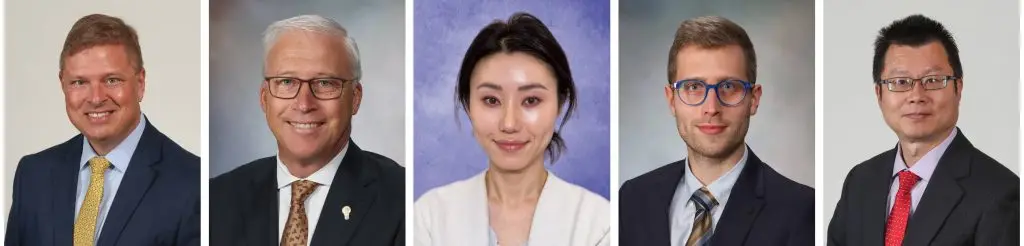 Left to right: Dr. Rickey Carter, Dr. Charles Bruce, Dr. Michele Dougherty, Miko Wieczorek and Dr.aFeifei Li
For Dr. Charles Bruce, chief innovation officer at Mayo Clinic in Florida, the hackathon reflected a broader commitment: building bridges across disciplines and borders in a field that advances through shared expertise.
“Standing alongside leaders in this field strengthened our work and reminded us that advancement happens together,” Dr. Bruce says. “We entered this challenge as underdogs. None of us had prior quantum computing experience. But progress is built collectively. You learn from one another, blending biology with data science, and the work becomes stronger because of it.”
The multidisciplinary team from Mayo Clinic in Florida — Dr. Carter, Miko Wieczorek, Dr. Michele Dougherty, Dr. Feifei Li and Dr. Bruce — built the model from the ground up. Mayo Clinic’s Quantum Sensing and Computing program supported the effort, exploring how emerging quantum technologies may intersect with patient care.
“Some scientific questions remain unsolved not because we lack data, but because of how difficult they are to model. Quantum computing gives us a different way to approach that complexity.”
Dr. Feifei li
Miko Wieczorek, a data scientist in the Mayo Clinic Digital Innovation Lab, led the team’s work running the model on a quantum computer — a first for Mayo.
“When our model executed successfully on a quantum computer, it felt like stepping into the next chapter of science,” Wieczorek says. “In that moment, we realized we weren’t just observing this field — we were helping shape it.”
Dr. Michele Dougherty, a medical physicist in Radiation Oncology, contributed expertise in complex optimization.
“Quantum computing could eventually help us design safer and more precise radiation treatments,” she says. “If it accelerates how we find the best possible plan for a patient, that’s meaningful.”
Dr. Feifei Li, a former theoretical physicist who is now a medical physicist in Radiation Oncology at Mayo Clinic, says the project highlights how quantum computing could expand the boundaries of medical research.
“Some scientific questions remain unsolved not because we lack data, but because of how difficult they are to model,” Dr. Li says. “Quantum computing gives us a different way to approach that complexity.”
Quantum computing moves toward application
The event was hosted by Berlin-based quantum software company Kipu Quantum and supported by the State of Berlin’s Quantum Initiative and the Charité-Berlin University Medicine.
“Quantum computing is proving this year that we can design hybrid quantum-classical solutions for tackling industrial problems,” says Enrique Solano, CEO of Kipu Quantum. “Medical imaging and life science will occupy a key role in the list of applications. By winning the hackathon, Mayo Clinic is making an important step toward this visionary goal.”
Shaping the frontier
For the Mayo Clinic team, the Berlin hackathon reaffirmed that real progress begins with curiosity, collaboration and the courage to explore uncharted territory. Together, they showed how multidisciplinary teams can carry some of healthcare’s most pressing challenges toward its next frontier.
Related Articles