
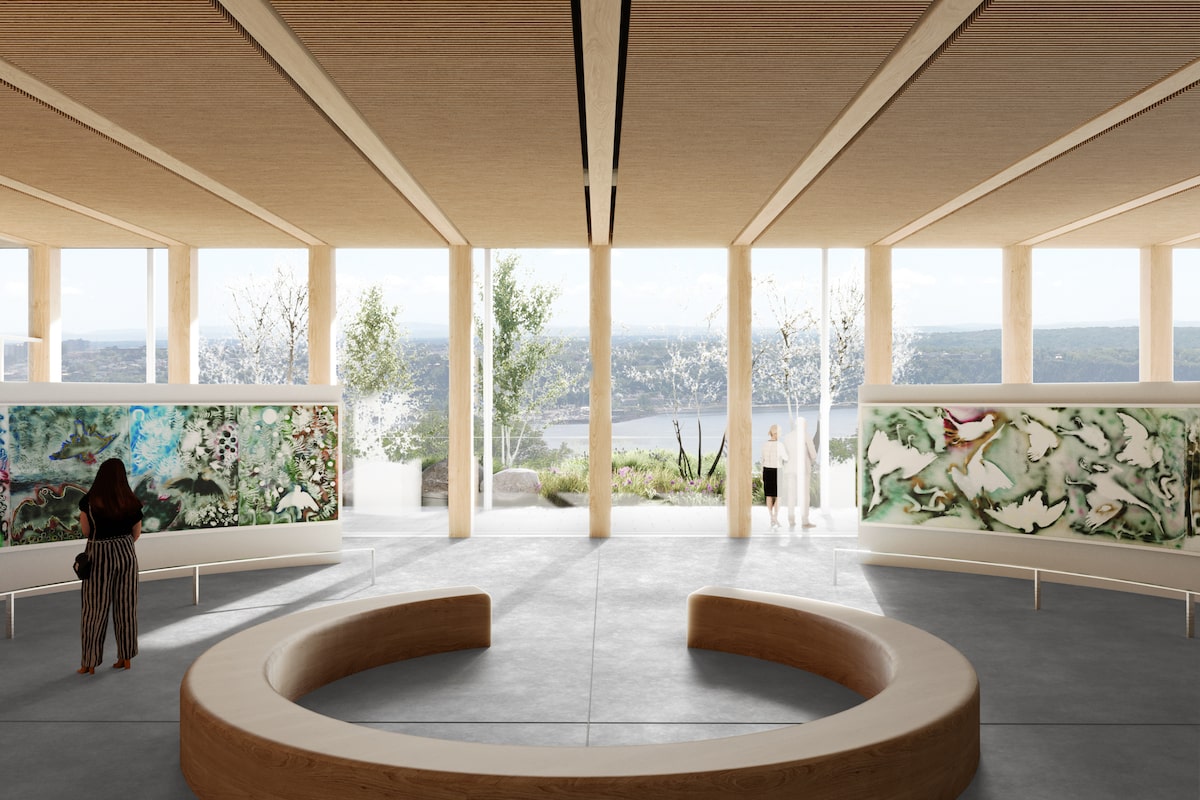
A rendering of the inside of the Espace Riopelle at the Musée national des beaux-arts du Québec in Quebec City. The pavilion is set to open in October.Musée national des beaux-arts/Supplied
Not so long ago, Jean Paul Riopelle was at risk of becoming an artist without honour in his own country.
The last years of one of Canada’s greatest painters were a sad denouement spent on an island northeast of Quebec City, “drinking himself silly” and making “progressively more deranged” pictures of snow geese and owls, in the words of critic and curator Sarah Milroy. His reputation suffered accordingly.
Shortly after Riopelle’s death in 2002, a fire sale of his works through a Montreal and Palm Beach auction house threatened to scatter a major part of his oeuvre and depress his market, prompting legal action from his daughters and disgust in the Canadian art world.
“I don’t think Canada ever really ‘got’ Riopelle,” said Miriam Shiell, a prominent Toronto dealer, at the time.
You wouldn’t say that any more. Since the lead-up to the 2023 centenary of his birth, a wave of appreciation has washed over the artist in Canada, with major shows in Montreal, Ottawa and Toronto, plus the creation of the Fondation Jean Paul Riopelle to spread awareness of his legacy. A cascade of record auction prices have piled up in the past decade.
The capstone of the Riopelle homecoming will arrive this fall with the opening of the Espace Riopelle – Pavillon Michael Audain at Quebec City’s Musée national des beaux-arts du Québec. It has been spearheaded and bankrolled by a figure who, in some ways, is a most unlikely patron – and who shows how truly pan-Canadian Riopelle’s reassessment has been.
A rendering of the exterior of the Espace Riopelle at the Musée national des beaux-arts du Québec.Musée national des beaux-arts/Supplied
Michael Audain is one of the most important cultural philanthropists in B.C. His collections and donations of Emily Carr and West Coast First Nations work have made him a household name in the province’s art world.
It turns out he is also an obsessive Riopelle fan, and has quietly amassed a huge private collection of the artist’s pieces, especially the coveted palette knife “mosaic” canvases from the 1950s.
In a move that has gone mostly unnoticed outside of Quebec, Audain donated his trove of Riopelles to the Musée national earlier this year. The 37 works, spanning the artist’s career, will be housed in the museum’s new pavilion, scheduled to open in October. The value of his gift totals $91.3-million, including $76.9-million in artworks. The rest will go toward the museum and a chair in art history.
Jardin, 1957 by Jean Paul RiopelleJean Paul Riopelle/Collection of Michael Audain and Yoshiko Karasawa/Supplied
Audain’s love affair with Riopelle began at an early age. While studying at a private boarding school in Port Hope, Ont., he visited an art exhibition in Peterborough with his headmaster. A Riopelle was hanging on the wall. “I said, ‘What is this?’” Audain recalled in a recent interview. “He said, ‘That’s called abstract art.’”
Abstraction is a term Riopelle abjured, but much of his best-known work is non-figurative, characterized by a thick accretion of paint that takes on a sculptural quality. His work was also deeply influenced by his quarter-century-long relationship with American painter Joan Mitchell, who is often associated with the abstract expressionists.
Whatever you want to call Riopelle’s style, Audain was drawn to it.
“Over time I would see his art abroad, in France, and I was attracted to the energy and also that it was essentially concerned with nature.”
He began collecting the artist around 1990 and never looked back. Eventually, his living room walls were floor-to-ceiling Riopelles.
Les oies sur la ville, 1983-1984 by Jean Paul Riopelle.Jean Paul Riopelle/Collection of Michael Audain and Yoshiko Karasawa/Supplied
The two men never met, although Audain says he felt a certain intimacy from living alongside Riopelle’s work for so long. Even now, he isn’t sure they would get along: one English, one French; one a straight-laced home-building magnate, the other a hard-partying bohemian; one good at making money, the other at spending it (Riopelle loved antique cars, among other luxuries).
“I couldn’t stay up all night drinking,” Audain said. “He probably wouldn’t want to have much to do with me as a business person.”
It was the art – along with a mutual love of Maurice Richard and the Montreal Canadiens – that connects them across time and space.
Michael Audain’s collections and donations of Emily Carr and West Coast First Nations work have made him a household name in Quebec’s art world.Audain Foundation/Supplied
Audain gradually began realizing just how significant Riopelle and his cohort were. A signatory of the 1948 anti-establishment manifesto Refus global and a member of the Automatistes movement, with its quest for “resplendent anarchy,” Riopelle was part of a generation of Quebec painters that “were absolutely at the forefront of modern art in a way no Canadian artist had ever been,” Audain said.
During visits to Montreal, the city of Riopelle’s birth, Audain learned that other major collectors felt the same – notably the mining industry veteran and financier Pierre Lassonde and members of the Desmarais family (of the Power Corporation of Canada). Together they created the Fondation Jean Paul Riopelle and, after the Montreal Museum of Fine Arts pulled out over financial concerns, decided to locate their temple to the artist in Quebec City.
The new pavilion – built partly with provincial funds provided – overlooks the Plains of Abraham. Audain is satisfied that Riopelle will have a permanent home in Quebec, in a museum dedicated to Quebec art, not far from the artist’s beloved last home on Isle-aux-Grues.
Iceberg no. 3, 1977 by Jean Paul Riopelle.Jean Paul Riopelle/Collection of Michael Audain and Yoshiko Karasawa/Supplied
The museum hopes the pavilion, and especially its top story, which will house Riopelle’s monumental L’Hommage à Rosa Luxemburg, will become a global tourist draw.
“People go to the Louvre to see the Mona Lisa,” said Fabrice Alcayde, executive director of the museum’s foundation. “We want to recreate that.”
It’s all a long way from the fire sale and legal battles of the early 2000s, when Riopelle’s standing at home was dimming. Today, few members of the country’s art world would loudly object to Audain’s assessment of the Quebec painter’s worth.
“I’d call him the pre-eminent Canadian artist of the 20th century.”