
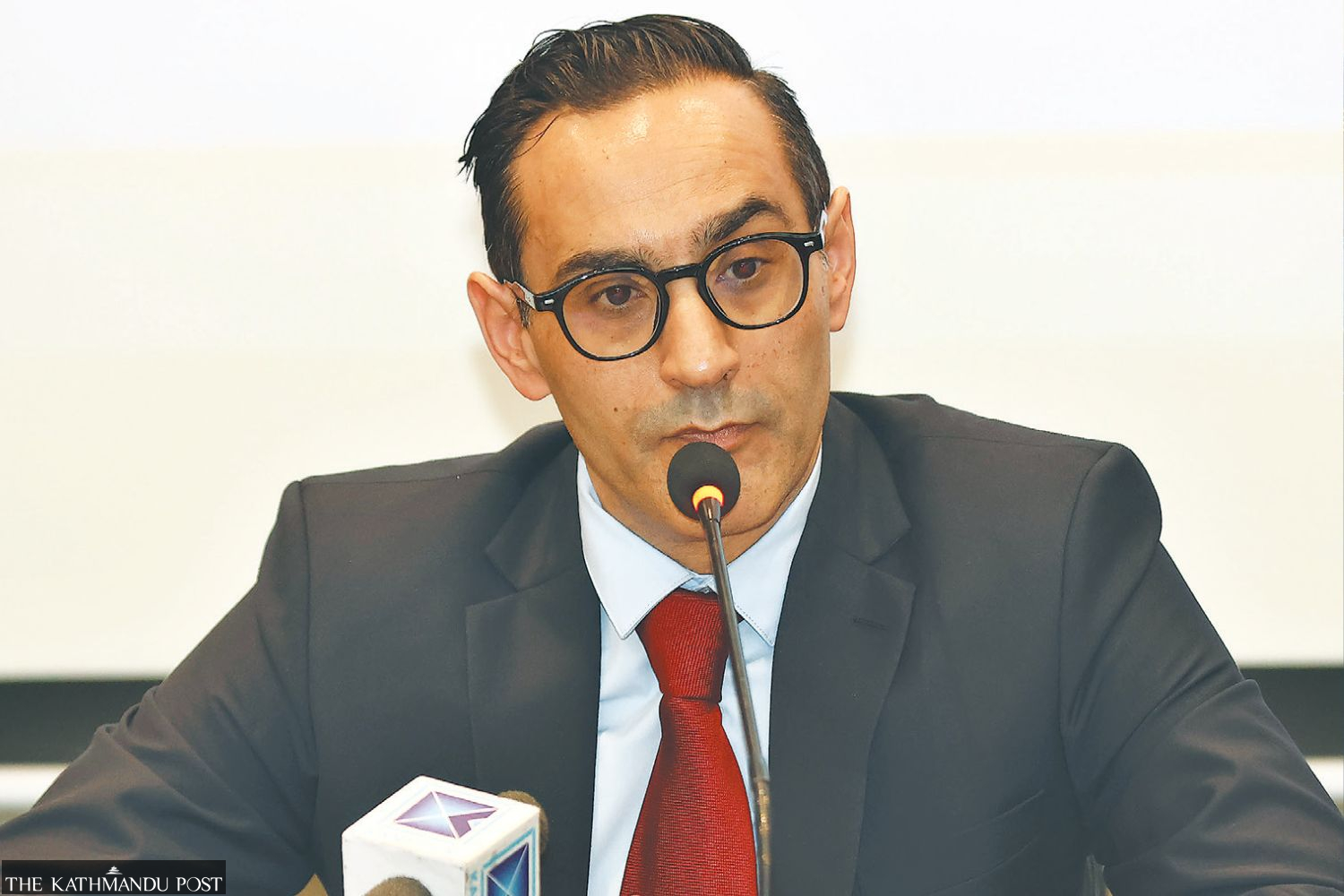
Black suit with a blue shirt. A burgundy tie. Clear glasses with a black frame. And his hair brushed back. Gugliermo Arena, who got his appointment letter as the head coach of the Nepal men’s national football team on Thursday, seemed calm as he attended a meet-and-greet at the hall of ANFA Complex in Satdobato, Lalitpur, on Friday.
Soft-spoken Arena did not make big promises. Even when the All Nepal Football Association (ANFA) said that Arena was tasked and expected to win the SAFF Men’s Championship in September-October, Arena responded, “I can answer that after a few weeks.”
Arena has been in Nepal for around 10 days. He was expected to be appointed the new head coach ever since he was found watching matches of the National League in stadiums.
When Arena, a UEFA pro-license holder coach, was asked about his impressions of the players after watching the National League, he was not excited. “I saw some National League matches. Nepali players have qualities that are requested of international football,” he said. “But these qualities are not fully developed in the league, especially in terms of fitness and practical aspects of the game.”
Arena also said that Nepal lacked good strikers. “Nepal’s problem is in scoring goals,” he said. “And when I saw the National League, all the strikers in the clubs were foreigners.”
Arena played as a centre midfielder in the third tier of Swiss league football. As a coach, he has extensive experience, but mostly at the club-level.
Having worked with over a dozen different clubs across Asia, Africa and Europe since 2003, Arena’s only stint with a national team was with Laos in 2023. And the Land of a Million Elephants will be one of the two teams against which Arena will be tested in less than two weeks.
Nepal are facing Laos on March 31 in what will be the last group-stage match of the AFC Asian Cup Qualification Third Round for both teams. Further, both have already been eliminated and will be playing for a win to end their campaign on a high note.
Meanwhile, Nepal might not be able to host Laos for the second leg. The reason: the country has not had an AFC-recognised stadium ever since Dasharath Stadium was declared unfit in February 2024. The venue for Nepal’s home fixture against Laos is yet to be announced.
While it is uncertain where Nepal will face Laos, Nepali fans will be able to witness Arena at Dasharath Stadium on March 26 when the Gorkhalis host Hong Kong for a friendly.
“We are already out of the qualification for the AFC Asian Cup. So both the matches, against Hong Kong as well as Laos, will be friendlies. It will be very interesting to try something against them,” Arena said. “And then I know the fans always want the result. But we will try to make improvements, and we will try to make all the Nepali fans happy.”
Alongside the lack of an international stadium that meets the standards of the AFC and FIFA, Nepali football has been struggling with basic training infrastructure, preventing players from leaving the country and hindering the organisation of a regular domestic league.
Nonetheless, Arena stressed that he wanted the players, fans and other stakeholders to strengthen their belief.
“We know that football is about belief. So, if players want to find a better life and a better contract in football, it is only possible with performance and belief,” he told journalists.
The two international matches will be a major challenge for Arena as he does not have sufficient time.
“We have made a list of 46 players. I hope we can start the training next week. But as the league is underway, I think they will be available only two days before the FIFA Window,” Arena said.
The upcoming FIFA Window is from March 23 to 31. There is an 11-day break in the National League from March 23 to April 2 for the international fixtures.
Will Arena complete his term?
Arena succeeds Matt Ross, an Australian UEFA pro-license holder who resigned in October last year with around five months remaining in his one-year term.
When the news of Ross’ resignation surfaced, even the players were surprised. “We were not informed by Ross before he suddenly resigned,” Nepal’s captain Kiran Chemjong said in November before the team headed to Bangladesh for a friendly.
There have been speculations that Ross left after being dissatisfied with lack of support from Nepal’s footballing body. The speculations were a result of the problems in Nepali football revealed by Nepal women’s team head coach Patrick de Wilde, who resigned with 11 months left in his one-year term, in an exclusive interview with the Post in July last year.
And the previous concerns led journalists to ask how good a support Arena would get so that he could freely implement his vision.
“There was a mutual understanding over a variety of topics before the agreement reached with Arena, who was selected out of 800+ applicants,” said Hari Khadka, ANFA’s technical director. “We first shortlisted 10 applicants and then brought it down to three before we finalised Arena.”
ANFA also revealed that there were many high-level coaches whom they could not afford. “So, we looked for coaches whom we could afford, and with whom our views aligned,” Khadka added.
Khadka, who was working as an interim coach after Ross’ resignation, assured that ANFA would provide every support Arena asks for.
“We will give complete freedom to Arena. The players that will be in his squad will be his choice,” said Khadka. “We should not expect a drastic change. But we all do expect him to help Nepal win the upcoming SAFF Championship.”
ANFA had given similar assurance when they revealed Ross and de Wilde.
Regarding the tenure of Arena, Khadka said, “We always sign a one-year deal with coaches. We will analyse his performance in the SAFF Championship and decide on whether or not to extend the contract.”
Similarly, Arena will also not be getting overseas support staff. According to Khadka, it is a hassle to bring in overseas coaching staff due to visa hassles and other formalities. “Arena will be helped by Nepali coaches who have worked with foreign coaches over the years,” he said.
Arena seemed satisfied with the arrangement. He said, “I will have with me a staff with big motivation from Nepal.”
Good experience in club football
Though Arena does not have enough experience with national teams, he has a good resume in club football.
His first professional coaching was in 2003 when he reached Burkina Faso and joined ASFA Yennenga and helped the club defend their top-division title in the 2003-2004 season, be runner-up of the National Cup and participate in the CAF Champions League.
After that, and around a three-year gap, Arena was back to winning titles. In the 2007-2008 season of Division 1 in Benin, Arena helped AS Tonnerre win the title.
He then helped COD Meknes get promoted to the top division of Morocco in 2008-2009.
He then reached Asia, worked in clubs of Singapore and the UAE, before winning the National Cup Sultan Qaboos and Oman Super Cup with Fanja SC in Oman in 2014. Fanja also finished as the runner-up in the Oman Professional League that season under Arena.
Following this, Arena worked in China with HZ Greentown FC (2014-2015) before returning to the UAE, until 2017. After that, he was not seen in the coaching role until he joined Rapid Club Oued Zem in Morocco for the 2022-2023 season. The same year, Arena joined Laos and became a national coach for the first time.
Meanwhile, his last coaching role before coming to Nepal was with MAS Fes (2024-2025) in Morocco’s top division.
Impressed by Nepal before
“Nepali players have a very good capacity. Maybe, now we have only 25-30 players with the capacity to join the high level,” Arena said when asked about his impression of Nepali football.
However, he had a better impression before. And it is what led him to apply for the post of head coach of Nepal.
“When I was coaching in Laos, I scouted Nepal because I had to play against them,” Arena said, recalling two fixtures between Nepal and Laos in October 2023 during the 2026 World Cup Qualification.
“I saw Nepal have very good quality players,” added Arena, who left Laos in September 2023, before the matches against Nepal.
Compared to 2023, Nepal’s national team has seen several big names leave the sport and search for better opportunities abroad.
Arena thinks that times are difficult in football. “In Brazil also, 30 years ago, it was not easy for Neymar and Romario and all those players. I think we have to try,” he said. “Solution comes from belief, by the players, coaches and clubs.”
“We know in each country we have room for improvement. And this room for improvement is also in Nepal,” Arena, who also goes by the nickname Gu Li, said in the beginning. “I think in Nepal, you have to speak less, everybody. I say ‘everybody’. And work more,” Arena concluded the press conference that lasted around 18 minutes.