
On a Tuesday afternoon in early March, a group of neighbors stood at the end of their residential street at the edge of town. As they chatted, they stared steadily at the sun dropping low over an adjacent 114-acre parcel of land.
Dogs lolled on the ground, nudging tennis balls suggestively at their owners’ feet. One of the neighbor’s children, a 5-year-old girl with a sequined heart on her shirt, played nearby. The day was winding down, but in a few hours’ time, many of the property owners gathered on the dead-end street — a restaurant owner, a former mine worker, a stay-at-home mom — planned to fill the chambers of the Laurel City Council to weigh in on the future of the nearby plot of land and, therefore, the future of their city.
The plot abutting their properties became a point of fierce fixation for the neighbors and other Laurel residents beginning in January, when state officials announced the site as the future home to a 32-bed psychiatric facility to treat and rehabilitate people in the criminal justice system. Mental health advocates and the administration of Gov. Greg Gianforte have pushed for the facility’s construction to ease the backlog of people languishing in local jails, awaiting mental health evaluations before they can proceed to trial.
Many locals aren’t opposed to the facility’s purpose. Some even agree that it’s vital. But the announcement that the facility would be built in Laurel — along with the obscure process that led to that decision — catapulted residents of the south-central Montana town, with a population of roughly 7,200, into a chapter of vigilant community organizing unlike anything many longtime locals have ever seen.
In recent interviews with Montana Free Press, the facility’s opponents rarely described themselves as adept government watchdogs. But a common sentiment has quickly pushed them to clear the learning curve: the bitter perception that the people of Laurel were overlooked and disregarded by state and city officials who don’t care about their town’s future nearly as much as they do.
In the hours before she joined her neighbors at the end of their road, one of nearby property owners, Shawna Hopper, had filed a petition with Yellowstone County officials to remove Laurel’s mayor from office over allegations of backroom dealing to bring the facility, and its promise of jobs, to the city’s backyard. In the weeks prior, Hopper and others had been busy on other fronts. They’d pushed for a key city employee to resign, launched a Facebook group called Laurel C.A.R.E.D. (Community Advocates for Responsible Economic Development) that now has more than 1,000 members, launched a website, drafted emergency ordinances, filed a slew of public records requests for officials’ emails and text messages and began surveying residents about their stances on the new development.
Hopper, a local restaurant owner who’s married to the local fire chief, said the full-tilt organizing comes out of a commitment to Laurel’s present and future — and a strong distaste for being done wrong.
“I have the heart to make this a better community,” Hopper said, reflecting on local fundraising efforts she’s helped spearhead for everything from local softball teams to the fire station. “But I’m not one that’s going to be pushed and walked all over.”
Rep. Lee Deming, a Republican lawmaker and retired teacher who taught in Laurel for decades, said in a recent interview that the community blowback against the state’s new psychiatric facility had “created huge rifts” in the community. The clash, Deming said, was far and away more severe than other local fights he could recall, including the multi-year legal saga over the development of the NorthWestern power plant just south of town.
“I think it is different. I think it’s much more intense,” Deming said.
“There are going to be some people who are going to be upset for a long time over how the process worked out,” he added. “And I don’t blame them for that at all.”
The move to recall the mayor is a recent crescendo in the Laurel group’s furious organizing. (Asked to comment on the recall petition, Laurel Mayor Dave Waggoner said he had hired a lawyer and planned to file an injunction in District Court to have the petition invalidated.) Beyond that, the group’s aims are multifold. In the short term, many locals have said they want state officials to simply show up to speak directly with residents and listen to their concerns. Others are focused on a larger achievement: preventing the state from building the facility at the current site altogether.
A ‘REMARKABLY SUCCESSFUL’ LOCATION
Amber Zahn first learned that the state’s facility was coming to the field next to her house in January via a series of late-night text messages from Hopper, who had read about the site selection on the local news, KTVQ. She remembered feeling stunned and then concerned — about the facility blocking a path for the development of future homes and businesses; about her home’s property value; about her children’s safety if any patient were to escape from the secure building.
“We can be selfish and say it’s gonna take away our view, which it is,” said Zahn, looking out over the nearby property from her backyard patio. “But it also puts us in fear. And is fear a great thing to base things off of? No, but it makes a lot of decisions for a lot of people.”
In November, the Friday after Thanksgiving, the state announced that Laurel would be the home to the new forensic facility, baffling many local residents. Unlike the eastern Montana towns of Hardin and Miles City, Laurel had never officially sought the facility.
Asking towns in the eastern half of the state to apply for the facility had itself been an abrupt change to the selection process steered by the administration of Gov. Greg Gianforte and the Montana Board of Investments, the state’s development arm. It came about only after Billings and Yellowstone County officials brusquely rebuffed the state’s advances over the summer to locate the facility in Montana’s largest city.
The forceful opposition from Billings officials in the summer of 2025 was a prelude to the outcry that would eventually erupt in Laurel. Influential locals in the metropolitan hub blasted the Gianforte administration for appearing to announce that the facility was coming to their city, rather than asking for public buy-in. (“It’s pretty bizarre,” Billings City Councilmember Mike Boyett told MTFP in an August interview.) In one particularly tense stand-off during a tour of another site in July, a frustrated local elected official jabbed a finger at the chest of a state lawmaker backing the facility. (“I would say Sen. (John) Esp and I were nose to nose,” recalled Yellowstone County Commissioner Mark Morse, explaining his anger at the state’s presumptive attitude. “The whole thing just felt like it was a done deal.”)
While the state concentrated its early efforts on Billings, the prospect of locating the facility in Laurel, or other southeast and south-central Montana towns, lurked in the background.
But when the Gianforte administration backed off from Billings and pivoted to seeking applications from other locations, Laurel didn’t submit a proposal. Instead, the city’s chief administrative officer, Kurt Markegard, sent a letter to the Board of Investments explaining why Laurel wasn’t lining up alongside other contenders. In short, he said, Laurel didn’t have a suitable 10-acre site within its city limits to offer.
Local residents, however, pointed to other parts of Markegard’s letter as proof of a kind of courtship with state officials. In his explanation, addressed to Board of Investments Executive Director Dan Villa, Markegard referenced conversations that he and Waggoner, the mayor, had previously had with Villa about another suitable site outside of Laurel’s boundaries — a parcel that could be annexed into the city.
“Laurel’s Mayor Dave Waggoner and I have described to you a location just outside Laurel’s city limits that has most of the criteria that would make building the facility remarkably successful,” Markegard wrote.
To Zahn, Hopper and other opponents, the November letter only raised more questions about those past conversations, and the parcels being considered. In a small town, the facility was bound to turn into someone’s new neighbor. Residents set out to learn more.
In between attending public meetings and writing letters to city council members, locals began filing public records requests for past emails, text messages and other communications between Markegard, Waggoner and Villa. Their requests were eventually successful, yielding months of documented conversations among the three men dating back to July — including Markegard’s suggestion of a different small parcel of land closer to the interstate that runs through the city.
In an August email to Villa, state health department director Charlie Brereton and state budget director Ryan Osmundson, Markegard highlighted a 10-acre plot of land just west of Laurel, bordered to the north by Old Highway 10. He discussed the options for water and sewer infrastructure, access to the interstate and zoning regulations.
“The Mayor of Laurel would like to invite you all to a (Microsoft) Teams meeting to further discuss the potential for the proposed site to become the home of a new state facility,” Markegard wrote. “Please look over the included information and pictures and consider this site as the best site in Yellowstone County to build a facility.”
In a March interview, one of the Laurel opponents, Kris Vogele, said the August email left a bad taste in his mouth about Markegard’s involvement — even if he suggested a parcel of land different from what the state eventually chose.
“He almost acted as an agent of the state,” Vogele said. “I don’t know if I call it nefarious, but I would say that it was being derelict of his duties or something, where he wasn’t representing the city.”
Markegard declined to comment to MTFP, citing the strain that the community backlash has already had on him and his family. But in a brief interview after a city council meeting in early March, Waggoner described all of his and Markegard’s communication with the state as a fact-finding expedition to better understand the facility it intended to build.
“Honestly, we questioned. And all the emails and the phone logs, we were questioning, ‘What are you going to do?’” Waggoner said.
The mayor, who was elected in November to serve a second term, acknowledged he was also originally intrigued by the prospect of bringing jobs to Laurel.
“I was voted in to better the community. When I heard 130 jobs, I thought, you know, we’re not getting them all. But if we get 30, 40, 50 of them, we are going to have some residents that are going to up their way of life,” Waggoner said.
Local residents haven’t found any indication that Waggoner or Markegard knew — or suggested — the 114-acre plot west of town as a possible location for the facility. The footprint is far larger than what the state originally said it was looking for. But the selection of that plot of land, many opponents said, took the situation from bad to worse.
GROWING PAINS
For some Laurel residents firmly dug in against the new facility, the opposition comes down to a basic equation about geography and taxes.
Laurel’s development is hemmed in by a variety of man-made and natural boundaries. The sprawling city of Billings lies directly east. Iconic sandstone “rimrock” cliffs border Laurel to the north. To the south, the Yellowstone River runs and industrial giants loom: the CHS Laurel Refinery and NorthWestern Energy’s Yellowstone County Generating Station, a gas plant.
With those borders in place, some locals say the community’s most direct path for development lies to the west. But if the 114-acre property near a large swath of Laurel’s western edge becomes a site for a state-run, tax-exempt mental health forensic facility, Vogele and others point out, a future source of revenue that could be derived from residential homes and commercial businesses gets drained.
Without expanded tax revenue filling Laurel’s coffers, city services for everything from the fire department to sidewalks will suffer, opponents say.
“I think it’s a death-blow to Laurel. I do,” said Steve Krum, a retiree whose family sought to block NorthWestern Energy’s gas plant for several years. “That is the direction that they can go and reasonably create a tax base to help fund the operation of the city. There’s no other way to grow.”
Some of the most vocal opponents say they’re not fighting against the psychiatric facility because of what it is, but because of where it is. In addition to residential homes, the future facility is not far from an elementary school — a fact that spurred the local school board to oppose its construction.
In the absence of communication with state officials, fears among Krum and other residents have only grown. But locals say the Board of Investments, represented by Villa, has backed away from town halls and other meetings with local residents, worsening the confusion.
But Villa and Brereton, the state health department director, have not shied away from answering questions about the Laurel facility altogether. In an early March presentation to state lawmakers in Helena, Brereton and Villa put up a slideshow of “myths vs. facts” about the forensic facility’s potential impact on Laurel. One of the topics Villa addressed was the future building’s location — including its proximity to the elementary school.
“(E)ssential infrastructure frequently co-exists within residential boundaries,” Villa said, drawing comparisons to the psychiatric facility at Billings Clinic, located in a residential neighborhood, Shodair Children’s Hospital, a psychiatric hospital for minors in Helena, and the state’s own adult psychiatric Grassland’s Facility, a satellite location of the Montana State Hospital also located in Helena.
“This secure facility was recently built in the very affluent neighborhood of Helena, 431 yards from Smith Elementary,” Villa said. “In Laurel, we are evaluating the feasibility of a 114-acre lot, which is over a half mile wide, to ensure a massive geographic buffer.”
At a higher level, Brereton sought to debunk the claim that the facility’s presence would make local residents of Laurel unsafe.
“Unlike a civil facility, this type of forensic facility serves those involved in the criminal justice system and therefore does not discharge patients into the community,” Brereton said. “So patients are securely transferred to and from the facility and the community, arguably, will never see these individuals or these patients. That is the fact.”
After Brereton and Villa’s presentation, Hopper described feeling only more enraged by the “myth-versus-fact” framing. (“I am livid,” Hopper wrote in a pre-6 a.m. text message to MTFP the day after the meeting. “More lies.”) Again, she said, local opponents felt dismissed.
In a Facebook post, Zahn shared some of the remarks she said she sent to Villa, questioning his arguments. She prefaced the post with a callout to her fellow Laurel residents.
“They think we are stupid. They think we don’t see. Well, we hear and see them,” Zahn said. “Now it’s time for them to hear and see us.”
‘OUR FRIENDS AND NEIGHBORS’
On the Tuesday before the Laurel City Council meeting, Hopper and her neighbors dispersed from the road looking out over the sprawling property and headed to the Front Porch, a local event space business right next door to City Hall. The location, owned by Laurel C.A.R.E.D. member Cheryl Hill, has become the staging area for organizers to gather and strategize before city council meetings.
The room slowly filled as Hopper gave recent updates. She talked about the next steps to recall the mayor, presuming the county clerk would clear their petition for signature gathering, and what to expect from the city council’s discussion that evening.
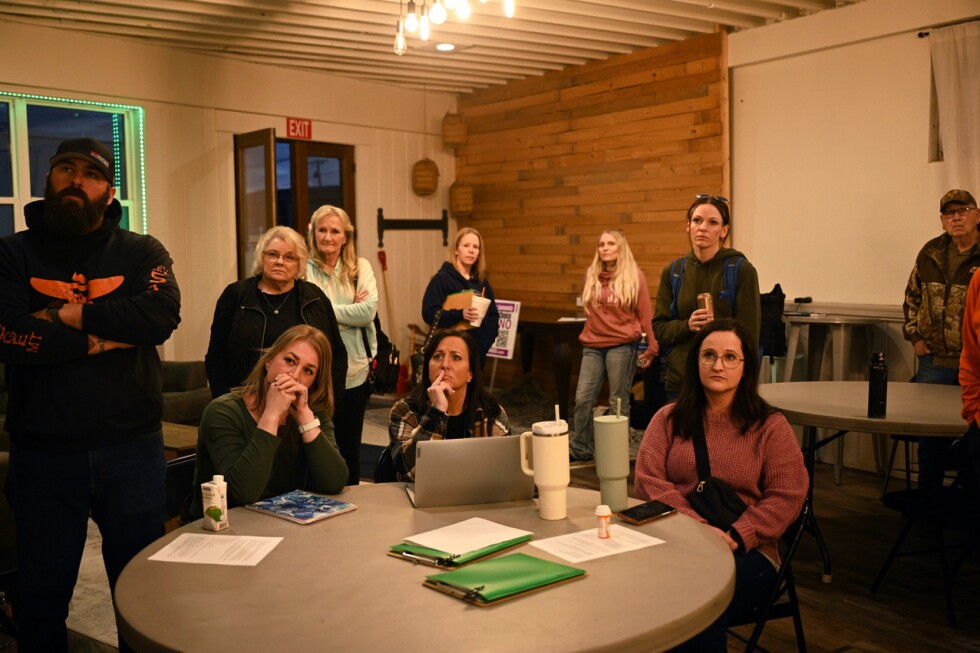
The group also learned that they had made the local news, again, with their push to recall Waggoner. They gathered around a television to watch the clip together. Then, armed with notebooks and other printed materials, they marched next door, filing into the committee hearing room until every chair was full.
During the meeting, the city council moved to schedule a date in the coming weeks to discuss emergency ordinances drafted by Vogele and others to block the facility’s development. Addressing the city council members, Laurel’s city attorney acknowledged that the drafts were detailed and well-researched and deserved careful consideration.
But perhaps the most notable part of the evening was not something that organizers had predicted. During the time set aside for council members to present business to the mayor and one another, City Council Member Jodi Mackay asked permission to read a statement into the record that she had recently sent to Villa, Brereton and the governor. All eight city council members had signed on.
In the letter — the first official outreach from the city council to state officials — Mackay and other local representatives described Laurel as “a small, hardworking, thoughtful community.” But, the letter said, the community had been disrupted in recent months by the “chaos” brought about by the state’s efforts. “(T)he State has been pushing ahead with the intent of building the facility just west of Laurel and disregarding public input and outcry. To date, the Laurel City Council nor Laurel citizens have had no meaningful engagement with any state officials regarding this topic,” Mackay read.
“It should be noted that your efforts have galvanized a grassroots effort comprised of concerned and educated citizens,” her letter continued. “They are digging into this issue and carefully evaluating your methods. They have raised countless legitimate concerns and have sought avenues for public comment and engagement. It would be wise to engage with these voters and make them part of your process.”
Mackay and the other council members added that they did not in any way intend for the letter to suggest how they would vote if presented with future requests for annexation or zoning.
“This council is committed to weighing the options set before us and listening to our constituents who are, in fact, our friends and neighbors,” the letter said.
Mackay read off the names of the council members who signed the letter, shuffled her papers and ended her remarks.
After a brief moment of silence, members of the audience burst into applause.
___
This story was originally published by Montana Free Press and distributed through a partnership with The Associated Press.