
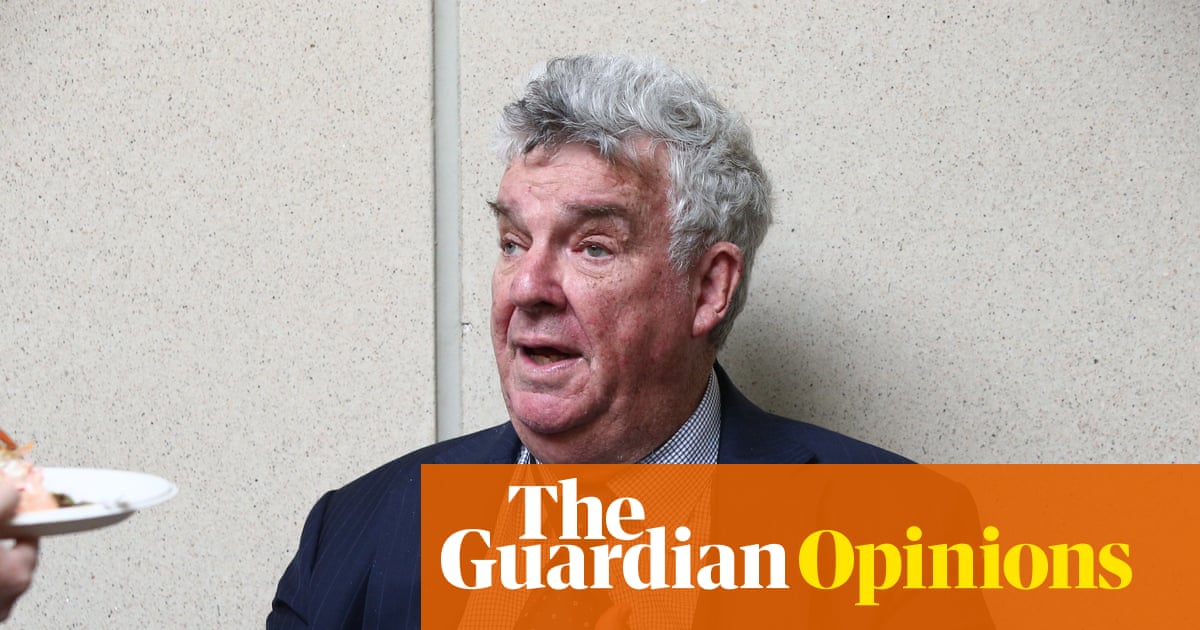
Ron Boswell had one of the great campaign slogans of Australian politics.
“He’s not pretty, but he’s pretty effective,” corflutes, billboards and television commercials for the Queensland National proclaimed in 2001, as he prepared for the greatest battle of his political career, taking on the firebrand One Nation leader, Pauline Hanson, to retain his senate spot.
And his message resonated – former Queensland Liberal George Brandis famously described “Bos” as having the appearance of an unmade bed.
When he retired in 2014, after 30 years in the Senate, Boswell mused that beating Hanson, at a time when her “aggressive, narrow view of Australia” had first struck a chord with the Australian electorate, had been his greatest political achievement.
Boswell died in January, leaving the next great battle with Hanson to his political protege and the new leader of the Nationals, Matt Canavan.
Hanson’s support is again soaring as uncertain economic times, among other factors, drive her populist message.
Sign up for the Breaking News Australia email
For the Nationals, Boswell’s prescription for defeating One Nation may be needed more than ever.
Demonstrating that a demagogue like Hanson, who has been joined by National party “turncoat” Barnaby Joyce, doesn’t have the answers may prove the defining task of Canavan’s leadership. The trick, according to Bos, is to paint One Nation as ineffective.
One Nation’s policies, he believed, were a hot mess of grievance and ideology, as Hanson and her cohorts struggled to establish what they stood for.
Some of the first-hand experience Boswell offered on dealing with Hanson was straightforward: preference deals between the Coalition and One Nation never work. This is because they send moderate voters to Labor and alienate enough conservatives that they will back Hanson outright.
Matt Canavan has shown he is keen to follow his old mentor’s advice. Photograph: Mick Tsikas/AAP
He argued that his Liberal and National party colleagues should take the fight up to Hanson and forcefully explain to voters what to expect if One Nation won enough support to influence policy and governance.
Even before he replaced David Littleproud on Wednesday, Canavan showed he was keen to follow his old mentor’s advice and engage directly with Hanson, to take the fight to her. When she used the debate about Australians in Syria linked to the terror group IS to claim there were no “good Muslims”, Canavan called her “un-Australian”, a term Hanson herself is fond of using. He said she was unfit to lead, correctly predicting that Hanson would not apologise.
On the attack, Canavan went Hanson on what he claims is a pretty poor record over decades in frontline politics.
Originally a Liberal candidate, she was first elected as an independent in the lower house in 1996, losing just two years later. After a few attempted comebacks and a turn on Dancing with the Stars, she won a Senate spot at the 2016 double dissolution. The party currently has four senators, plus Joyce in the lower house. And One Nation’s candidate for the Farrer byelection, businessman David Farley, is tracking well. The Liberals are due to name a candidate this weekend, while Canavan campaigned with the Nationals candidate, Brad Robertson, on Friday.
With the spotlight on him for the first time as leader, Canavan said Hanson had never delivered a single dam, a road, or a hospital.
Known for having a glass jaw, she hit back, suggesting Canavan was part of a “woke pile-on” that included left-wing activists. Canavan doubled down, telling the ABC that Hanson could dish out criticism but not take it in return. “Welcome to politics, Pauline,” he quipped.
Despite attempting to talk Joyce out of defecting to One Nation last year, Canavan has now been forced to criticise his old boss.
Joyce, he argues, has now relegated himself to a grievance player by joining a protest party. And he pointed out that Joyce had employed this same criticism against his old foe, independent Tony Windsor, in 2016.
Recent polls put One Nation’s support as high as 28% nationally, up from single digits last year. The Coalition, who seem to have paused its efforts to self-immolate since Angus Taylor took the leadership, recorded a primary vote of 31.8% at the election. In the most recent Guardian Essential poll, that vote had dropped to 26%. One Nation was at 22%, and is even higher in Newspoll.
Next weekend’s South Australian state election is a key test of Hanson’s ability to translate polling numbers into actually winning seats.
But the challenge facing Canavan now seems harder than when Boswell took Hanson on a generation ago.
Politics has become more fragmented, and the dominance of the major parties so much less secure, that traditional campaigning methods won’t do.
Plenty of protest voters open to supporting One Nation at the ballot box are likely to already know the party won’t get into government, and therefore its policies aren’t really that important.
These voters, the white hot, angry ones, feel as if they kept their end of the bargain, working hard and following the rules, only to find they can’t now afford a house and might have to choose between the weekly supermarket shop and filling up their petrol tanks. For these voters, backing Hanson is about sticking it to the whole system, not about registering a protest against the traditional conservatives.
Canavan’s attempts to win back voters on the right could make it hard for Taylor to win voters closer to the centre. This is the main game if the Coalition ever wants to dislodge Labor from government.
His views on social issues, climate change and renewable energy are badly out of line with much of mainstream Australia, and he will have to moderate some of his backbench impulses. His weaponisation of net zero by 2050 policies since the election is a plain denial of science, and a gift to Anthony Albanese.
Like Ron Boswell before him, Canavan faces an uphill battle at the ballot box.
And the result for the coalition is unlikely to be pretty if Canavan is unable to capture disaffected conservative voters and prove he is effective against One Nation.