
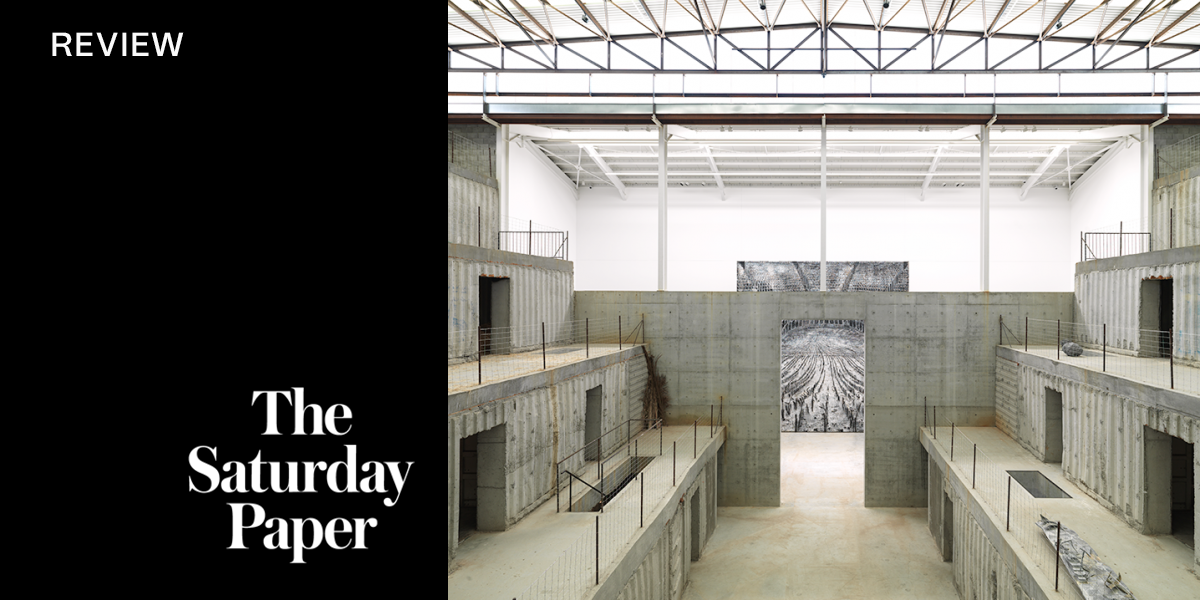
Anselm Kiefer, the German neo-expressionist, is one of the most polarising and enigmatic artists of our time. One does not witness his complex labyrinths from a distance; rather, we walk among ruins, Earth’s encrusted layers, enter the celestial and into the enigma, the repository of human memory.
Transmitting sacred, gnostic knowledge as well as revelation, his works reveal truth in between the differences: between eschatology and genesis, history and mythology. Crossing historical and literary schemas, his monuments confront the being in human. They map human consciousness to the celestial. Kiefer begins at the site of wreckage. For him, “ruins are the beginning”, they are the origin of new ideas.
Kiefer’s meditations on the Holocaust, annihilation, and theories from Greek and Assyrian religions, Jewish mysticism, cosmology, alchemy and the Kabbalah, as well as philosophy, architecture, string theory, poetry and quantum physics, rewrite memory into a malleable material.
He is notable for countless large-scale paintings, sculptures, lead books and installations. However, his most impressive masterpiece is his studio – estate La Ribaute, Barjac, in southern France. Referred to as a laboratory or ancient city, Barjac stretches more than 40 hectares, with underground tunnels, an amphitheatre, towers, subterranean spaces, greenhouses and outdoor works.
“There is nothing that compares to Kiefer’s Barjac when it comes to vision, scale, ambition and complexity,” says Georges Armaos, Kiefer’s former artist liaison at Gagosian Gallery.
“One could make a parallel with Donald Judd’s creation in Marfa or James Turrell’s Roden Crater project.”
The colossal, multi-level amphitheatre at La Ribaute is the basis for Kiefer’s latest installation at Mona, titled Elektra. The museum’s founder, David Walsh, had wanted Kiefer to re-create elements of his studio since he first visited it four years before Mona opened. The original budget for the new wing at Mona, developed primarily to house Elektra, was $11 million. The final cost is more than $100 million.
Designed by Australian architect Nonda Katsalidis, Mona’s most distinctive feature is its labyrinthine network of tunnels, voids and passages. The architecture is critical to invoking disorientation and descension into the underworld. Katsalidis, who worked with Kiefer on Elektra, says: “Every aspect of Kiefer’s amphitheatre in Barjac is replicated, even the defects, the dust, stains and accidents. Kiefer said to me, ‘Just build it as it is.’ ”
It’s a monumental commission by Mona. Within Kiefer’s ruins of remembrance, we encounter fragmented collective and personal histories while questioning the process of recollection itself.
Analogous to an Indian stepwell or an inverted ziggurat, entering Kiefer’s ruin at Mona evokes a sense of reclaiming a lost civilisation. It’s a momentary illumination of such depth that its resonance resounds through the walls.
Elektra is made from cast concrete and shown together with three overwhelming, large-scale paintings, as well as his celebrated Woman of Antiquity bride sculptures.
Time bends into overlapping memories and co-existing temporalities as the tomb-like labyrinths and light voids oscillate the viewer between weight and emptiness. These connections or diversions within the maze either psychologically locate the viewer or orientate memory within space. “It’s like the book The Underground Railroad by Colson Whitehead, which is part real and part imaginary,” Kiefer told me in an earlier interview. “First, you think it’s a real tunnel; then it becomes a spiritual tunnel. It takes you from one place to the other.”
Other works or relics – archival lead-photographs suspended from the ceiling like film reels, elongated sunflowers, stones, glass shards with encrypted celestial coordinates – are entrapped around the tunnels. These surreal and hallucinatory moments are cryptically perplexing, rendering a feedback loop of interconnected synapses and rhizomatic networks.
Reaffirming Kiefer’s belief that stones are living entities possessing spiritual consciousness and ancestral memory, the raw geological boulders at the amphitheatre’s crossroad serve as an anchor throughout the installation. These stones balance a similitude: as co-existing coordinates between matter and memory, between mind and celestial. Recalling Giulio Camillo’s 16th century memory theatre, Elektra abstractly references the mnemonic architectural system – the method of loci, constructed to locate human knowledge in relation to the cosmos.
With a foreboding entropy, the painting Die Lebenden und die Toten (The Living and the Dead) (2019), based on an original photograph of a monumental 700-seat Aula Magna at Fribourg University in Switzerland, suggests an exchange between scorched wood sticks and a deserted auditorium. Part of the series Superstrings, Runes, The Norns, Gordian Knot (2019), this work reveals Kiefer’s interest in quantum physics while also proposing that perhaps reality is made from interconnected vibrating strings.
Continuing a similar inquiry, the Jaipur (2008-19) painting depicts intersecting lines tracing or mapping planetary coordinates with the great 1200-year-old stepwell in India. The title refers to Jaipur’s founder and astronomer, Sawai Jai Singh II (1688-1743).
The shift from the celestial to human eradication alters the tempo through the painting Dulce et decorum est pro patria mori (It is sweet and fitting to die for one’s country) (2018-20), confronting the viewer with Germany’s history, human remnants and the glorification of war. Disintegrating into thick textures – coal, wood, fabric and acrylic – the Latin phrase shows Kiefer’s use of language as an instrument to reorientate or obscure historical lineage as layers of co-existing time.
In the middle of the amphitheatre Kiefer’s majestic bride sculptures Melancholia (2007), Sappho (2007-23) and Paete, non dolet (2007) reclaim history’s representation of women. Melancholia’s head is replaced by a polyhedron form and signifies a tension between order and chaos. The polyhedron, often associated with German Renaissance artist Albrecht Dürer, also suggests the term melancholia as a historical weight, as well as symbolic of transformation.
Lead, a material synonymous with Kiefer, is sculpted into illegible book pages in the bride Sappho, redolent of hidden history, as well as a critique on the obliteration and control of knowledge. A toxic material, charged with a corrosion resistance that doesn’t decay, lead, for Kiefer, transmits an auratic quality. As he states in his lectures at the Collège de France: “Lead is a substance that unaccountably contains in its depth a spark of light, a glimmer that seems to belong to some other world. One beyond our reach.”
Elektra operates as a self-governing entity, reforming ancient memory anew so that we bear witness to our own shadow. It is the being in being, a revelation of humanity’s ability to destroy the very thing it is so anxious to preserve.
It’s a monumental commission by Mona. Within Kiefer’s ruins of remembrance, we encounter fragmented collective and personal histories while questioning the process of recollection itself. For this artist, history is not a fait accompli, it’s not fact. He says: “Who today can say whether or not Homer actually existed? And does it really matter?”
This article was first published in the print edition of The Saturday Paper on
March 14, 2026 as “Into the labyrinth”.
For almost a decade, The Saturday Paper has published Australia’s leading writers and thinkers.
We have pursued stories that are ignored elsewhere, covering them with sensitivity and depth.
We have done this on refugee policy, on government integrity, on robo-debt, on aged care,
on climate change, on the pandemic.
All our journalism is fiercely independent. It relies on the support of readers.
By subscribing to The Saturday Paper, you are ensuring that we can continue to produce essential,
issue-defining coverage, to dig out stories that take time, to doggedly hold to account
politicians and the political class.
There are very few titles that have the freedom and the space to produce journalism like this.
In a country with a concentration of media ownership unlike anything else in the world,
it is vitally important. Your subscription helps make it possible.
Send this article to a friend for free.
Share this subscriber exclusive article with a friend or family member using share credits.

Used 1 of … credits
use share credits to share this article with friend or family.
You’ve shared all of your credits for this month. They will refresh on April 1. If you would like to share more, you can buy a gift subscription for a friend.
SHARE WITH A FRIEND
? CREDITS REMAIN
SHARE WITH A SUBSCRIBER
UNLIMITED
Loading…

Exhibition
Adelaide Biennial of Australian Art
Jennifer Mills
This Adelaide Biennial eschews political content, preferring to focus on materiality, aesthetic forces and the ways works of art are experienced.