
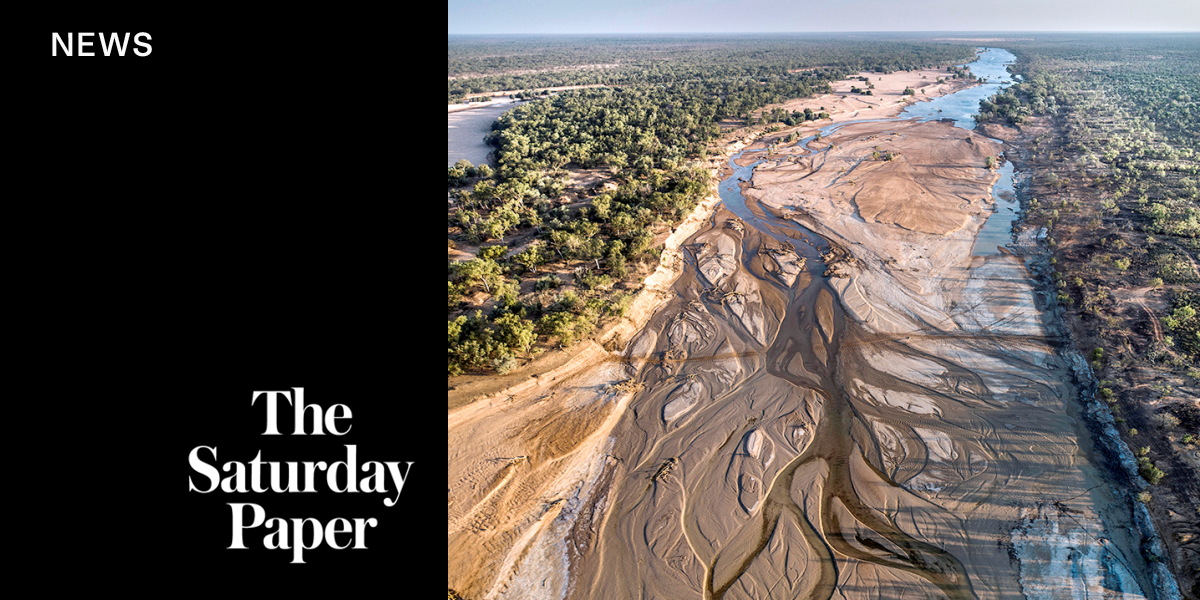
A Texan oil mogul’s plan to frack the Kimberley invokes “the end of my people, really”, says Bardi-Kija-Nyul Nyul custodian Albert Wiggan.
Wiggan, a spokesperson for Kimberley Voices for Country, describes the region as “a garden of Eden”. He says it is a place that has never registered an extinction of any species.
“We still have the same species here ever since day dot,” he says.
“There’s no other place like it on the planet. It’s only when you come to the Kimberley that you appreciate how magic it is.”
Fracking is banned in Victoria, Tasmania and South Australia, but permitted with varied restrictions in other states and territories. It was banned in Western Australia after a 2017 state inquiry found economic benefits were slight and environmental risks were beyond regulatory scope. That ban was lifted in 2019, however, when Texan oilman Rhett Bennett bought an exploration permit over the Canning Basin – an area twice the size of Victoria, covering the Martuwarra Fitzroy River catchment.
Bennett registered Bennett Resources, a fracking subsidiary of his Black Mountain Energy company. He faced unprecedented resistance among Kimberley’s 40,000 residents, almost half of them Indigenous.
Indigenous Culture is maintained through intact songlines – “a sort of mapping”, says Wiggan. Songlines here flow with the river, its tributaries and aquifers, “the sacred source of creation. The water serpent formed the waterholes and forged the landscape within our ceremonies, our language, our protocols, our dance, our corroborees.”
Posting a call on social media, Wiggan galvanised support across Australia, alongside frack free campaigns by groups including Kimberley Land Council, Martuwarra Fitzroy River Council, Lock the Gate and Environs Kimberley.
“People have been defending the Kimberley since colonisation,” says Environs Kimberley executive director Martin Pritchard, who describes the region as “the largest, most intact tropical savanna in the world – its coastline is in the top 4 per cent of pristine coastlines on the planet, with an incredible culture that’s alive and rich here. There’s nowhere like it.”
Allied Kimberley bodies have fended off Alcoa, Origin, Mitsubishi and Squadron Energy, but a battle persists against Black Mountain, which according to Boiling Cold energy bulletin has already spent $40 million on Project Valhalla, much of it overcoming seemingly insurmountable regulatory roadblocks. The project needs both state and federal approval for an initial 20 exploration wells in the Martuwarra Fitzroy River catchment – a vast, heritage-listed area – which entail drilling about four kilometres into rock-shelved gas reservoirs. Megalitres of water, chemicals and sand would be forced into rock layers to fracture them, releasing gas. The necessary infrastructure includes roads, processing plants, a pipeline and wastewater treatment.
The state forbids export of onshore gas, but by late 2021, Bennett had secured an exemption. He repeatedly deferred a requirement to conduct a seismic survey and spend $8 million on an exploration well. He seemed undeterred by pressure on the Albanese government to tax gas exports and halt approvals for fossil fuel extraction.
“Indigenous groups are all connected through that one river … that disconnect between families impacts Country and Culture.”
Discussing his Australian investments on the American Powers podcast in 2021, Bennett remained sceptical about anthropogenic climate change, claiming there were “periods of time when CO2 concentrations were 30 [times] what they are today – apparently our ancestors survived”. (Homo sapiens evolved an estimated 300,000 years ago; consensus science holds that atmospheric concentration of CO2 is currently the highest in 16 million years.)
Black Mountain claimed Project Valhalla would operate with “net-zero carbon emissions”, but in 2023, the Australian Securities and Investments Commission fined it for greenwashing and false or misleading claims. It found Black Mountain’s sustainability claims “had no credible basis”.
Nor was the Australian government’s Independent Expert Scientific Committee convinced. It found “substantial uncertainty” in Project Valhalla’s hydrology claims, doubting its “ability to assess all potential impacts on water resources”. It found “baseline data, model outputs and conclusions drawn” were “not sufficient” and “largely unsupported”. The claim that Project Valhalla wouldn’t impact downstream water resources wasn’t substantiated, nor did it prove vulnerable species – sawfish, northern blue-tongued lizard and greater bilby – would not be at risk.
Kimberley residents, too, were sceptical, following studies finding correlations between proximity to fracking fields and childhood cancer and premature deaths. Widely screened films about fracking’s contamination hazards – Gasland (2010), Don’t Frack Our Future (2013) and Groundswell Rising (2015) – have helped cement public opinion. Polling shows an overwhelming majority of Western Australian residents oppose fracking, according to the Conservation Council of WA.
Failing to raise investor capital, Black Mountain delisted from the Australian Stock Exchange and faced another setback when the November 2025 Western Australian Labor Party conference voted again to ban fracking. When the company revised estimates to the state’s Environmental Protection Authority of each well’s water use to 100 million litres – more than twice original estimates, in a water-scarce state – its application seemed unwinnable.
In January this year, however, the EPA found risks posed by Project Valhalla were “insignificant” and recommended it for ministerial approval, with conditions.
“People are absolutely aghast,” says Pritchard. “They see the Kimberley as a sacred cultural and environmental landscape and they cannot understand how the EPA made this recommendation.”
“There’s anxiety and mistrust,” says Wiggan. He says ongoing battles against extractors impose trauma on Kimberley people. “The feeling was genuine fear. I always thought protection meant keeping something free from harm,” he says, but the EPA “failed the Kimberley and what we have protected since the Dreamtime”.
WA EPA chair Darren Walsh says his recommendation will “ensure that significant environmental harm does not occur”. The authority noted fracking wouldn’t proceed until an improved “regulatory framework” was introduced.
Enforceable fracking standards and Traditional Owner rights of veto have long been promised but are not yet legislated.
Responding to questions from The Saturday Paper, Walsh says Black Mountain “has an Indigenous Land Use Agreement in place with the Yungngora people and a Land Access and Use Agreement in place with the Warlangurru people”.
There’s disagreement within these groups, however, and other Aboriginal communities within Bennett’s leaseholding oppose Project Valhalla. Black Mountain “hasn’t spoken to downstream communities at risk”, says Bunuba advocate Millie Hills, who describes the catchment as “a life-vein that runs throughout the Kimberley – our waterholes to hunt and gather, where we teach our kids to fish and collect food. It’s how our ancestors lived back in the day; we still do that today.”
She says a minority of individuals have succumbed to “the royalties chucked into their faces”.
Black Mountain executive director Michael Laurent did not respond to emailed questions, but the company’s website states it will fund football teams, art supplies, laptops, barbecues, clothing, “cultural training” and “science classes”.
Albert Wiggan says some Traditional Owners are vulnerable to exploitation.
“These people need financial support, they’re struggling. We’ve seen it before – promised royalties and benefit to improve disadvantage.”
Such deals “create division and conflict”, he says. “Indigenous groups are all connected through that one river” but “that disconnect between families impacts Country and Culture when the relationship between communities is fractured. Fracking creates access restrictions for Aboriginal people; it contaminates water tables, aquifers and water basins … they’re all interconnected.”
A federal government spokesperson tells The Saturday Paper, “Engagement with First Nations people is part of the referral and assessment process under the Environment Protection and Biodiversity Conservation Act.”
In February, with limited time and despite a $10 fee, the community launched an unprecedented volume of appeals, urging WA Environment Minister Matthew Swinbourn to reject the EPA recommendation. Assisted by Environs Kimberley crowdfunding, appeals surpassed 8000, easily breaking the prior record of 727.
A state government spokesperson tells The Saturday Paper it “would be inappropriate to comment on it while [the appeal] process is ongoing”.
Pritchard says next steps might include electoral tactics. “The safe Labor seat of Fremantle was nearly lost [last election] to an independent who took up the Kimberley fracking cause. The Labor Party will also remember the near-loss of the prized Kimberley seat in 2013 to the Greens” amid the fight against Woodside’s proposed gas refinery.
“People don’t come to the Kimberley to see gas fields,” says Millie Hills. “They come to see unspoilt nature and experience our ancient culture. We don’t want fracking – we’ve seen what happened in Texas. Fitzroy is a mighty big river system vital to our living and our health; our wilderness and waterways provide for us and we rely on them for Cultural practices. Water is more precious than gas. I’m gonna keep fighting.”
This article was first published in the print edition of The Saturday Paper on
March 14, 2026 as “The Texan fracker”.
For almost a decade, The Saturday Paper has published Australia’s leading writers and thinkers.
We have pursued stories that are ignored elsewhere, covering them with sensitivity and depth.
We have done this on refugee policy, on government integrity, on robo-debt, on aged care,
on climate change, on the pandemic.
All our journalism is fiercely independent. It relies on the support of readers.
By subscribing to The Saturday Paper, you are ensuring that we can continue to produce essential,
issue-defining coverage, to dig out stories that take time, to doggedly hold to account
politicians and the political class.
There are very few titles that have the freedom and the space to produce journalism like this.
In a country with a concentration of media ownership unlike anything else in the world,
it is vitally important. Your subscription helps make it possible.
Send this article to a friend for free.
Share this subscriber exclusive article with a friend or family member using share credits.

Used 1 of … credits
use share credits to share this article with friend or family.
You’ve shared all of your credits for this month. They will refresh on April 1. If you would like to share more, you can buy a gift subscription for a friend.
SHARE WITH A FRIEND
? CREDITS REMAIN
SHARE WITH A SUBSCRIBER
UNLIMITED
Loading…
News
The bill that could stop fracking at Beetaloo Basin
Mike Seccombe
A concession to the Greens over the Nature Repair bill has handed the environment minister a means to obstruct the Beetaloo Basin fracking project – the question now is whether she will use it.