
3:43PMMarch 12, 2026.
Updated 8 hours ago
The Weekend Australian Magazine
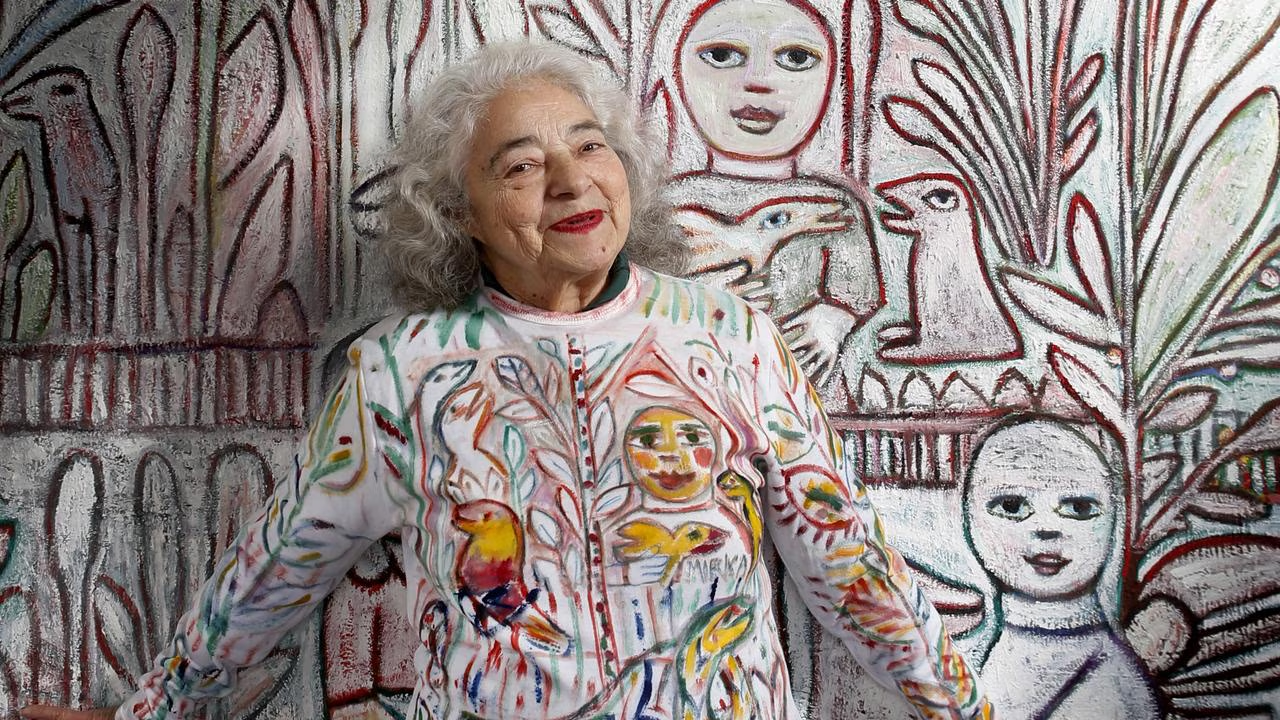
On July 16, 1942, when the late artist Mirka Mora was 14 years old, she, her two sisters and her mother were arrested in Nazi-occupied France and put in a cattle train, destination unknown. Within the cramped confines of the train, pressed up against panic-stricken strangers, struggling to breathe, and without food or water, Mirka’s mother Suzanne spotted a slit in the carriage walls. She raised her teenage daughter onto her shoulders and instructed her to call out the names of every station they passed. As the young Mirka called out the names, Suzanne wrote them down on a piece of paper. She fashioned this crude list into a letter, addressed it to Mirka’s father Leon, and, in an act of desperate hope, pushed it out of the slit in the train wall.
“I think about the person who found that letter, stamped it, and sent it to my great-grandfather [ensuring their survival] all the time,” Lily Mora tells me. “Without him I wouldn’t be here today.”
Lily Mora, granddaughter of Melbourne personalities Mirka and Georges Mora, is the founder of Sunday Salon, an online platform for accessibly priced art that champions emerging artists. She is also the curator of the new exhibition Radical Nurture at Melbourne’s Heide Museum of Modern Art. It’s the first exhibition she has curated in a major museum, and she’s excited to show me how she’s weaved her late grandmother’s works alongside those of Sidney Nolan, Charles Blackman, Joy Hester, John Perceval and Albert Tucker, the artists known as the Heide Circle, who lived and worked under the patronage of John and Sunday Reed.
But Lily Mora is distracted, and apologises for repeatedly checking her phone. Her one-year-old has just started daycare and she is waiting for a call to let her know how little Claude is getting on after his nap.
It ties in rather neatly with what her exhibition sets out to explore – a reflection of the harsh realities of “balancing motherhood with artistic practice, and exploring how nurture, trust and friendship shaped the Heide Circle”.
Standing in the kitchen of Heide I, one of three museums on the property, and the Reeds’ former home, we look at a group of Mirka Mora’s dolls. They are strange stuffed figures – a bird with the head of a woman morphs into a snake that kisses her own face. Then there are the paintings of mother and child. Angels. Babies. On the gallery windows there’s a brightly coloured mural that a younger Lily helped her grandmother paint, aglow with smiling snakes and beaming wide-eyed faces. But then there are the darker paintings. The same cherubic faces, reminiscent of Mirka Mora’s own large-eyed, round visage, peering out of the darkness. Bewildered, panic-stricken, haunted.
“My grandmother never forgot the faces of the people that were left behind,” Lily tells me.
The letter that Lily Mora’s great-grandmother slipped out of the train reached Leon, who was able to deduce that his family had been transferred by train to Pithiviers, a transit camp 90km from Paris that operated as a holding centre for prisoners destined for Auschwitz. Through his contacts in the French Jewish Resistance Leon was able to arrange his family’s release. Had he reached them any later they would have been transferred to the death camp. Mirka and her family, including her future husband, the restaurateur and gallerist Georges Mora, would live in hiding in the French countryside until the end of the war.
“She did not like talking about the war,” Lily says. “But she did occasionally speak about the memory she had of being saved. Of looking back and seeing the faces of the people she’d met in that camp, holding onto the gate, watching as she left. A lot of the angels she painted are the children she met there.”
While Mirka and Georges Mora were living in the French countryside, fighting in the Resistance, fearing for their lives, a very different kind of life was playing out on the other side of the world. The salacious stories surrounding the coterie of artists and writers of the Heide Circle are almost as well known as the names of the artists at its centre. Heide’s hotbed of hedonism and romantic entanglements were so intertwined, one could do with a corkboard and string to work out just who was in bed with whom, and when. The stories are debauched, but expected: if an artists’ commune didn’t have open marriages, affairs, the occasional threesome, jealousies and estrangements, was it even an artists’ commune at all?
In short: John and Sunday Reed were a blueblood Australian couple united by their vision for living lives less conventional than the ones they came from. The property in Heidelberg – 15 acres of scrubby, open land spooned by the slow curve of the Yarra on Melbourne’s ragged north-eastern edge – was a wedding present from Sunday’s father. Heide, as it would come to be known, has long been recognised as the birthplace of Australian modernism, a place where the Reeds indulged in their shared taste for the avant-garde, for art and literature (it was the Reeds who published the Angry Penguins magazine), and for incubating (read: housing, bankrolling, influencing, bedding) the artists who would shape the landscape of modern art in Australia.
At roughly the same time in history Gertrude Stein’s Paris salon became a crucible for artists and thinkers. She and her brother Leo were also visionary collectors, drawn to the works of artists like Picasso and Matisse well before they were accepted by the mainstream artworld. In Australia, the Heide Circle were a much more hands-on bunch, combining painting, poetry and debate with time spent cooking communal meals in the kitchen and plunging their hands into the soil, planting the native gardens that are now the idyllic grounds upon which gallery visitors meander between Heide’s three galleries.
“Some artists lived here but most just came to gather,” Lily Mora says. “Every day at 4pm they would have ‘arvo tea’ where Sunday would serve her famous scones. The artists were encouraged to spend time in the library, or doing their own individual work. They were also encouraged to work in the garden and help with the cooking. They lived as an extended family of sorts. There were children running around and family duties were shared.”
“Can you imagine that kind of community? That kind of help?” I ask her. She nods enthusiastically, checking her phone again.
Hung alongside Mirka Mora’s painting of mother and child in the kitchen is a Joy Hester painting of a faceless rag doll named Gethsemane. The Reeds were unable to conceive, and desperately wanted a child. Gethsemane, often referred to as Gethie, became a symbol of the children Sunday craved. So much a part of her life was the doll that Sunday encouraged her friends and family to treat it as though it were a real child and enquire after its wellbeing.
Looking at the painting, Lily Mora tells me that giving the doll facial features was “an act of friendship from Joy Hester to Sunday.” We stare at the doll painting for a while. “That’s really creepy,” I say, finally. Mora laughs, and agrees. Nearby is a photograph Albert Tucker took of his then-wife Joy Hester breastfeeding their baby son, Sweeney. It’s an astonishing portrait: Hester sits in a patch of sunlight on the wooden steps of the Heide homestead. Her eyes are pressed closed, her fingers push a cigarette against her lips. Sweeney’s chubby legs are bent in the fetal position, and his tiny hand reaches upwards but grasps nothing; a shadow cast across his face obscures the point at which his mouth latches onto his mother’s nipple.
“Joy Hester is such a clear example of how motherhood acted as a structural barrier for artists at the time,” Mora says. “It was already difficult for women artists, let alone throwing in motherhood on top of that as well. Albert Tucker’s career didn’t change. But Joy struggled with the responsibilities of motherhood alongside her practice.”
Another photograph shows the Reeds, Joy Hester, Albert Tucker and young Sweeney. “Who’s holding him?” I ask, squinting at the picture. “Sunday,” Mora says.
Sweeney’s story is the hardest of all the Heide stories to stomach. In addition to Hester’s frustration at being unable to paint, and Tucker’s disappearance to Europe (it later emerged he was not Sweeney’s biological father), Hester had been diagnosed with Hodgkin’s disease. Caring for Sweeney became impossible. Thinking she would soon die, the 27-year-old Hester gifted Sweeney to John and Sunday. He was two years old. The Reeds adopted the young boy and he became their cherished only child. Hester moved to Sydney, underwent radiation treatment, repartnered and went on to have two more children before dying aged 40.
We continue our walk through the homestead, the paint-splattered floorboards creaking as we pass the dining table where Sidney Nolan painted his Ned Kelly series – one hand on a brush, the other looped around Sunday’s waist as John watched on voyeuristically – and into the library, where Lily Mora has placed paper cutouts Charles Blackman made for his children among the thousands of books lining the walls. Hanging above the fireplace is a 1952 painting by Blackman, Sweeney Flying a Kite, that catches my eye.
“Sweeney was at the centre of the community,” Mora tells me. “He was everyone’s child.”
The boy is mid-leap, his hand holding onto the string of a kite, the sun setting in the distant valley. Light shines upon his figure, but his face, again, is obscured by shadows.
It was fear of the Cold War that promptedthe Moras’ move to Melbourne from Paris in July 1951. Deciding against Casablanca and Saigon, Mirka convinced Georges that Melbourne, a place she had read about as a child, was the place for their family to build a post-war life.
“When my grandmother first moved to Australia, she described it as a cultural desert,” Lily Mora says. “They felt completely out of place. They were very bohemian, artistic and wild, and they were dumped into suburban Melbourne. And they just thought, ‘Where are we?’ Meeting John and Sunday Reed was a big part of them finding their community.”
On the shelves of the Heide library Mirka and Georges found the same books that had lined the rooms of their Parisian home. “Sartre, Simone de Beauvoir, all these people were there, in their bookshelves, and that made us very close straight away,” Mirka wrote.
The Moras’ studio in Collins Street became a salon of sorts – there were gatherings, exhibitions, parties. Mirka was beautiful and flamboyant, known for her mischievous and childlike sense of humour. A favourite family story is that every year on her birthday she would plunge her face into her cake, forcing friends and family to eat the wreckage either from the floor or to lick it off her face. She also had a penchant for flashing her bum.
Lily Mora tells me that her grandmother’s wickedness delighted her as a child, but it may have been different for her father and his two brothers. Mirka and Georges had three sons, Philippe, William and Tiriel. Philippe became a film director and screenwriter, William (Lily’s father) an art dealer and gallery director, and Tiriel an actor known best for his roles in Frontline and as the woebegone suburban lawyer Dennis Denuto in The Castle (he utters the film’s most memorable line: “In summing up, it’s the Constitution, it’s Mabo, it’s justice, it’s law, it’s the vibe, and… uh, no, that’s it, it’s the vibe.” So memorable was the line that “the vibe” is occasionally used in courtroom discourse today to reference legislative intent.)
“Mirka’s love for her kids was always present,” Lily says. “She painted a lot of babies, mother-and-child motifs, but she was always unapologetic about the fact that she was an artist first. She had her studio set up in the middle of the family home, which … well, in the 1950s, Australian mothers were mothers. They weren’t other things as well.
“There’s an amazing quote in her book, which I put on one of the wall labels in the kitchen, where she says, ‘I was trying to be a complete woman, and I wanted my kids to see me as a person first and a mother second.’ It was radical, and I think she copped a lot for it.”
“Did her children resent her for it?” I ask.
“I don’t think they resented her for it, but they perhaps wanted a more conventional mother! My dad would always joke that he wanted her to pick him up in a twin-set and pearls but she would come to the school gate covered in paint in a bohemian dress. She was always unapologetic about having that other part of her identity, her work.”
The Moras opened Mirka Café in December 1954 at 183 Exhibition Street.The French singer Jean Sablon performed on opening night. Later, it would be the location of Joy Hester’s first major solo exhibition. Mirka Café was the first Melbourne café to offer Parisian-style pavement dining and became an avant-garde artists’ haunt, with Mirka’s murals on the walls and diners eating from crockery painted by Arthur Boyd and John Perceval.
When, in 1956, Georges Mora was elected President of the Victorian branch of the Contemporary Art Society, he declared: “We must break down this prejudice in the world that Australia is an artistically backward country. There is only one solution: that is, the pushing of Australian artistic achievements into the world and to bring the world’s artistic achievements into this country.”
In 1958, the Moras established Café Balzac in East Melbourne where politicians, writers and visiting movie stars converged. Ava Gardner and Marlene Dietrich may have brought their international movie star glamour to the restaurant, but it was Mirka’s flamboyance that kept the regulars returning.
“Being beautifully French, whatever she said came out sounding like ice cubes in a glass, tinkling and making you want to leap on anyone who was available,” photographer Robert Whitaker said. She ate steak with ice cream, she painted her unique figures – innocent, childlike, disturbed – on the restaurant walls. In 1967 Georges Mora established Tolarno Galleries in St Kilda and launched the careers of exhibiting artists such as Dale Hickey, John Peart and Robert Hunter.
Gallerist Anna Schwartz tells me she once met the great French mime Marcel Marceau at Georges’ permanent artists’ table at Tolarno. Unbeknownst to his children, Georges Mora had worked alongside Marceau in the French Resistance and was responsible for the rescue of over 70 Jewish children, helping to spirit them across the border to neutral Switzerland. The tale was immortalised in Philippe Mora’s 2016 documentary Monsieur Mayonnaise. (Gerorges earned the moniker for his approach to duping the German soldiers, which leaned heavily on their distaste for mess: when he hid stacks of papers under baguettes oozing mayonnaise, the soldiers would not touch them.)
Georges’ easy going sophistication would infuse Melbourne with an unprecedented European flair. Food and wine were as important to Mora as art and discourse, and anchored the culture that had formed around the European émigrés. Schwartz tells me that when she started her first artist-run gallery, United Artists, in the former Tolarno space, Georges, who had become an informal mentor to her, offered her some advice. “‘Feed them,’ he said. And I did!” Schwartz tells me. “Georges understood the context of food and conversation in mediating the art he was presenting and in creating serious collectors in the new country.”
Mirka Mora’s flair also cut deep into the fabric of Melbourne through her work. Immortalising her impact as a St Kilda identity are her mural on Acland Street and her mosaic on the foreshore. But most prominent is her 9m long and 4m high mixed-media mural at Flinders Street Station.
In 1960, the Reeds and the Moras bought adjoining blocks of land in the seaside town of Aspendale and built two beach houses linked by a communal garden. And so a new era of shared living, working and loving emerged.
While the Aspendale years are recalled as a decade of wild summers, incredible food and regular weekend jaunts for the Mora and Reed families – and some of the country’s most significant artists, writers and personalities – there are also reminders that their bohemian way of life, both at Heide and at Aspendale, was not all bountiful meals, free-flowing ideas and free love. In her 2000 autobiography Wicked But Virtuous, Mirka Mora recalled: “Other summers, other scenes. Joy Hester wild, screaming sentences so terrible they would make the head of Medusa a pleasure to look at. At Joy’s feet, in my poor little house, Sweeney lay on the floor in a fetal position. No sounds from him.”
It reminds me of the photograph of Joy Hester and baby Sweeney. And of the conversation Lily Mora and I had in front of the Blackman painting of the boy flying the kite. Sweeney, the beloved ward of the Heide set, grew into a troubled youth. He was by all accounts an excellent poet, and had a career as a gallerist, but he would die by suicide at age 34.
When Sweeney died, John Reed wrote that their “world had fallen apart … our lives centred on Sweeney in a natural and organic way, partly perhaps because of the link between him and Joy, but essentially because of Sweeney himself’”. Sunday recalled the last time she saw her son. She and John were working in the kitchen garden when they saw Sweeney standing at the top of a hill. They raised their hands towards him, and he raised his in return, before turning and walking into the distance. They would not see him alive again.
I asked Lily Mora, knowing this, what does she really think of the Heide life? With all their “radical” ideas of communal living, of sharing the domestic load, sharing the lovers, sharing the children… Ultimately, did it work?
She pauses. “I think the conditions that were happening here led to Australian modernism being able to flourish and take hold. So it’s almost too reductive to say if it worked or did not work, because there were incredible outcomes. But then also it wasn’t necessarily easy for a lot of them. Things weren’t always smooth. It wasn’t all totally Utopian… Certainly a great old time was had. And this museum is the legacy of what John and Sunday built. But should it necessarily be followed as a playbook? I’m not so sure…”
As we go outside of the homestead and into the sweltering Melbourne heat of late summer, past the garden beds where the artists planted the vegetables they would use in the kitchen, and the cattery where John and Sunday’s many cats prowled, we take a moment in the shade of an enormous Moreton Bay Fig. Lily Mora’s phone rings. It’s daycare. One-year-old Claude has woken up from his sleep. And he’s feeling very happy.
Radical Nurture is at Heide Museum of Modern Art until August 9