
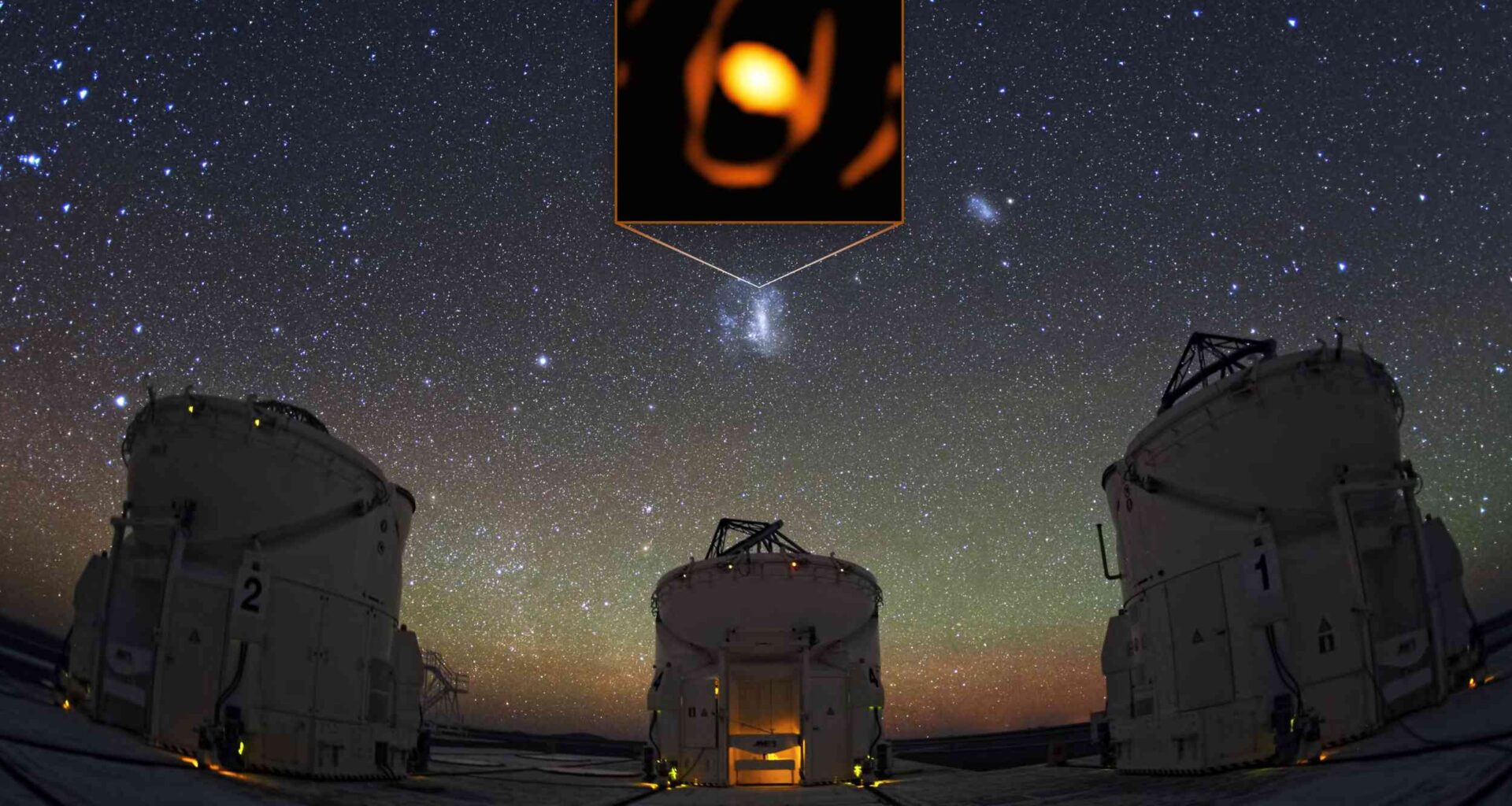
One of the largest known stars in the Universe has transformed from a red supergiant into a hotter yellow hypergiant within just a few years.
That unexpected transition shows that the final stages of massive stars can change direction rapidly, rather than ending in a simple march toward explosion.

In the Large Magellanic Cloud, WOH G64 dimmed sharply in 2011 and returned looking hotter and yellower than before.
The break begins
Using those records and newer spectra, Gonzalo Muñoz-Sanchez, an astronomer at the National Observatory of Athens (NOA), and colleagues traced the turn.
By 2013 and 2014, the team found the surface looked about 1,000 K hotter and its old rhythm had vanished.
That pairing of lost pulsations and rising temperature ruled out an ordinary wobble and forced a harder question.
Decades as a red giant
For decades, WOH G64 was classed as a red supergiant, a star near death, with a radius above 1,500 times the Sun’s.
Older survey records showed it pulsing every 886 days, a pattern caused when outer layers repeatedly expanded and then fell back.
Midway through the last decade, that behavior stopped, and the star’s color moved from deep red toward something warmer.
A change that sharp drew attention because surface color tracks temperature, so the light was signaling a real physical overhaul.
From red to yellow
From those changes, the team concluded that WOH G64 now resembled a yellow hypergiant, a hotter, far rarer late phase.
In that picture, the swollen giant did not explode but exposed deeper layers after losing much of its outer material. Researchers argued that the new object was nearly half the size of the old red supergiant.
Such an outcome gives astronomers a rare look at a massive star changing course before its final collapse.
The companion matters
Another piece of the puzzle came from signs that WOH G64 is not alone but locked into a gravitational partnership.
The authors described it as a symbiotic system – a pair in which one star strongly alters the other’s surroundings and appearance.
Beside the giant sits a hotter blue companion, brightest in blue light and capable of reshaping what telescopes detect.
Once a second star enters the story, the ending of the larger one becomes harder to read from color alone.
Violent stellar interaction
One explanation centered on a common-envelope phase, when an expanding star swallows its partner’s orbit inside shared gas.
Friction inside that envelope can dump energy into the outer layers, helping blow material away and peel back hotter regions.
In that scenario, WOH G64 only looked like a single bloated red star while the hidden companion stirred the chaos.
If that happened, astronomers may be watching a buried binary system reappear after shedding part of its disguise.
A dusty disguise
The other explanation ran in the opposite direction and suggested the hotter star was there all along behind its own debris.
A long eruption may have hurled out so much gas and dust that the whole system looked cooler and redder for decades.
As that material thinned, more blue and yellow light escaped, making the system appear to change identity without a blast.
Either way, the results left the trigger unsettled, and that uncertainty is part of what makes this unusual stellar system so valuable to astronomers.
A strange star
WOH G64 was unusual even before this latest result, because astronomers captured the first close-up view of such a star beyond our galaxy.
That 2024 image showed a tight dusty cocoon, because fresh dust can block cooler light and distort a star’s look.
Earlier work had also found gas around the star heated by violent impacts, another hint that its surroundings were anything but calm.
The new transformation lands on top of those earlier anomalies instead of replacing them, which makes every new observation harder to ignore.
Fate of WOH G64
The future remains open, but the massive star will most likely end as a supernova rather than drift quietly onward.
Another path could leave behind a black hole, either after later collapse or after a merger with the blue companion.
What makes WOH G64 powerful is that it sits in the murky mass range where models have struggled to predict endings.
“No current stellar models can fully explain this transformation,” Muñoz-Sanchez said.
Decades made this
None of it surfaced without the Optical Gravitational Lensing Experiment (OGLE) at the Astronomical Observatory of the University of Warsaw.
Since 1992, OGLE has watched the sky in a long-term survey, building the kind of patient record that catches rare behavior.
Those continuous measurements let researchers see the missing 886-day pulse, the sudden dimming, and the altered recovery as one event.
Big surveys do more than find odd stars, they also reveal when the sky has quietly stopped following old rules.
Why this star matters
WOH G64 now shows that the last years of a massive star can be redirected by hidden companions, lost material, and timing.
Its sudden change also proves that patient sky watching can catch stellar evolution as an ongoing event rather than a one-time record.
The study is published in Nature.
—–
Like what you read? Subscribe to our newsletter for engaging articles, exclusive content, and the latest updates.
Check us out on EarthSnap, a free app brought to you by Eric Ralls and Earth.com.
—–