
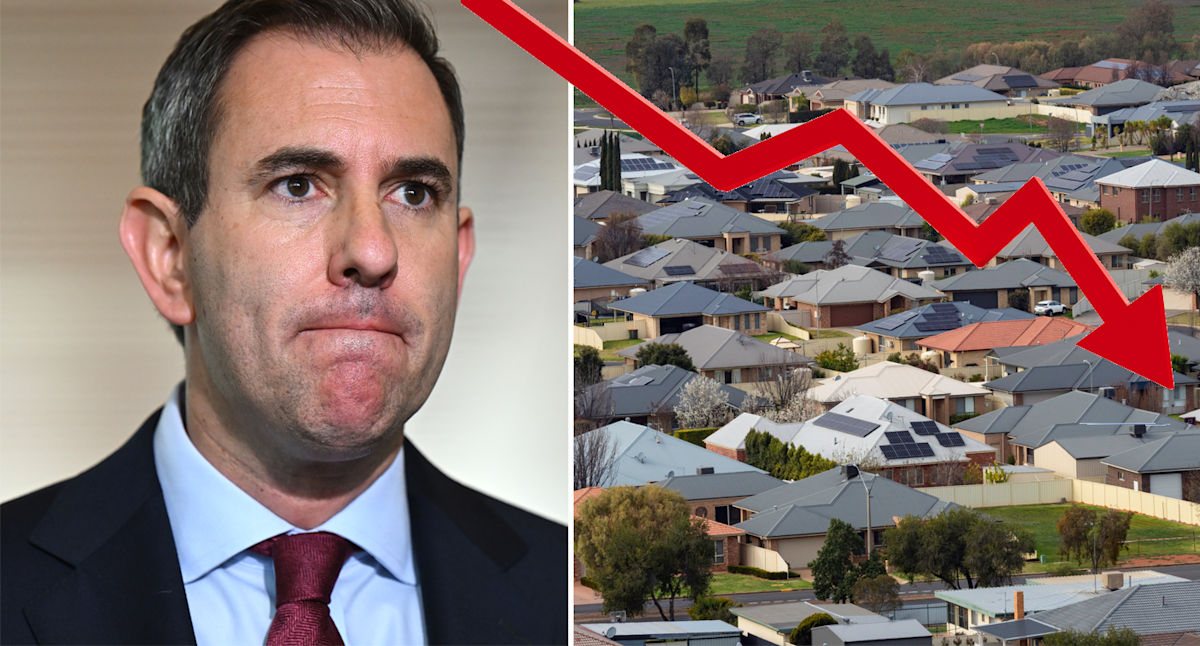
 It’s likely mum and dad investors will simply move funds into alternative asset classes. (Source: AAP/Getty)
Capital gains tax (CGT) reform is once again well and truly on the national policy agenda. And given the state of housing in Australia, some dangers are lurking beneath the proposed changes.
Moves to reduce or remove the CGT discount are often framed as a way to rebalance the system away from “wealthy investors” and toward aspiring homebuyers. At first glance, it sounds politically attractive to tax investors more while improving affordability and levelling the playing field.
But the real danger of blunt CGT reform is not that investors will suffer. It’s that renters will. It’s that supply will shrink. And it’s that long-term affordability may deteriorate rather than improve.
RELATED
The common belief assumes investors are the primary beneficiaries of the CGT discount. In reality, the discount was introduced in 1999 to encourage long-term investment and risk-taking. Property development, off-the-plan purchases, small-scale subdivision, and value-add renovations all rely on investors being willing to deploy capital with uncertain returns over multiple years. The discount rewards that long-term commitment. If the incentive is materially reduced, capital doesn’t just disappear; it relocates.
High-net-worth investors will simply move funds into alternative asset classes like equities, private credit, international markets, or commercial structures that offer better after-tax outcomes. Sophisticated investors have flexibility. Mum-and-dad investors, however, often do not. And therein lies the issue.
Australia’s rental market is overwhelmingly supported by small private investors. These are not institutional landlords operating at scale; they are families holding one or two properties as part of a long-term wealth-building strategy.
According to ATO data, the majority of property investors own just a single investment property. When tax settings change in a way that reduces long-term returns, these investors reassess their risk. And property, unlike shares, already carries significant barriers, including high entry costs, maintenance expenses, tenancy risk, and regulatory complexity.
RELATED: The number of properties each landlord owns, and how many are negatively geared
If the after-tax upside also adds to those barriers, the risk-reward equation starts looking less appealing to Mums and Dads. Some will hold, some will exit. But fewer will enter, and that’s the factor that matters most.
Housing affordability is not purely a demand issue. It is fundamentally a supply issue. Australia has been under-building relative to population growth for years. Construction costs remain high, planning systems are slow, and labour shortages have not improved. At a time when we need more private capital flowing into residential supply, whether through new builds, dual occupancies, small developments, or build-to-rent projects, weakening the after-tax incentive risks reducing that flow of new supply.
Developers rely on pre-sales. Pre-sales often rely on investors. Remove or dilute investor appetite, and projects will stall before they begin. When projects stall, supply tightens. When supply tightens in a high-migration, high-demand environment, rents rise.
We are already seeing the consequences of constrained supply. Vacancy rates in many capital cities have been sitting below 1 per cent. Rent growth has surged. Tenants are competing at inspections, which has created an ongoing rental crisis. If CGT reform reduces investor participation without simultaneously delivering large-scale institutional build-to-rent capacity, the short-term result is fewer rental properties available to tenants.
There is also a timing mismatch that policymakers often underestimate. Tax changes can be implemented quickly. Supply responses take years. A project conceived today may not be completed for 18 to 36 months. If investor sentiment cools sharply due to tax uncertainty, the development pipeline contracts long before any replacement supply is ready. This lag effect just compounds the problem.
Importantly, investors are not the same as speculators. Speculative activity typically occurs with the short-term flipping of properties. Long-term investors who hold property for 10, 15, or 20 years provide stability to the rental market. They absorb maintenance costs, periods of vacancy, interest rate volatility, and regulatory changes.
The CGT discount is only realised at exit, often decades later. If reform disproportionately penalises long-term holders rather than short-term speculators, the unintended consequence is to discourage precisely the type of patient capital the housing system requires.
 Policymakers could consider tapering discounts based on holding periods. (Source: Getty) · Getty Images
None of this is to argue that tax settings should never evolve. Policy must respond to economic conditions. But reform should be targeted and evidence-based. If the goal is affordability for first-home buyers, demand-side tax changes alone will not achieve it. History shows that when demand is suppressed without increasing supply, prices may stabilise temporarily, but the structural shortages remain.
If the goal is to reduce speculation, policymakers could consider tapering discounts based on holding periods, encouraging longer-term ownership rather than discouraging investment entirely. If the goal is to shift toward institutional rental models, then reforms must be combined with clear incentives and planning reform to enable that transition.
What should be avoided is a broad-brush approach that treats all investors as interchangeable and assumes higher taxation automatically equals better housing outcomes.
In an environment where affordability is already stretched and rental markets are tight, policy changes that risk reducing private capital participation must be approached with caution.
To genuinely address the housing crisis, governments must adopt a vision that extends beyond the electoral cycle. Housing supply cannot be solved within a single term, it requires coordinated infrastructure investment, planning reform and policy settings that unlock new land and deliberately increase density.
Across the country, we are operating in structurally undersupplied markets while population growth continues to accelerate.
The most cost-effective and economically rational response is to incentivise long-term private capital, invest heavily in enabling infrastructure, expand supply capacity, and commit to a sustained, long-term strategy. Anything less risks perpetuating the very affordability pressures policymakers are attempting to resolve.
Abdullah Nouh is the founder of Mecca Property Group and a Melbourne-based buyers’ advocate specialising in long-term, fundamentals-driven property strategy. He works with families and investors to build sustainable wealth through strategic residential and commercial acquisitions. Abdullah is currently completing a Master’s in Property at the University of Technology Sydney.
Get the latest Yahoo Finance news – follow us on Facebook, LinkedIn and Instagram.