
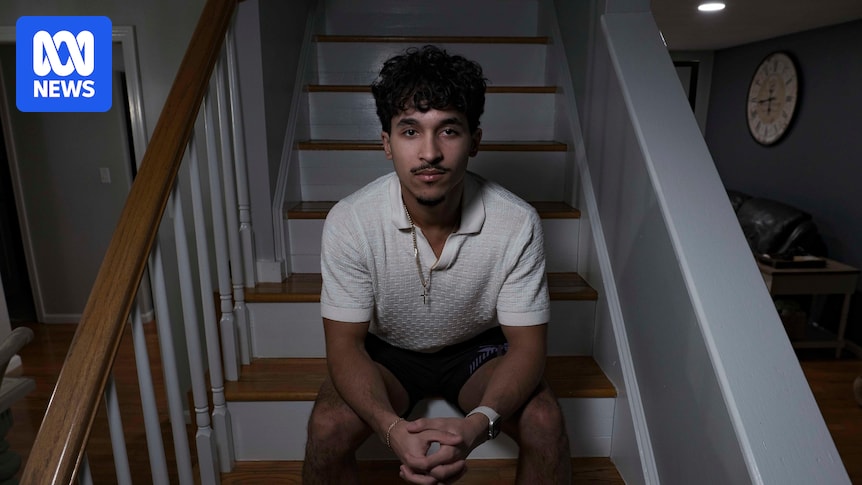
Marcelo Gomes da Silva had just picked up a teammate for volleyball practice on a drizzly Saturday morning last year when he realised he was being followed.
At first, he thought it was his friends playing a prank. In the small town of Milton, south of Boston, bumping into people happened regularly.
As he pulled into the driveway to pick up another teammate, three more cars drove up behind the first. Police lights started flashing.

Milton is a town south of Boston, Massachusetts. (ABC News: Rachel Clayton)
A man walked over and knocked on his window.
“I thought maybe I did something wrong, but I honestly had no clue,” Marcelo says.
“I feel like that’s one of the reasons I was really, really calm, is because I knew I didn’t do anything wrong. I was driving really slow and really respectfully.”
But the agents weren’t interested in his driving.
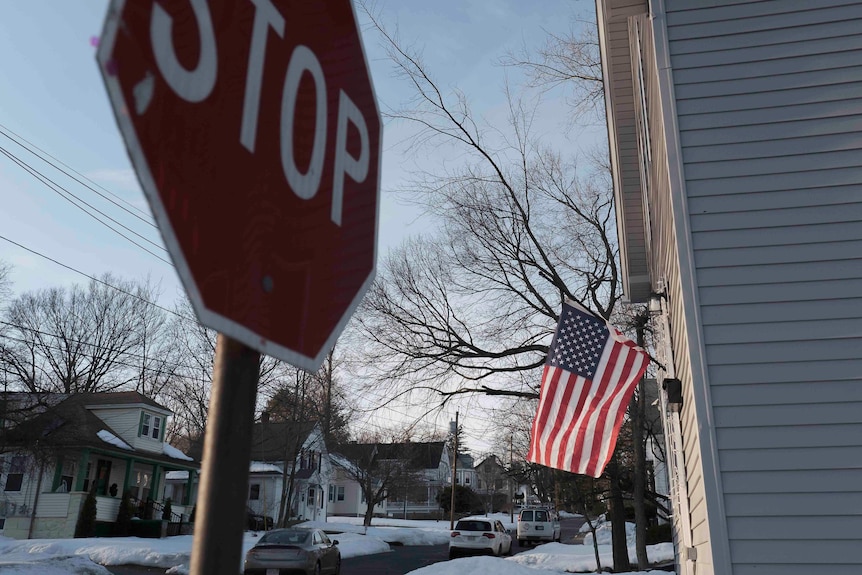
Marcelo was pulled over after picking up his friends for volleyball training. (ABC News: Rachel Clayton)
They wanted to know where he was from.
Marcelo is from Brazil, but had been living in the US since he was six, when he moved with his parents.
He had a student visa, but it had lapsed.
Marcelo was now caught up in an immigration crackdown that the Trump administration had long said was targeting violent criminals.
He says the agents told him, and everyone else in the car, not to touch their phones or they’d be arrested.
His friends were in tears as Marcelo, then 18 years old, was handcuffed and driven away.

Marcelo’s friends watched as he was handcuffed and taken into ICE custody. (ABC News: Rachel Clayton)
Locked up
Almost 70,000 people are being held in ICE detention in the US, according to data analysed by research organisation TRAC.
Like Marcelo, about three quarters of them have no criminal convictions.
In the past, many would have been granted “bond hearings” before immigration judges, then released while their cases were dealt with, immigration lawyers say.
But the Trump administration has reinterpreted the law to block detainees from routine bond hearings.
So lawyers have had to find a new strategy to stop immigrants being detained indefinitely while their matters are considered by courts.
In Marcelo’s case, his lawyer prepared a writ of “habeas corpus”, a legal mechanism enshrined in the US Constitution that forces DHS to justify someone’s detention.
“Petitioner has no criminal history anywhere in the world,” the writ said.
“He is a junior at Milford Public High school. His student visa status has lapsed, but Petitioner is eligible for and intends to apply for asylum.”
Lawyers are increasingly filing the writs to secure due process for their clients, immigration lawyer Caitlyn Burgess says.
But they have to move fast.

Caitlyn Burgess said the Trump administration was routinely ignoring court orders to release detainees. (ABC News: Rachel Clayton)
The writs must be filed in the court district where the detainee is located, and ICE is now routinely moving them interstate after their arrest, she says.
“So we have to file them as soon as we find out the person is detained,” Ms Burgess says.
“ICE would detain someone, and we wouldn’t be able to find them for three weeks in the system. [ICE] wouldn’t answer our emails, our calls.”
In Marcelo’s case, the writ was filed the day after Marcelo’s arrest.
But his ordeal was still some way from over.
Prayers in detention
The ICE agents who arrested Marcelo had driven him to Burlington, about an hour away on the other side of Boston.
His fingerprints were taken, and he was put in a small cell with about 30 other inmates.
He says he was denied a phone call to tell his parents what happened or to try and reach a lawyer.
“I always thought I was [going to get out] because I knew I didn’t do anything wrong,” he said.
“I prayed a lot and put my faith in God. Nothing was to do with me, God was my guidance.”
Meanwhile, Marcelo’s school community was coordinating a public pressure campaign demanding his release.
On the day Marcelo was due to graduate, scores of classmates marched to Milford’s town hall in their graduation robes.
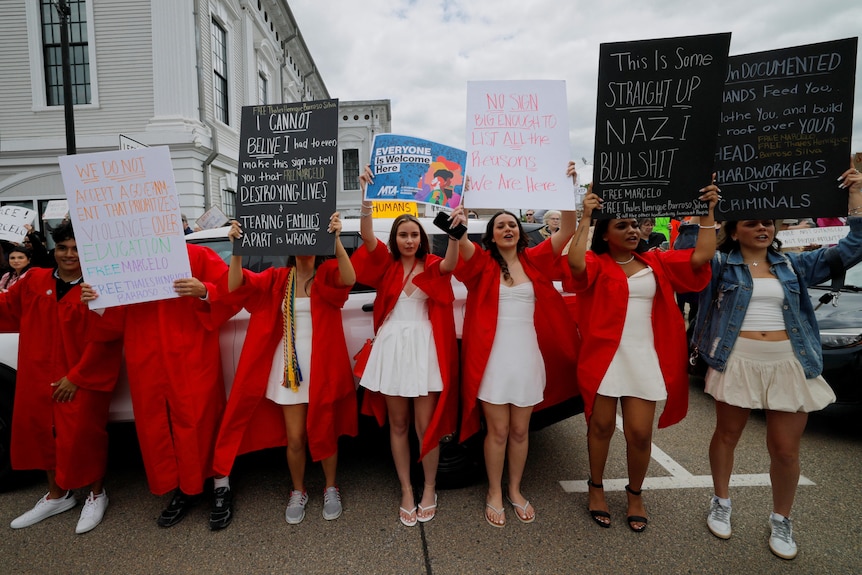
Marcelo’s schoolmates rallied outside the local town hall in their robes on their graduation day. (Reuters: Brian Snyder)
Teachers and community members joined them with placards calling for his freedom.
Inside the detention centre, Marcelo says a kind guard pulled him aside.
“He was like: ‘Hey, you’re like, really famous outside of the detention centre.’ And I was like, what is this guy talking about?”
DHS responded to the backlash with a tweet that said Marcelo had not been officers’ “intended” target.
They had wanted to arrest his father, who DHS accused of having a “habit of reckless driving”. They found and detained Marcelo instead.
Six days after his arrest, Marcelo was released.

Marcelo still thinks about the people he met inside detention, including one man who “took care of me the entire time”. (ABC News: Rachel Clayton)
Legal tactics
Immigration lawyers say habeas corpus writs, like the one used in Marcelo’s case, have become a valuable weapon in a broader fight to force the government to follow due process.
Caitlyn Burgess, a senior lawyer with MacMurray & Associates in Boston, rarely used them in the past. Now she files four to five a day.
But the government is not always following court orders to release detained migrants.
“There’s no accountability with this administration,” Ms Burgess told the ABC.
“Due process is being completely eroded.”
A Reuters investigation last month found US judges had ruled more than 4,400 times since October that ICE had detained immigrants unlawfully.

Marcelo had built a life in the US after arriving as a child. (ABC News: Rachel Clayton)
Some were scathing in their findings.
In January, Minnesota’s chief federal judge said his “court has had to threaten contempt — again and again and again — to force the United States government to comply with court orders”.
The same month, a Florida judge said the government appeared to “deliberately mislead the court” over the detention of a Venezuelan teenager who had been in the US since childhood.
The student had a pending asylum claim, permission to work in the US and no criminal record.
The judge ruled immigration officials had relied on the wrong law to detain him for days without charges or a hearing.
“In this country, we don’t enforce the law by breaking the law,” Judge Roy Dalton Jr wrote.
DHS did not respond to the ABC’s questions.
But the department has argued that the government is enforcing the law “as it was actually written” rather than how it was enforced in the past.
And government lawyers have told courts that detention is necessary to prevent detainees from fleeing. They describe it as an administrative measure — not a form of punishment.
It was “no surprise that more habeas petitions are being filed by illegal aliens”, DHS spokeswoman Tricia McLaughlin told Politico recently. “Especially after many activist judges have attempted to thwart President Trump from fulfilling the American people’s mandate for mass deportations.”
A parting gift
Marcelo still thinks about the people he met in detention.
“They were all really nice people,” he says.
Many were dressed in work clothes and boots.
“They really just took a bunch of workers and brought them to the detention centre.”
He says one man “just took care of me the entire time”.
“He treated me like I was his kid.”
Right before the two were separated into different cells, the man ripped a piece of tin foil from the emergency blankets the detainees were given to stay warm at night.
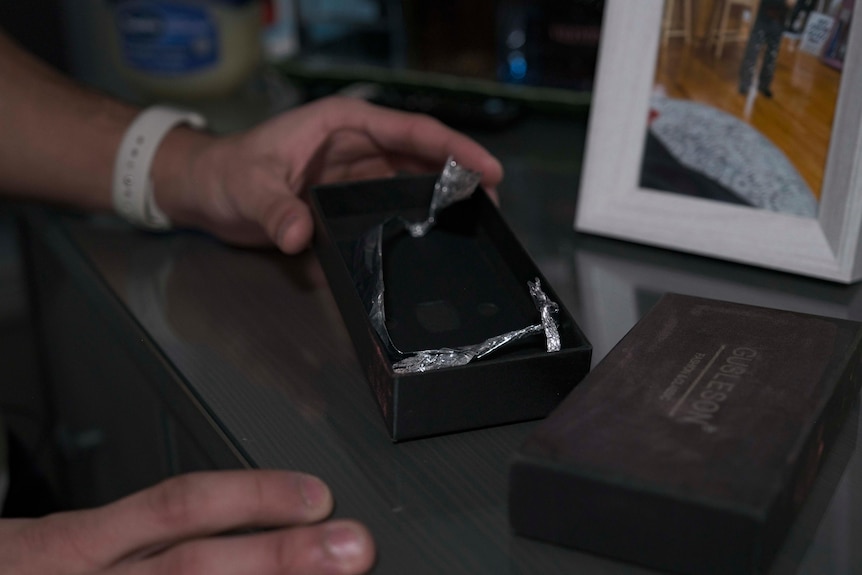
A fellow detainee gifted Marcelo a bracelet made from part of a foil blanket. (ABC News: Rachel Clayton)
He folded it carefully into a bracelet and wrapped it around Marcelo’s wrist.
“He said: ‘Here take this, take care of it, because I know that I’m going to go to a different cell, I might not see you again. This is just for you to remember me.'”
Marcelo doesn’t know what happened to him, or the other people he met in detention.
But he says he is now working with members of Congress to help craft a law he hopes will protect other migrants from being swept up without due process.
“It’s not something I wanted to happen,” he said. “But I see beauty in everything because I believe in God.”
He was brought to Donald Trump’s State of the Union address last month as a guest of Democratic congressman Seth Moulton.
But he left for his own safety before the speech finished after DHS posted that night on X that Marcelo was “an illegal alien who has no right to be in our nation”.
Marcelo’s application for asylum is pending.