
The Athletic has live coverage of Arsenal vs. Everton.
There is no doubt that the Ekstraklasa — the highest division of Polish football — is the most competitive top flight in European football. There is now a compelling argument that this league season is the craziest ever.
With less than a third of the 34-game Ekstraklasa season remaining, all 18 clubs can mathematically either win the title or be relegated. Across the division, there are storylines that defy logic.
Zaglebie — who begun this weekend as league leaders — are from tiny Lubin, whose 70,000 inhabitants ranks it outside the top 50 largest cities in Poland by population. Zaglebie finished 15th last season, just one place above the relegation zone.
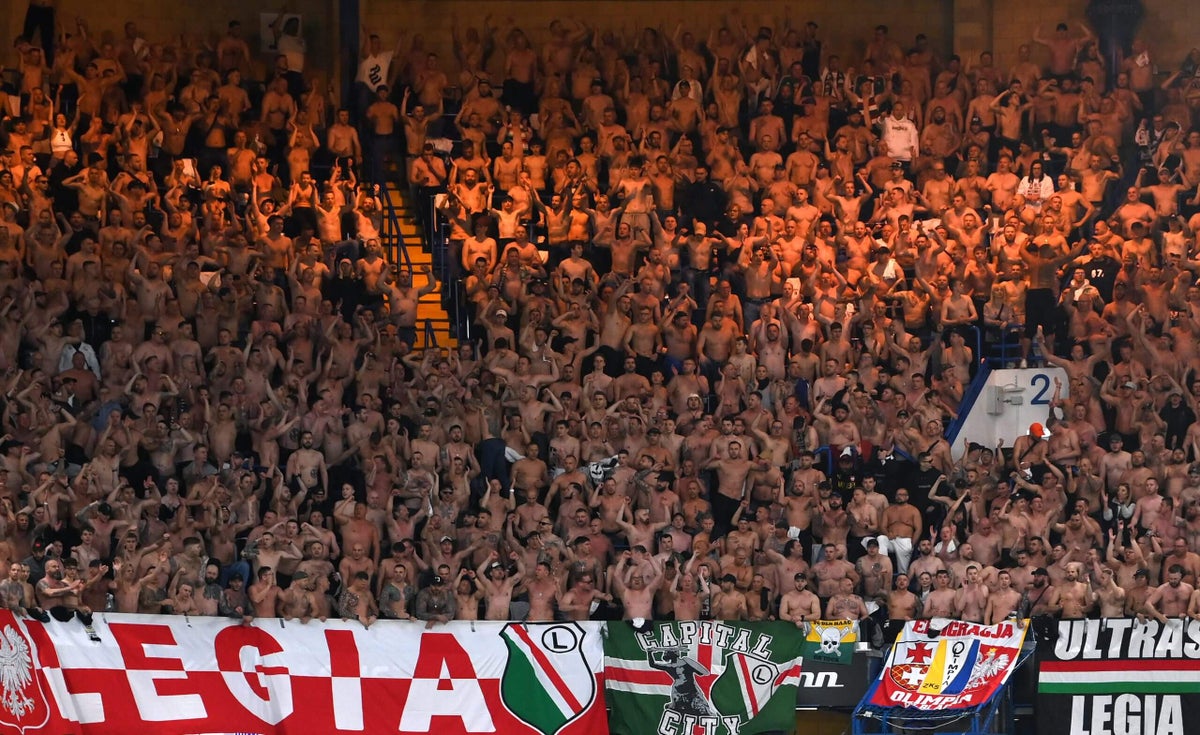
Legia Warsaw, the nation’s biggest and most successful club, are in the relegation zone. Last season, they reached the Conference League quarter-final stage: eliminated by Chelsea, who they defeated at Stamford Bridge. Less than a decade ago, 15-time Poland champions Legia were in the Champions League group stage.
This season, big-spending Widzew Lodz have signed the three most expensive players in Ekstraklasa history, according to Transfermarkt, including Ghana international Osman Bukari from Austin FC for a reported €5.5million ($6.4m). Widzew, like Legia, are in the relegation zone.
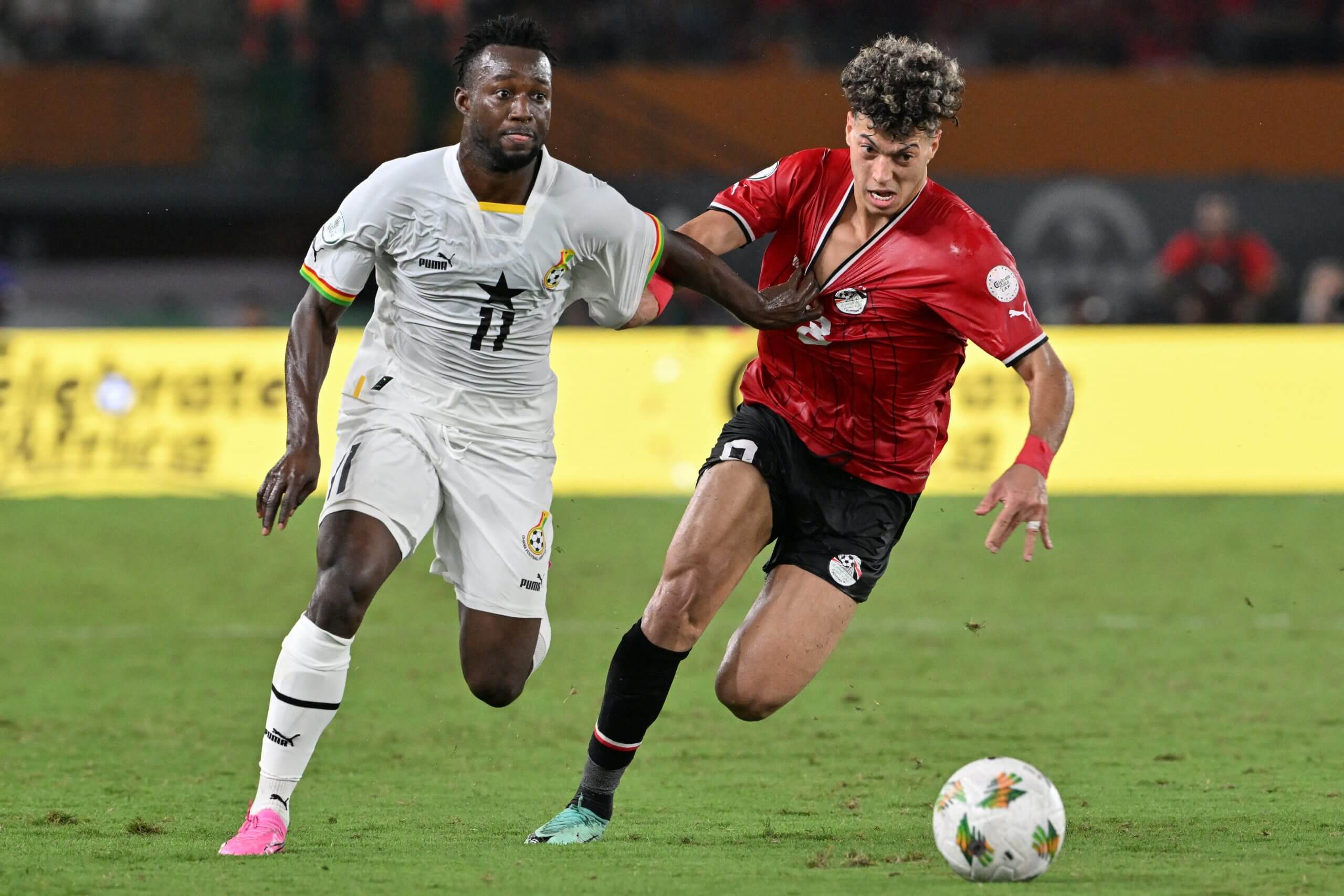
Ghana international Osman Bukari, who joined Widzew Lodz this season, is one of the most expensive signings in Polish football history (Issouf Sanogo AFP via Getty Images)
At the midway stage of the league, Wisla Plock were top of the Ekstraklasa. After five successive defeats, they are now eighth and just three points above the relegation zone.
Then there is the case of Cracovia, who were seventh in the table after 22 matches. The Krakow-based club lost their next two matches — but, due to results elsewhere, moved up one place to sixth.
Polish football’s chaos extends beyond the division. Wisla Krakow and Ruch Chorzow have 27 league titles between them but are in 1 Liga, Poland’s second tier. Polonia Warsaw and Slask Wroclaw, who have both also won the top division this century, are also in the second division.
The quarter-finals of this season’s Polish Cup, meanwhile, had two clubs from the third division and one club from the fourth.
Between 2019 and 2024, Poland had three first-time league champions: Piast Gliwice, Rakow Czestochowa and Jagiellonia Bialystok.
What makes Polish football uniquely unpredictable? And is this good for its game?
‘Smart clubs beat rich clubs’
Football is Poland’s most popular sport and the national side frequently qualifies for major international tournaments. Poland has a population of 37.9 million and many of its citizens are urban-based, with 23 Polish cities having over 150,000 inhabitants. Such an urbanised society provides conditions for a strong framework of football clubs, which helps explain why Poland has had a notable 20 different title-winning clubs and nine since 2000.
“We never had proper, textbook oligarchs in Poland, contrary to many post-communist countries,” Pawel Wilkowicz, a Polish football journalist from Sport.pl, tells The Athletic. “In football, we did not have a hegemony like elsewhere: look at Shakhtar Donestk (Ukraine), Steaua Bucharest (Romania), Dinamo Zagreb (Croatia), Crvena Zvezda (Serbia) or Ludogorets (Bulgaria), who all dominated their leagues. In the early 2000s, Wisla had a great side and then in the 2010s, Legia were very powerful.
“But in the past decade, smart clubs regularly beat rich clubs. Patience and vision beat money. Outsmarting opponents is more important than outspending them. Wisla are in the second division, Legia and Widzew are in the relegation zone despite both breaking transfer records. The gaps between clubs’ wage bills exist, not as large as in other leagues, but this is not how to measure Polish football.”
Piotr Kozminski, a freelance football reporter who has worked for UEFA, European football’s governing body, believes an influx of investment may change the landscape of Polish football. A year ago, Polish real estate entrepreneur Robert Dobrzycki became the owner of Widzew. Despite currently being in the Ekstraklasa relegation zone, the club broke multiple Polish transfer records in January. “If they survive, they will be very dangerous next season,” says Kozminski.
‘Legia relegation unthinkable’
Legia are the most popular and successful club in Polish football with 43 trophies, including 15 league titles. Having previously been the club of Poland’s army — their home ground is the Polish Army Stadium — they are the only club to have never been relegated from Poland’s top league since the Second World War. This season, that may change.
Jakub Balcerski of sport.pl believes the club’s possible relegation is “unthinkable”, and he compares the scenario to Juventus, Bayern Munich or Paris Saint-Germain going down in their respective leagues. “It would be cheered by so many neutrals. You either support Legia or hate them. They are always the biggest topic on TV.”
Legia are the best-represented club in Poland’s national team, with four players included in recent squads. There is no guarantee, however, of instant promotion should they go down. Wisla, the 13-time Polish champions, were relegated in 2022 and are now in their fourth season in the second tier.
Who would be a popular league winner?
There are 12 teams within 10 points of league leaders Zaglebie (41 points), but Jagiellonia, Lech (both 38), Rakow (37) and Gornik Zabrze (35) are in the leading group.
“There is no neutral fan favourite,” says Pawel Wilkowicz. “Jagiellonia are admired for their football and smart way of running the club. Lech can be spectacular in attack and fun to watch. Rakow is more respected than loved.
“Zaglebie have their fanbase mostly in Lubin and are owned by mining giant KGHM. In Poland, they are a bit like Wolfsburg (the Bundesliga club that was a multi-sports club for Volkswagen workers in Germany). Zaglebie’s coach is a self-made man, Leszek Ojrzynski. He has clear principles, is old-school in his approach, and not very keen on possession! But he is clever and combative.”
Clubs make their mark in Europe
Polish football may be ultra-competitive, but there are signs that the strength of the league has improved at the same time.
Going into this week’s European matches, Poland was sixth in UEFA’s co-efficient table for the season, above France. This was explained by Poland’s four representative clubs — Rakow Czestochowa, Jagiellonia, Lech and Legia — racking up 17 wins in the pre-league qualifiers and 11 victories in the Conference League league phase.
Rakow, currently fourth in the Ekstraklasa, were unbeaten in the group stage and finished second, while Lech finished 11th and also reached the knockout phase.
“The Conference League gave Polish clubs life,” says Piotr Kozminski. “Teams were not strong enough for the top two tournaments, but the expansion was perfect for leagues like this.”
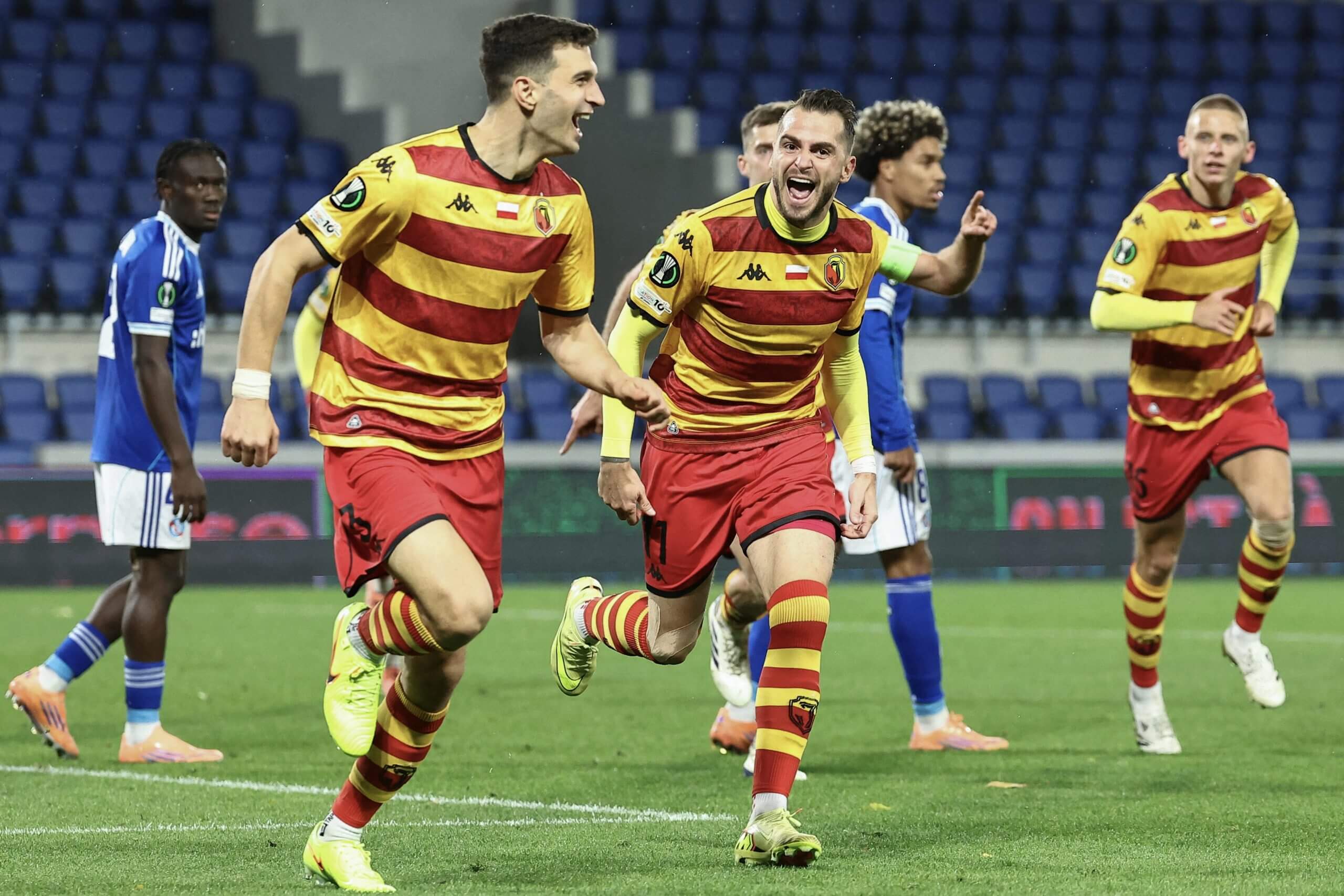
Jagiellonia Bialystok’s players celebrate a goal against Strasbourg in the UEFA Conference League (Frederick Florin/AFP via Getty Images)
‘Polish football is finally en vogue’
Measuring the strength and growth of leagues generally monitors trends of performance in continental competitions, expenditure of clubs, the attendances at matches and the infrastructure.
Every stadium across the Ekstraklasa has either been built, rebuilt or undergone extensive renovations this century. Much of this coincided with the nation co-hosting the European Championship with Ukraine in 2012, but continued investment in stadiums and infrastructure has continued in the 14 years since.
Poland now has 23 football stadiums with a capacity upwards of 15,000, helping create an affordable and accessible environment for fans. This season, the Ekstraklasa has recorded an average attendance of 13,000 per game — 117,000 per matchday. In 2014-15, when there were two fewer top-division clubs, there were just 66,000 fans across the Ekstraklasa on an average matchday. Figures have jumped almost 60 per cent in the last decade.
When current attendances are extended to include the second division, boosted by the presence of big-hitters Wisla, Slask and Ruch, the number of match-going fans per weekend surpasses 165,000.
“The European runs have helped change feelings toward domestic football,” Pawel Wilkowicz explains. “It is en vogue to go to Ekstraklasa games. Polish music and cinema have exploded in recent years, now we believe football may follow this path.
“Clubs are now able to sell players for good prices, they are encouraged to develop players for profit, and they have their own contract network. There is no longer a need to sell to Legia, Lech or Wisla. Pogon Szczecin and Wisla Plock are perfect examples of clubs who have been operating smartly in the market in recent years. Clubs are becoming profitable and sustainable.”
Hooliganism: ‘More stereotype than truth’
Across the 2023-24 and 2024-25 seasons, Legia were fined by UEFA after 17 of their 30 continental ties, with the running total for their transgressions costing the club €464,250 (£396,000/$524,000).
Most were due to the behaviour of Legia’s fans. The largest of those penalties — €100,000 — followed a night of extreme violence when playing at Aston Villa in November 2023.
In 2016, Legia was ordered to play Real Madrid behind closed doors in the Champions League after crowd disturbances and racist chanting during a 6-0 loss at home to Borussia Dortmund.
Hooliganism has been a serious issue in Polish football but disorder is generally considered rare at games in the Ekstraklasa, with Ultra groups instead more prominent during continental fixtures.
“The issue is more stereotype than truth,” says Piotr Kozminski. “Statistics say that Polish stadiums are safe and almost free of hooliganism, there are no fights here. It was a problem in the past but not now.
“It is the same with racism, which is one of the ugliest things in the world. Poland does not have a problem with this, no more than any other nation does. This makes me proud of my country.”
Nobody can predict which club will win this season’s Ekstraklasa, or which teams will be relegated, or qualify for Europe. Poland’s top flight is unlike any other — every game matters.