
The latest wellness craze to take social media by storm is fuelling a growing grey market of injectable peptides in Australia, and it has experts worried.
Promises of tanned youthful skin, weight loss and bigger muscles are luring social media users to dabble with unregulated substances that are not approved for human use.
Tasmanian general practitioner Tim Jones is one doctor who has seen an uptick in the number of people using unregulated peptides.
“We’re hearing from our patients more and more that this is something they are accessing,” he said.
What’s the point of peptides? We want to hear your stories
Dr Jones is the Child and Young Persons’ Health Chair at the Royal Australian College of GPs, and he is also concerned about teenagers using unregulated peptides.
“We’re seeing children as young as 14 reporting that they’ve been accessing these products online,” he said.
“One of the scariest things for us is that we just don’t know and in the developing body, like a young person, in the growing mind, we have no idea what the consequences of these products could be.”
What are peptides?
Peptides are short chains of amino acids that make up proteins in our bodies.
“Peptides are the very fundamental building blocks of the human body. They act as signals to the body to tell it what to do,” Dr Jones said.
There are a number of peptide-based medicines that are approved by the Therapeutic Goods Administration (TGA), the peak body responsible for medicines regulation in Australia.
They must be prescribed by a doctor and be taken under the care of a doctor. A couple of the most recognisable examples of regulated peptides are GLP-1 medications like Ozempic, as well as Insulin.
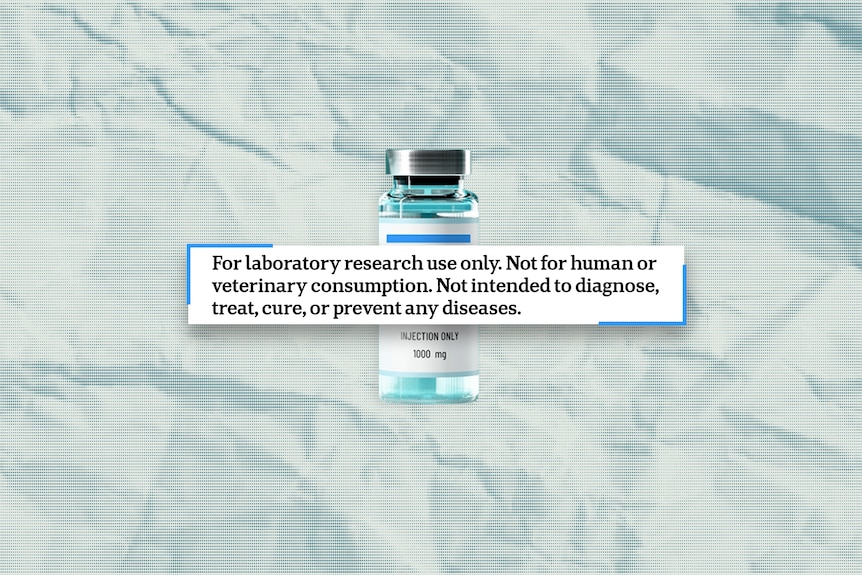
Some online websites that have unregulated peptides on sale have labels saying “not for human” use. (ABC News)
However, there are a number of unregulated peptides that are not approved for human use being sold online — and these are the ones behind the online peptide trend.
Social media users are creating content about the benefits of these peptides and how to buy and use them.
The craze has gone viral as influencers and beauty and wellness enthusiasts boast about enhancing their health and looks.
The main peptides circulating on social media are a GLP-1 style peptide promoting weight loss, copper peptides used in the hope of achieving younger-looking skin, a tanning peptide aimed at achieving darker skin and peptides aimed at faster muscle growth and recovery.
How are people accessing them?
With just one click, anyone on social media can add peptides to their shopping cart.
Some websites selling the unregulated substances include a disclaimer stating the peptides are “for laboratory research use only. Not for human or veterinary consumption [and] not intended to diagnose, treat, cure, or prevent any diseases”.
Despite these warnings, unregulated peptides are still sold without oversight.
More than 10 years ago, Nicholas Weir decided to use peptides after hearing about them from friends and acquaintances at the gym.

A wellness trend on social media that shows influencers using unregulated peptides is causing concern among health experts. (ABC News)
Mr Weir said he used a peptide to heal a partial dislocation in his shoulder so he could continue to compete in powerlifting.
But he is worried by the increasing popularity of peptides online and is urging others who are considering using them to be very cautious.
“I think sometimes the individuals making this content mean well, but a lot of the time, they don’t realise they’re probably doing a disservice to a lot of people and it can be quite dangerous spreading that information,” he said.

Nicholas Weir says the lack of awareness from influencers promoting injectable peptides can be “dangerous”. (ABC News: Tobias Loftus)
Mr Weir said promoting injectable peptides could be “dangerous, deleterious and detrimental”.
Stephen Lu is a GP and Chief Medical Officer of Everlab, a clinic specialising in health optimisation.
He said there had been a definite increase in the level of interest in peptides recently.
“This time last year I might get asked about this once a week. And these days I can’t get through a day without someone bringing it up,” Dr Lu said.

Steven Lu says he has noticed an increase in questions from patients about peptides. (ABC News Breakfast)
Dr Lu said it was natural for people to want to optimise their health, but unregulated peptides were a risky way to approach it.
“It’s like a trendy, quick fix with very little evidence,” he said.
“I’m quite worried about kids, especially teenagers. I had a patient who asked me about peptides for her son because her 16-year-old had seen something on social media, and she was like, is this safe?”
He said it was important that people either using peptides or considering using them felt comfortable talking with health and medical professionals about it.
“I really welcome these opportunities to chat to make sure that we’re not being judgmental but actually hearing them out,” he said.
‘Not enough data’
Timothy Piatkowski is a senior research fellow at the University of Queensland and researches the harms of some peptides.
One of the reasons many of these peptides are not approved for human use is that there is not enough evidence of their safety.
Dr Piatkowski said more data across a large variety of substances was required.

Timothy Piatkowski says there is not enough evidence of safety for many of these peptides. (ABC News: Lucas Hill)
“The problem here is we don’t have enough training for human clinical trials with a big enough sample size across a long time,” he said.
“We have a lot of people promoting these products without having full knowledge of the implications.”
Potential contaminants
The other safety issue is whether peptides contain what they say they do or whether they might contain potential contaminants.
Alison Craven runs a company that provides at-home testing kits for steroids and peptides. These tests are not approved by the TGA.
“We know from our research on anabolic steroids in Australia that there’s heavy metals, there’s residual chemicals left over from the manufacturer and there’s a lot of nasty stuff in there that’s never really been researched thoroughly, and we expect peptides to be exactly the same,” she said.
“Unfortunately, [with peptides] being a black-market product, most people don’t know what’s actually in what they’re buying.
“I think there’s not enough research done on the contaminants in them.”
In a statement, the TGA said:
“Unapproved peptides have not been assessed by the TGA for safety, quality or efficacy. Further to the uncertainty over safety, quality or efficacy, products purchased from online sources may be contaminated, mislabelled or unsafe.”