
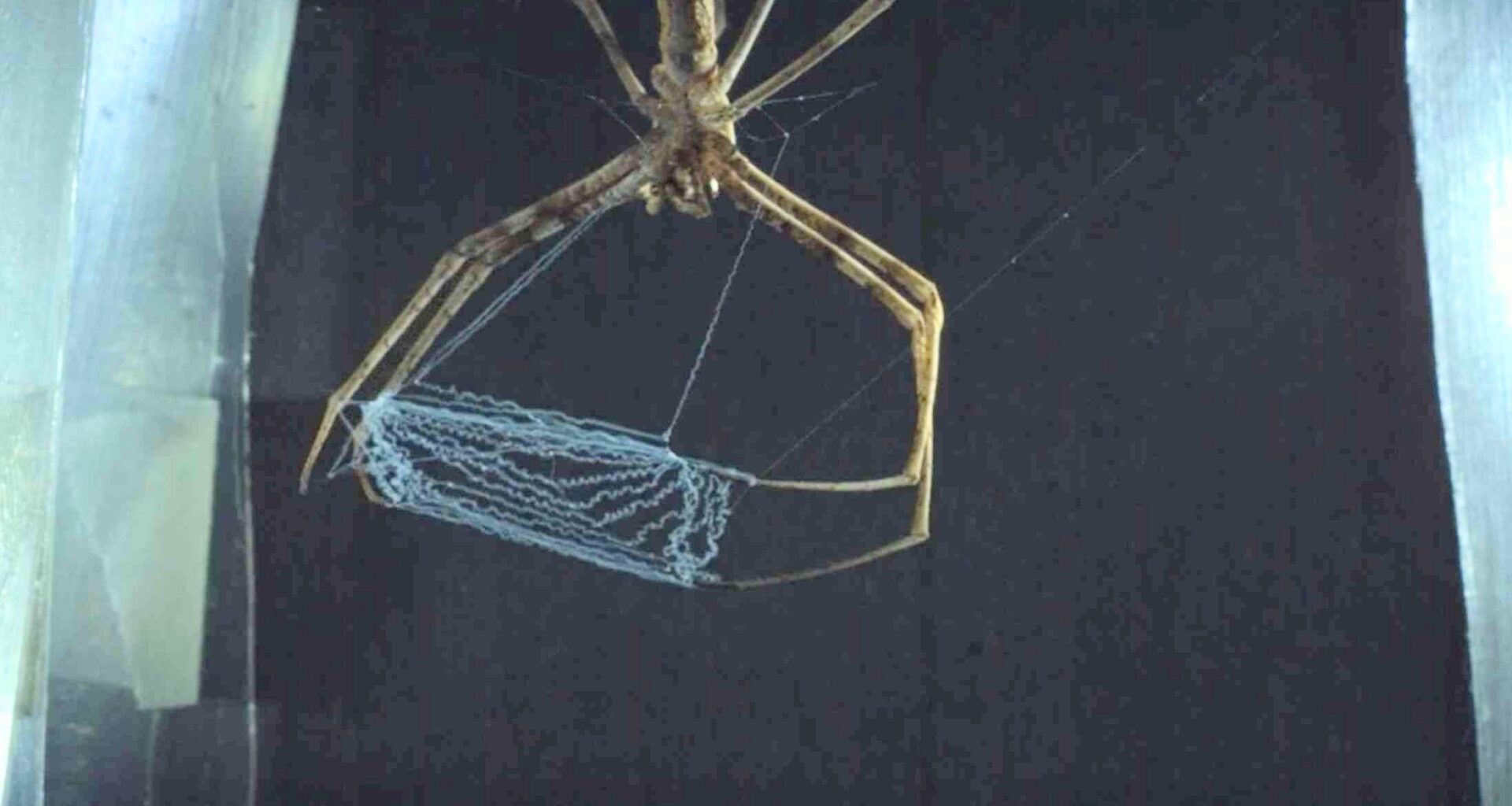
Researchers have found that an Australian net-casting spider builds a hunting web that stretches far beyond ordinary spider silk and then snaps back without tearing.
That unusual elasticity allows the spider to launch a handheld net at prey and still pull the trap tight without the silk breaking.
Silk with extreme strength

During a nocturnal strike, the rufous net-casting spider drops and its small capture web suddenly expands before recoiling into shape.
By examining those movements, Dr. Jonas O. Wolff at the University of Greifswald linked the violent stretch and recovery to a previously undocumented design in the silk itself.
Central lines in the net can lengthen by roughly 150 percent during the attack and still return to their original form.
That unusual performance raises a deeper question about how the silk manages both extreme stretch and the strength needed to restrain captured prey.
A flexible winding structure
Under a scanning electron microscope, a machine that images surfaces with electrons, the silk showed a soft core wrapped in looped bundles.
As the net stretched, those loops straightened first, so the thread began soft and then resisted harder pulling.
“We found that the prey-catching silk has a flexible, wool-like, winding structure that allows the spider to cast the net rapidly,” said Dr. Wolff, research group leader at the University of Greifswald and honorary research fellow at Macquarie University.
That arrangement solved the spider’s immediate problem: the web had to open fast without turning into a weak, sagging trap.
Legs that shape silk
During construction, the spider did not simply lay silk down, but reeled and re-reeled certain lines with its hind legs.
Each pass pulled thread through the spinnerets, silk-spinning organs near the abdomen tip, while extra fibers folded into loops.
More reeling cycles built more hidden length, so some parts became far stretchier than lines meant to carry the spider’s weight.
Because the animal tuned silk while spinning it, the material’s behavior depended on construction as much as chemistry.
Different lines, different jobs
Across the small hunting net, not every line did the same job or faced the same forces.
Upper and frame lines stayed stiffer, while lower spokes started soft because those were the sections that stretched most.
In the strike itself, the central web area expanded eight to 24 times in just 70 to 126 milliseconds.
That built-in gradient kept the whole system moving as one piece instead of ripping apart under uneven pulling.
Silk that snaps back
Most materials pay a price for flexibility, because soft fibers usually tear sooner when heavy loads arrive.
Here, the opposite sequence appeared: the silk started easy to pull, then stiffened as the loops uncurled and shared the force.
“No normal spider silk can extend that far yet still return to its original form,” said Dr. Martín J. Ramírez, arachnologist at the Argentine Museum of Natural Sciences in Buenos Aires (CONICET) and co-author of the study.
The combination stayed rare because materials that deform easily usually do not recover their shape and keep carrying weight.
Prey creates stress
Once an insect hits, the web faces a second test after the throw, stopping escape without tearing during retrieval.
Repeated loading showed strong viscoelasticity, meaning the silk dissipated energy and relaxed under tension instead of jerking apart.
Even after repeated stretches of 150 percent, elasticity held up better than the web’s load-bearing capacity.
That trade-off matters in real hunting, because a reusable net must survive several violent expansions across a single night.
Materials beyond spiders
Engineers have long wanted fibers that bend easily at first and then resist failure when loads rise.
By fastening stiff microfibers to a soft base, the spider achieved that sequence through structure rather than exotic ingredients.
Possible uses include surgical sutures, artificial ligaments, impact-absorbing textiles, and lightweight parts that need some give before they hold.
Any translation to factories remains early, but the design rule is simple enough to tempt materials researchers.
Why the hunt matters
Net-casting spiders do not wait inside a fixed trap, but hold the net between their front legs.
At night, huge eyes help them judge distance, and that hunting style makes rapid web motion part of survival.
A static orb web can spread force across many anchors, but the net-casting spider must manage the stretch in midair.
That ecological pressure helps explain why this silk system evolved in a spider that throws its web.
From web building to material design
A 0.002-inch close-up of the silk made the structure hard to ignore even outside spider research.
That image won the Royal Society Publishing Photography Competition in 2025, giving the hidden loops a wider audience.
Even so, Wolff and colleagues still need clearer answers on how different silk glands and repeated use alter performance.
Those details will decide whether engineers copy a neat idea or a reliable manufacturing rule.
What this spider does with its legs changes the silk before the hunt begins, turning web building into material design.
Future tests will show how far that design can travel from a Sydney bush web to human-made fiber.
The study is published in the journal Proceedings of the National Academy of Sciences.
—–
Like what you read? Subscribe to our newsletter for engaging articles, exclusive content, and the latest updates.
Check us out on EarthSnap, a free app brought to you by Eric Ralls and Earth.com.
—–