
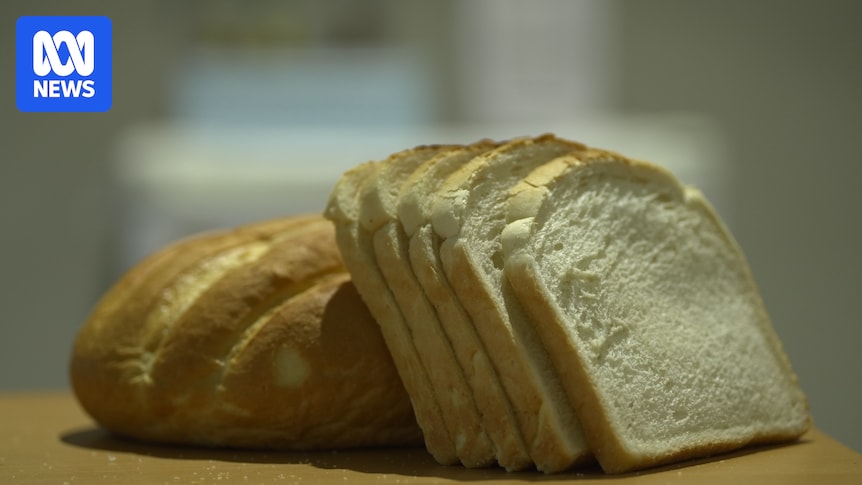
For decades health authorities have been advising to eat less white bread because of its low fibre content.
Now, should you wish, you can eat your fill.
And be healthier for it.
It’s possible because of a type of flour derived from a new wheat variety that contains considerably higher fibre levels.
High-amylose wheat, largely developed by the CSIRO, has taken 20 years to get here.
“We’ve changed the composition of the starch in the grain so that we’ve increased the fibre content in the flour that’s produced by about six-fold,” CSIRO plant scientist Crispin Howitt said.
Eating white bread guilt-free
Crucially, this beneficial fibre, known as resistant starch, is undetectable in flour-based baked goods such as white bread, pasta, pizza bases and tortillas.
“The goods that it’s baked into are then naturally higher in fibre without any compromise on taste or texture,” flour miller Joel Tazzyman said.
Mr Tazzyman oversees milling operations at Allied Pinnacle’s Kensington Flour Mill in inner Melbourne.
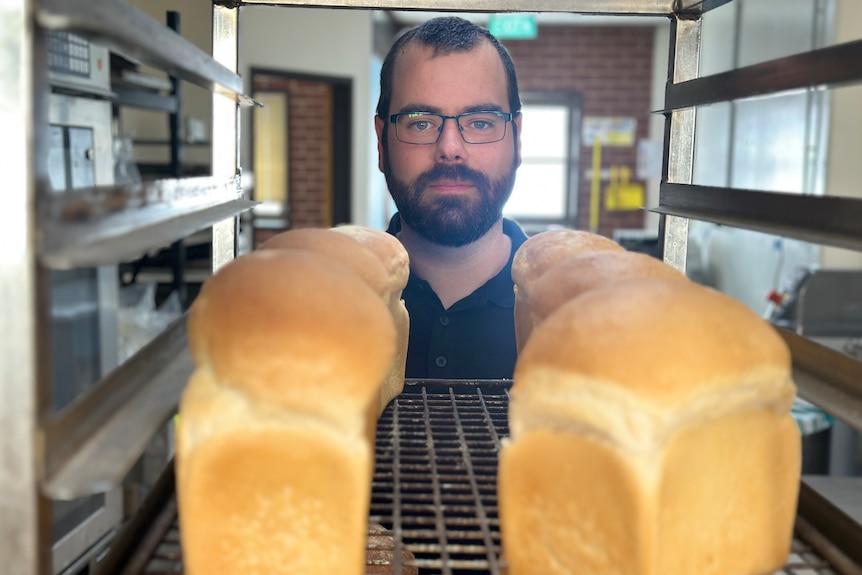
Joel Tazzyman displays some freshly baked loaves made from high-amylose flour. (ABC Landline: Tim Lee)
In 2023 the company, one of Australia’s largest producers of flour for baked goods, signed an exclusive deal with Woolworths to use and market high-amylose wheat flour.
Under the brand name “Wise Wheat”, it’s now widely used in the supermarket’s in-store bakeries and sold in distinctively labelled packaging.
Allied Pinnacle is now gearing up to meet rapidly growing demand.
“The demand is there and we expect to see it in a lot of other products across a variety of different ranges and different consumer offerings,” Manjiv Fernando of Allied Pinnacle said.
Manjiv Fernando says demand for Wise Wheat flour is growing rapidly. (ABC Landline: Tim Lee)
To reach this stage, the grain growers selected to grow high-amylose wheat needed to know it would yield well enough to be profitable.
Meanwhile, Allied Pinnacle needed to know if there was sufficient demand for Woolworth’s new high-fibre products to justify expanding its milling program.
With those questions answered, production is set to increase.
Producing high-amylose wheat
Grain grower Jock Binnie from Mt Bruno in north-east Victoria is thrilled to be among the handful of growers supplying high-amylose wheat.
“Our end product normally goes out in the truck and you’re never really sure where it’s really going. Having something that’s sort of uniquely come from here is pretty special, I think,” Mr Binnie said.
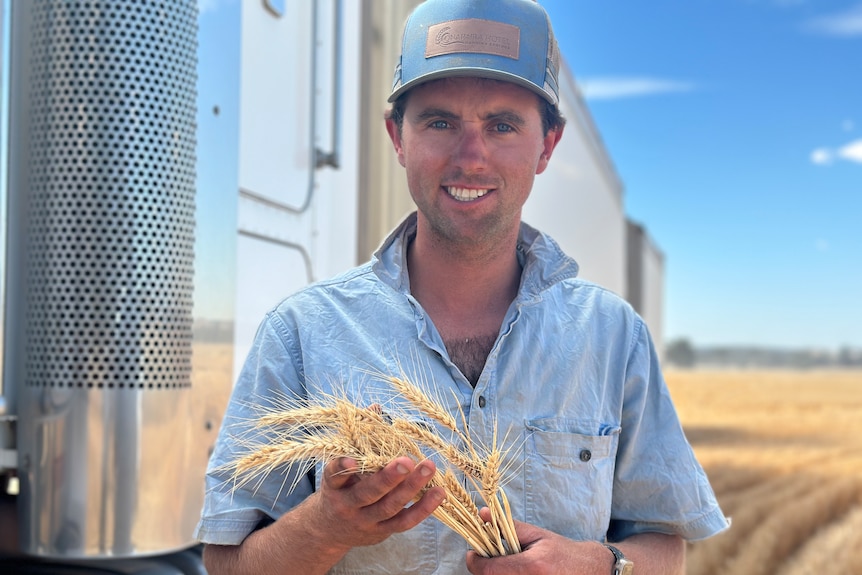
Jock Binnie says it’s rewarding to grow a beneficial food crop. (ABC Landline: Tim Lee)
Jimmy Nixon, who grows grain near Oaklands in New South Wales, agrees.
“I can just walk into the supermarket and pick up the loaf of bread and go, ‘well, I had something to do with that’ and that’s quite exciting. I’ve been promoting it and eating it also!” Mr Nixon said.
But the potential health benefits of high-amylose wheat go beyond Australia.
The western diet followed by about a third of the world’s population is based on white bread, pasta, pizza and tortillas.
“The idea behind high-amylose wheat is if we can’t change the diet can we actually change the composition of what people normally eat, so they get the benefits of high fibre in the foods that they eat every day and love,” Dr Howitt said.
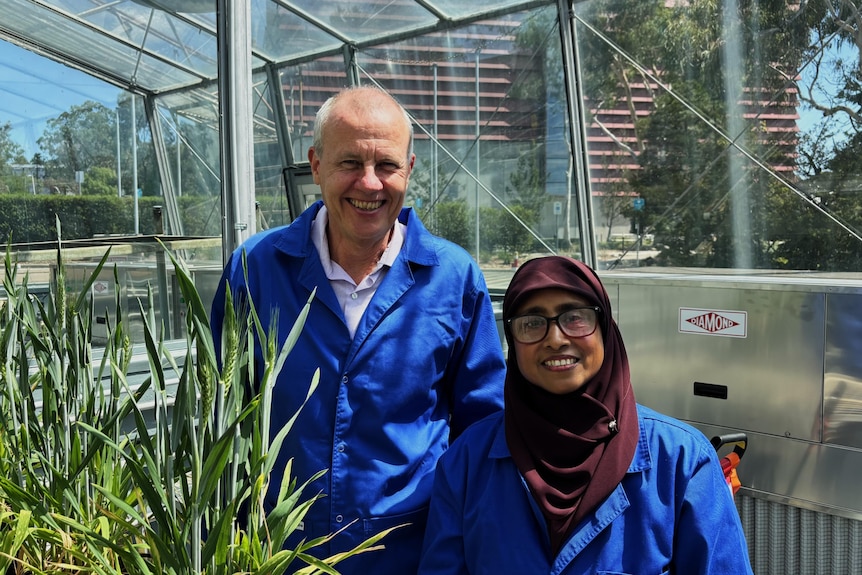
Dr Crispin Howitt and Dr Regina have spent more than 20 years on the wheat’s development. (ABC Landline: Kath Sullivan)
CSIRO plant breeders began collaborating with international scientists more than two decades ago to create a high-fibre wheat variety.
They screened countless wheat varieties for thousands of traits, honing in on amylose, a type of polymer found in starch.
“Because amylose is the component that is not readily digested, by increasing the amylose [in the wheat] we can increase the fibre through the level of resistant starch,” Dr Regina said.
Potential health benefits
Dr Regina, a former CSIRO principal research scientist, was the head of a team that created the new high-fibre produce from concept to commercialisation.
She said resistant starch was known to improve digestive and bowel health because it avoided digestion in the stomach and the small intestine.
As it travels to the end of the large intestine to feed good bacteria, it releases glucose more slowly into the bloodstream.
“The lower glycaemic index or GI of high-amylose wheat products can help reduce the impact of type 2 diabetes”, said Dr Howitt.
“About $2 billion a year is spent on just medication and medical costs for type 2 diabetes, and it’s estimated that 58 per cent of people with type 2 cases could be prevented with lifestyle rectification,” Dr Howitt said.
He said this grain also helped protect from colorectal or bowel cancer, which claims 5,000 Australian lives each year.
That’s about four times the annual national road toll.
The next challenge for plant breeders is developing a higher-yielding high-amylose wheat.
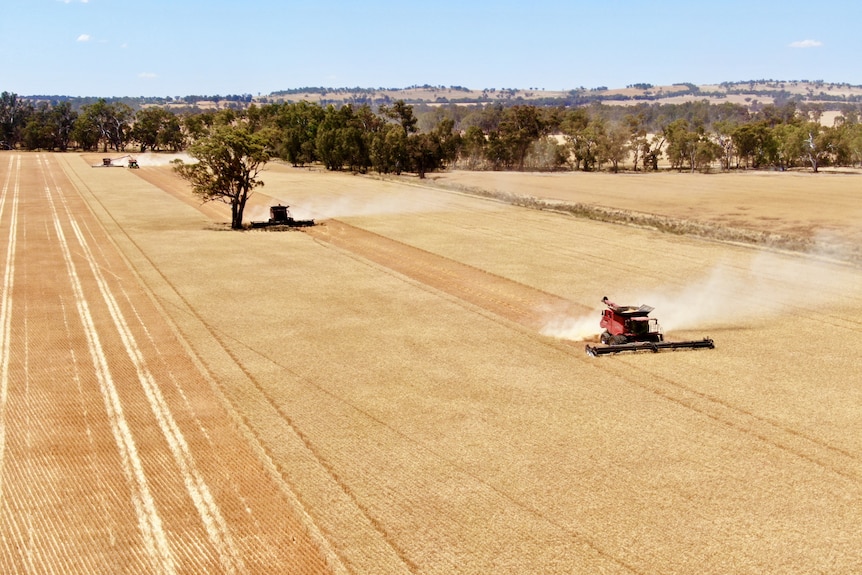
Harvesters roll through fields of high-amylose wheat near Yarrawonga, Victoria. (ABC Landline: Peter Healy)
The current variety yields up to 30 per cent less than other wheat types.
Growers are paid a premium price to compensate.
High-amylose wheat is now being grown in Europe and America as well.
Dr Regina is proud of this major scientific achievement.
“This is indeed a breakthrough in the field of human health as well as health food science.”
Watch ABC TV’s Landline at 12:30pm AEST on Sunday or stream anytime on ABC iview.