
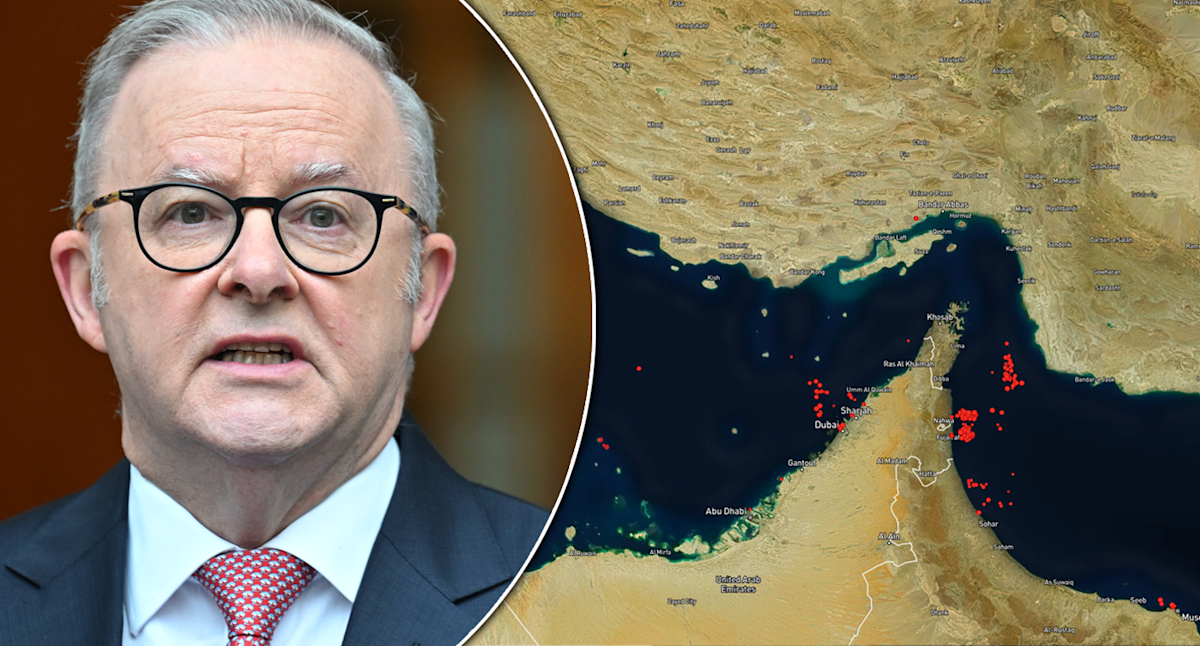
 What will happen to Australia’s source of fuel if the Strait of Hormuz doesn’t open up soon? (Source: AAP/Tanker Tracker)
Australia’s energy security has long been a matter of concern in the background of national debate, despite several notable political figures such as Independent MP Bob Katter and former Senator Rex Patrick placing a heavy emphasis on the issue. But it is front and centre now.
The closure of the Strait of Hormuz to the overwhelming majority of maritime trade, including what is by some estimates as much as 30 per cent of the world’s oil exports, has certainly focused the minds of policy makers in Australia. The behaviour of everyday motorists reveals the level of concern over the supply of fuel into Australia.
While the nation has significant oil reserves of approximately 2.5 billion barrels, it relies on imports of fuel for roughly 90 per cent of the nation’s daily consumption.
RELATED
As of the latest snapshot provided by Energy Minister Chris Bowen this week, Australia possesses fuel reserves worth 36 days of average petrol consumption, 32 days’ worth of diesel and 29 days’ worth of jet fuel.
As news continues to break of overseas refineries shutting down production and of some nation’s introducing restrictions to minimise energy consumption, it’s worth taking a close look at where exactly Australia gets its fuel imports from, and to what degree we rely on the Strait of Hormuz for our oil imports.
According to figures from the United Nations’ COMTRADE database, just three nation’s account for 65 per cent of all refined fuel imports into Australia, South Korea, Singapore and Malaysia, with South Korea alone accounting for 26.2 per cent of the total.
It’s here where a challenging picture emerges. Of the top eight sources for Australia’s fuel imports, six of them have domestic oil consumption levels higher than the level of their production. This of course leaves all of these nations with domestic obligations to meet regarding the supply of fuel and other refined products before exports enter into the equation.
 (Source: AvidCommentator/Yahoo Finance)
Of Australia’s top eight sources of fuel imports, there is a varied degree of reliance on the Strait of Hormuz for imports of crude oil.
Before we go further, a necessary qualifier.
For the largest consumers of oil from the Strait of Hormuz such as China, South Korea, Japan and the United States, we have hard data from the US Energy Information Administration.
Story continues
In other cases, data is based on estimates of flows from nation’s on the Persian Gulf derived from the UN COMTRADE database, then adjusted for the impact of oil piped around the Strait of Hormuz for export.
For India, there are updated estimates from the Financial Express which put India’s reliance on oil through the Strait of Hormuz in more recent times at 50 per cent of imports.
Of the various nations, the largest reliance on the Strait of Hormuz is held by Malaysia, which receives approximately 75.3 per cent of its oil imports through the critical shipping lane.
In second place is Brunei, with approximately 73 per cent of its oil imports transiting the Strait, followed by Japan with 65.3 per cent.
In this Brunei is an interesting case, a net exporter of oil, yet due to the grades of oil required for various petroleum products it does rely heavily on oil from the Persian Gulf for the relatively limited supply it does import.
Of the top eight sources of Australia’s refined liquid fuel imports – which account for 86.9 per cent of the nation’s much relied upon imports – approximately 59 per cent of their collective oil imports come via the Strait of Hormuz.
(Source: AvidCommentator/Yahoo Finance)
The disruption of flows of oil and by extension fuel supplies has only just begun and contingency plans are furiously being put together in the halls of power around the globe.
For Australia, with its reliance on fuel imports from nation’s who rely heavily on the Strait of Hormuz for their supplies, it’s only a matter of time before the flow of fuel to Australia is in jeopardy.
While Australia’s importers often have long standing relationships with various exporters across the world, the simple reality is that so does everyone else, and if the current crisis continues there simply won’t be enough fuel to go around at current consumption levels.
According to Reuters, China has told refiners and exporters to suspend new fuel export contracts being signed and cancel already contracted fuel export shipments.
Which raises what may be one of the most important questions of 2026: How will nations and companies allot the fuel they are able to export?
If the crisis drags on, Australia does have a great deal more leverage than the average nation. We are the world’s second largest exporter of Liquefied Natural Gas (LNG), often to the very same countries that supply much of our fuel such as South Korea and Japan, giving the Albanese government some leverage.
Ultimately, what is clear is that Australia is highly vulnerable to an interruption to its fuel supplies and we face a major problem in a protracted crisis.
Get the latest Yahoo Finance news – follow us on Facebook, LinkedIn and Instagram.