
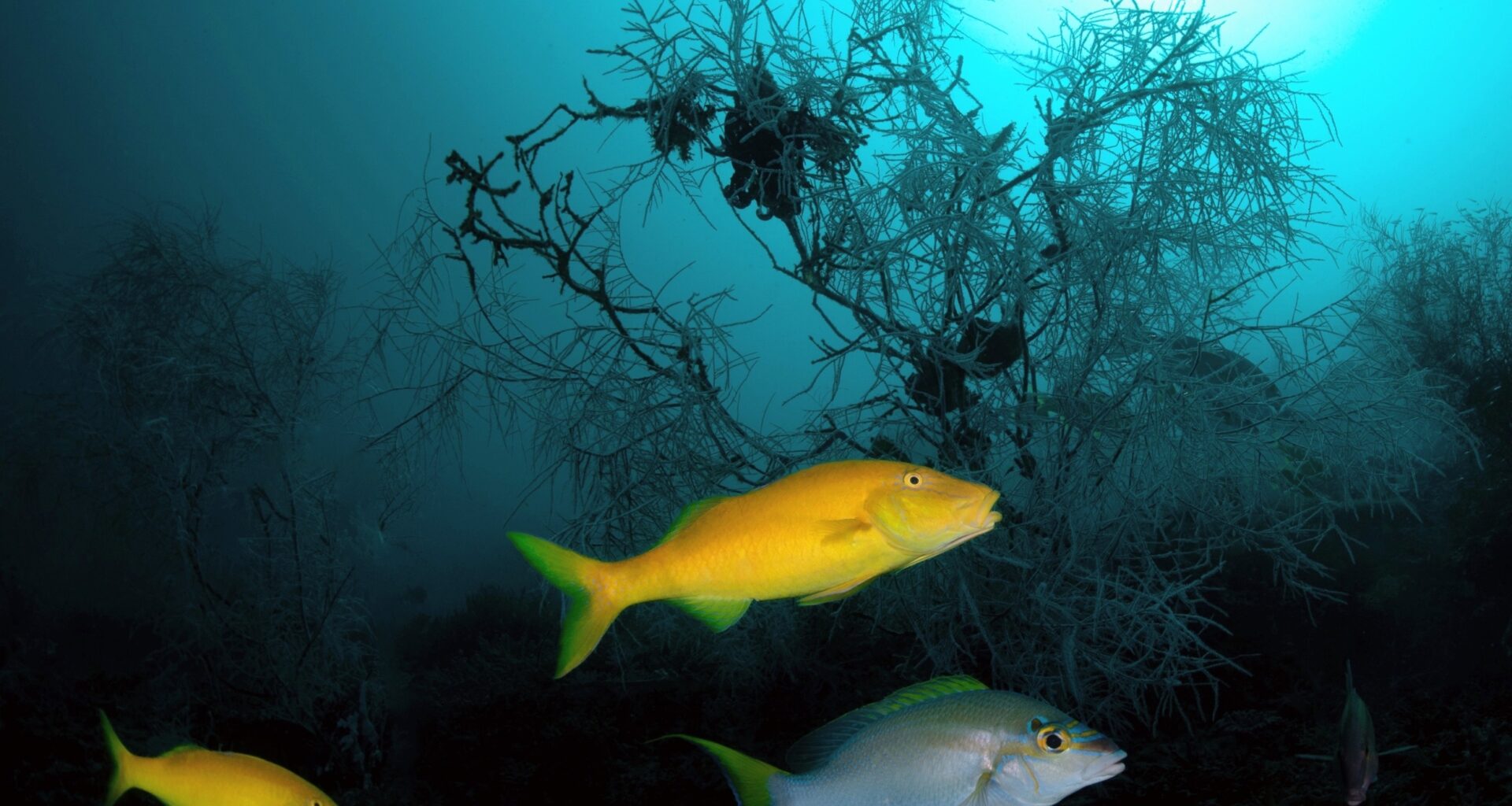
Nearly a mile beneath the ocean’s surface, the seafloor looks very different from the bright coral reefs most people know.
No sunlight reaches this depth. The water is cold and dark. Yet coral reefs still grow there, slowly forming large structures that can last for centuries and support many marine species.

Scientists have known about these deep-water reefs for years, but the ocean floor has been difficult to explore.
Recently, better mapping tools and robotic vehicles have allowed researchers to see how large these ecosystems might be. One of the most surprising discoveries has come from the deep waters off Argentina.
A hidden coral world
Researchers recently began mapping sections of the seafloor off Argentina’s coast and quickly realized something unusual was there. The structures they encountered stretched far beyond what scientists expected.
“We now think Argentina is home to one of the largest reef systems on earth,” said Professor Erik Cordes of Temple University.
“Something that we didn’t really know existed a year ago now turns out to be one of the largest cold-water coral ecosystems on the planet.”
Cordes and PhD candidate Morgan Will are part of a $1.5M research effort through the G20 Coral Research and Development Accelerator Platform, known as CORDAP.
The project brings together researchers from Temple’s College of Science and Technology, the University of Buenos Aires, and the Argentine Museum of Natural Sciences.
The team’s mission is to locate, study, and restore cold-water coral reefs that grow deep in the Atlantic off Argentina’s coast.
Exploring a dark seafloor
The research team works in a place that humans cannot reach directly. During a cruise in December and January, Will traveled aboard the Schmidt Ocean Institute’s research vessel R/V Falkor (too) to study the seafloor.
Instead of divers, the team used a remotely operated vehicle called SuBastian. The robotic vehicle descends to the ocean floor and sends video and data back to the ship above. It allows scientists to explore landscapes that sit thousands of feet underwater.
These dives help researchers locate coral formations and other deep-sea habitats such as cold seeps, where natural gases slowly leak from the ocean floor.
Scientists once believed cold-water reefs were rare and scattered. That idea is changing quickly.
“Our latest estimates suggest that cold-water coral reefs cover about twice as much area as shallow water coral reefs (such as the Great Barrier Reef),” Cordes said.
Life built by slow-growing coral
One coral species drawing attention in Argentina’s waters is Bathelia candida. These corals form large mounds that act as homes for many marine species.
Scientists had known Bathelia reefs existed in parts of South America’s deep ocean. What they didn’t expect was the scale of the structures found off Argentina.
“That really surprised me,” Cordes said. “I knew we were going to find coral mounds, but just how far they extended was really remarkable.”
Cold-water corals grow extremely slowly. Some colonies develop over hundreds of years, forming rigid skeletons that create shelter for fish, crabs, and other sea life. These reefs become hotspots of biodiversity in an otherwise sparse environment.
They also play a quiet role in global ocean processes. Cold-water coral ecosystems help capture carbon and move nutrients from the deep ocean toward surface waters, which supports food production across marine ecosystems.
“The most productive fisheries in the world are in places where there is an upwelling of deep-water nutrients,” Cordes said. “We’re learning that a lot of those nutrients are coming from these cold-water coral reefs.”
The challenge of deep-sea reef restoration
Finding these reefs is only part of the work. Many have already suffered damage from fishing trawls, oil and gas activity, and debris that sinks from the surface.
To understand the health of these ecosystems, researchers first need to know what an undisturbed reef looks like.
“We wanted to create a baseline, so that if we come back and see effects of human impacts, we know how to measure that against what a healthy reef should look like,” Cordes said.
Restoring these habitats presents a challenge that scientists have barely attempted. Unlike shallow coral reefs, which have been studied for decades, deep-sea restoration methods are still in their infancy.
“The issue in the deep sea is that reef restoration hasn’t really ever been done before,” Cordes said. “We have to create the methods for restoring these communities while we’re in the middle of exploring the deep ocean to find them.”
Building coral habitats by hand
Researchers are experimenting with creative ways to help damaged reefs recover. One idea involves building artificial coral skeletons made from cement mixed with crushed coral sand.
These structures are placed on the seafloor to mimic the hard surfaces that coral larvae prefer when settling and growing. Over time, scientists hope they will attract marine life and help rebuild reef communities.
Will spent much of her expedition deploying these artificial structures across Argentina’s deep-sea reefs.
“This was my first cruise out really deep where we could see a lot of structure-forming cold-water corals. I’ve studied them for a couple of years in the lab but had never gotten to see them myself,” Will said.
“The coolest thing I saw on a dive was this massive Bathelia mound. The number of organisms and coral species living with that structure-forming coral was breathtaking.”
Building knowledge across borders
The work in Argentina has also created a growing partnership among research groups in North and South America. Scientists from the United States and Argentina are sharing tools, training, and research strategies.
CORDAP is funding a new deep-sea camera platform for the University of Buenos Aires. The system will expand the country’s ability to explore its own offshore ecosystems.
“Much of this project is really focused on improving the capacity to do deep sea research in Argentina, because it just wasn’t there until now,” Cordes said.
“The capacity to conduct this research isn’t just in the hardware. It’s in the knowledge of how to organize and conduct an offshore cruise. That’s not something you can just step into, so we’re happy to be a resource and a partner.”
Each expedition reveals more of a world that has remained hidden for centuries. Beneath the dark waters off Argentina, coral structures continue to rise slowly from the seafloor, supporting life and shaping the ocean in ways scientists are only beginning to understand.
—–
Like what you read? Subscribe to our newsletter for engaging articles, exclusive content, and the latest updates.
Check us out on EarthSnap, a free app brought to you by Eric Ralls and Earth.com.
—–