
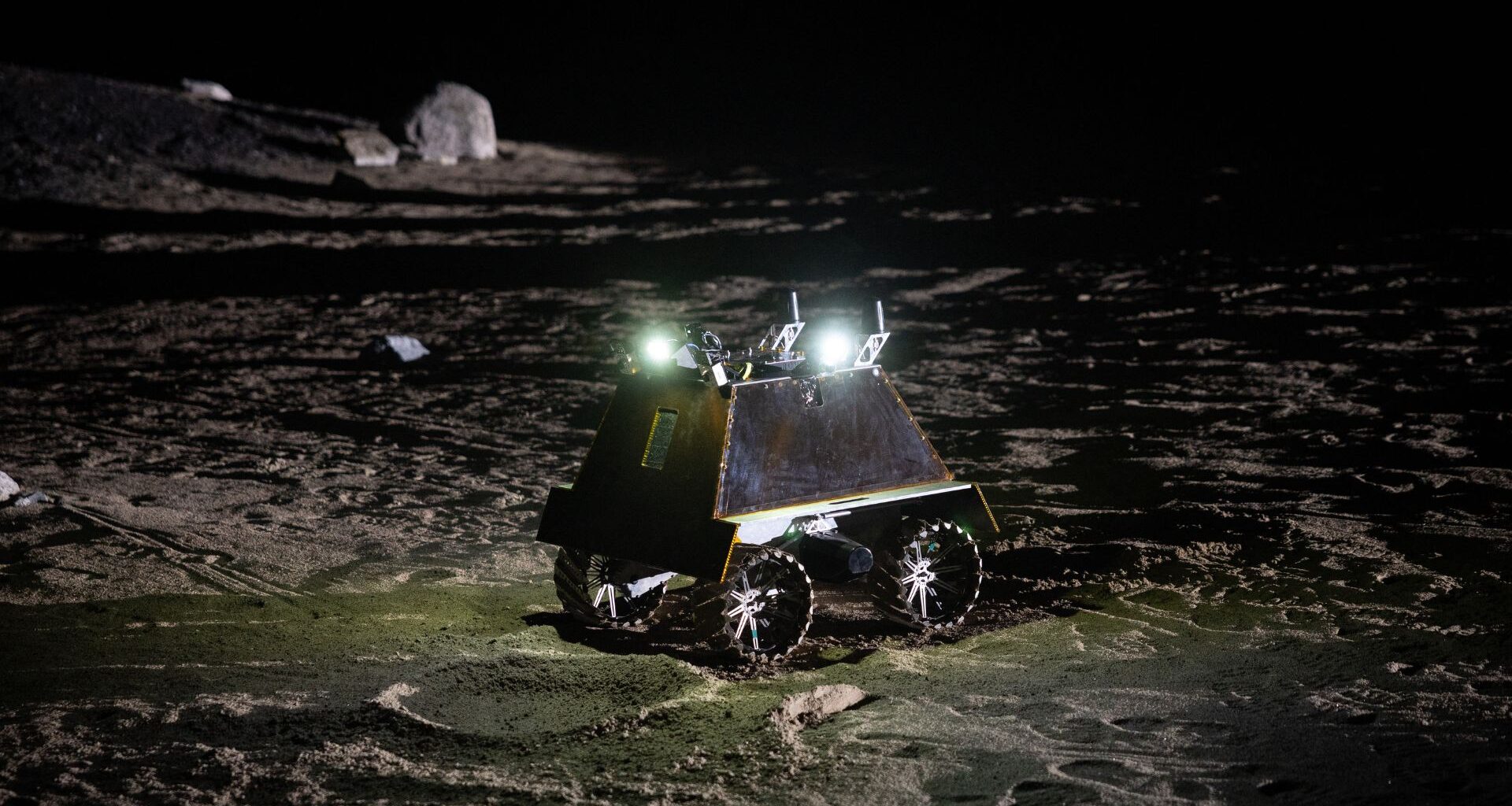
Engineers in China are exploring a new robotic system designed to operate as a versatile worker on the Moon. Developed by researchers from the Beijing Institute of Spacecraft System Engineering, the concept combines wheeled mobility with humanlike dexterity, allowing the machine to travel across the lunar surface while carrying out a wide range of tasks.
These include construction work, equipment maintenance, scientific experiments, as well as collecting and analyzing lunar samples. According to the team, the robot’s mechanical design is built for flexibility and precision. Its waist can rotate roughly 180 degrees in either direction and bend forward up to 90 degrees, enabling it to reach and position tools more effectively in challenging environments.
Meanwhile, its articulated hand offers four degrees of freedom, allowing for delicate manipulation, the researchers explained, detailing the design and its capabilities in a paper published in the Journal of Deep Space Exploration.
Advantages of wheeled locomotion for lunar operations
According to the researchers, a wheeled mobility system could give the robot a significant operational advantage on the Moon. An active suspension mounted on wheels allows the platform to move faster and remain more stable than traditional bipedal walking systems, creating a steady base for the robot’s upper body while it performs tasks.
The team noted that China already relies on wheeled locomotion for planetary exploration, pointing to the success of its Yutu lunar rovers and the Zhurong rover on Mars. To withstand the Moon’s harsh terrain and temperatures, the robot’s wheels are expected to use a lightweight metal mesh design reinforced with steel-wire treads, the South China Morning Post reported.
This structure provides durability while maintaining flexibility and shock absorption, helping the vehicle maintain traction and travel long distances smoothly across the rugged lunar surface even in extreme cold.
Humanoid-style machines have long been considered useful for assisting astronauts in space missions. One early example is Robonaut, a project jointly developed by NASA and General Motors. In 2011, the robot became the first humanoid system deployed in orbit when it was sent to the International Space Station.
China pushes forward multinational lunar base project
China has outlined plans for a new lunar outpost that could serve as a long-term hub for scientific research and exploration. In 2021, the country proposed the creation of the International Lunar Research Station, a multinational project intended to be built near the Moon’s south pole. The facility is envisioned as a comprehensive scientific base capable of operating autonomously for extended periods, with astronauts visiting only for shorter missions while robotic systems handle much of the routine work.
Beijing is also preparing a series of missions and technologies that would pave the way for its future lunar base. One of the key steps is the upcoming Chang’e‑7 mission, scheduled to launch later this year, which will perform an in-situ investigation of possible water ice deposits in permanently shadowed craters near the Moon’s south pole.
In addition to the semi-humanoid robotic concept, the Beijing-based team has proposed another machine designed specifically for logistics. The platform features six legs and would be capable of performing a soft landing on the Moon before walking across the surface to transport cargo, forming part of a broader robotic system envisioned to help construct the future lunar research station.