The Royal Australian Navy is not well resourced enough to be able to send warships to the Strait of Hormuz even if the US were to ask for Australian assistance to stabilise the critical shipping channel, defence experts have warned.
US President Donald Trump over the weekend asked China, France, Japan, South Korea, the UK and others to send ships to the Strait of Hormuz, where Iranian attacks have stopped oil tankers from going through, sending the price of oil soaring.
Australia has not received any requests and the Albanese government is unlikely to offer any help even if asked, The Australian understands.
And over the weekend, the US struck Iranian military infrastructure on Kharg Island, which hosts the country’s main oil export terminal. Mr Trump threatened to further weaken oil infrastructure if Iran did not let commercial ships path through the Strait of Hormuz.
The Iranian regime’s move to choke the key shipping lane has brought home the cost of the war to the rest of the world.
“Our navy is not in a state to contribute anything,” Strategic Analysis Australia director Michael Shoebridge said.
“Our military is in such a weak state that we don’t have much to give.”
Defence and maritime security expert Jennifer Parker said it wouldn’t be in Australia’s interest to send a ship even if Australia were called on because of the state of the navy.
“The current state of the navy and the impact this would have on preparedness – it’s probably not in our interests,” she said.
Two years ago, the Albanese government did not send a warship to the Red Sea despite the US request to fight off attacks on commercial shipping by Iran-backed Houthis and instead deployed personnel.
Opposition defence spokesman James Paterson said Australia’s primary strategic focus should be in the Indo-Pacific and that any request by the US should be “assessed against our national interest and the availability of naval assets”.
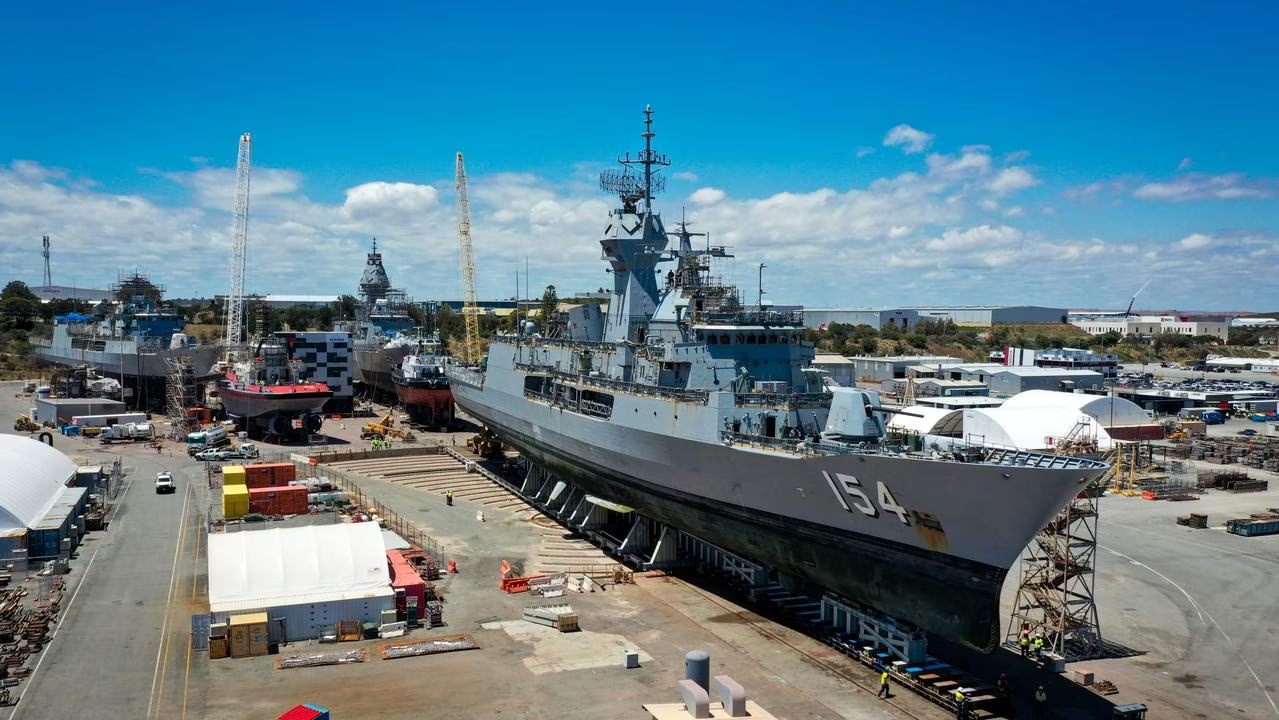
Ms Parker said the RAN “has the least amount of surface combatants it’s had since, I would say, World War II, certainly since the 1950s” and that it would be in Australia’s interest to send a warship as part of a US-led coalition that could actually restore shipping through the Strait of Hormuz were the navy better resourced. “It has 10 surface combatants. Seven of those are quite old … the Anzac-class. Three of those are very modern, capable warships, the Hobart-class,” she said. “So those (ships) are going through a series of upgrades. The three Hobart-class need to have their combat systems upgraded over the next few years to be able to enhance their ballistic missile capability.
“The Anzac-class are having all sorts of upgrades done to them. Now, if we send ships over there to provide a contribution that would materially change the outcome or they’re good experience for us, we may undermine actually trying to upgrade and enhance the preparedness of our ships and operating them in the Indo-Pacific.”
But she was doubtful whether a US-led coalition in the Strait of Hormuz would actually make a sizeable difference to the volume of oil going through.
“You’d only be getting a couple of tankers through,” she said. “Normally, that strait would have 20 to 30 oil tankers going through in a day, nearly 100 ships all up. You’re not going to be able to get 20 to 30 oil tankers through in a day.
“Unless you’ve reduced Iran’s (unmanned surface vehicle) and (unmanned aerial vehicle) capabilities along the coast, you’re not going to be getting significant numbers through to really change the oil problem.”
Mr Shoebridge said it was “interesting” that Australia was not in the list of countries from which Mr Trump demanded support. “We’re clearly not an ally that comes to mind for Donald Trump,” he said.