

When A Mirror premiered at Belvoir St Theatre in February, it marked a major milestone for its 25-year-old director, Margaret Thanos: her main-stage directorial debut.
However, the talented young director has had little time to bask in the glory of her achievement.
Instead, she headed straight into rehearsals for her next production: The River at Sydney Theatre Company.
A three-hander written by acclaimed British playwright Jez Butterworth and starring Miranda Otto, Ewen Leslie and Andrea Demetriades, The River is generating considerable buzz, not least because it marks Otto’s first return to the STC since her performance in The White Guard in 2011.
With two main-stage productions already under her belt in 2026, Thanos has cemented her place as a rising star of Australian theatre.
“It’s one of those funny things where you work towards it for a very long time and then it’s happening and everything is the same as it always was before, except now you’ve done this thing,” she tells ABC Arts.
Speaking backstage at STC, the Cypriot Australian director took time out of rehearsals to discuss A Mirror, The River and what it’s like working as a young female director in theatre today.
A culture of censorship
Currently playing at Belvoir St Theatre, A Mirror is set in an imaginary authoritarian regime where the Ministry of Culture closely presides over the arts.
Written by British playwright Sam Holcroft, the play seemingly begins with a wedding; however, it soon becomes clear the ceremony is a cover for an illicit performance of an unsanctioned play.
In a clever meta-fictional flex, the banned play in A Mirror is about a banned play. The result, says Thanos, is an exploration of “censorship, art and whistleblowing”.
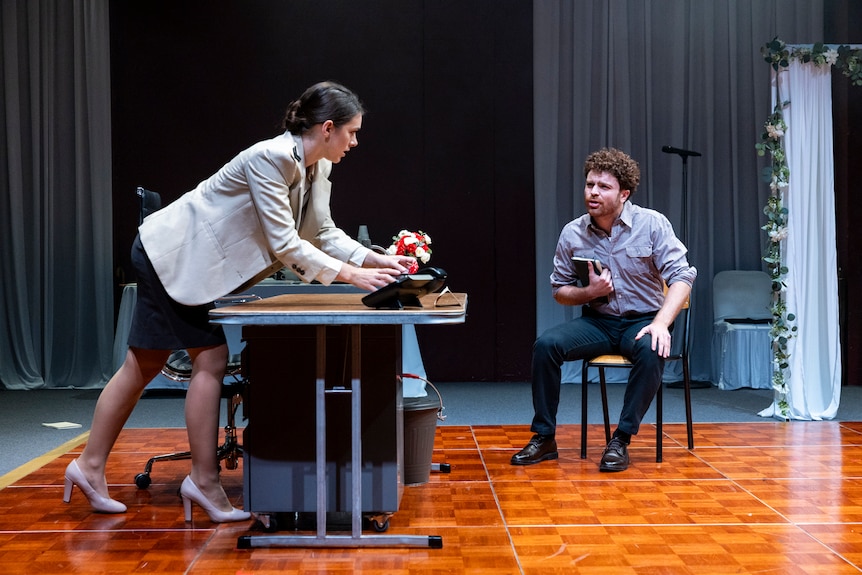
“Every society is only a few clicks away from having that kind of censorship,” Thanos says of the world of A Mirror. (Supplied: Belvoir St Theatre/Brett Boardman)
One of the play’s strengths, she says, is that it could be set anywhere.
Thanos told 702 ABC Sydney: “It could be the Eastern bloc, it could be in Soviet Russia, we could be in Australia 50 years from now.”
But despite the ambiguous setting, she believes “unequivocally” that the play is about our world.
It’s a position Thanos lays out in her director’s note in the play’s program:
“Let me make it crystal clear that my take is that this show is about us. Do we have a Ministry of Culture that vets and edits each individual play that goes on? No. But we do have something far more insidious — a culture that asks for self-censorship.”
She says implicit forms of censorship, including self-censorship, can become a feature of a system where artists rely on grants and other forms of government funding to produce work.
“I’ve seen enough examples of artists censoring themselves or being censored by different bodies.”
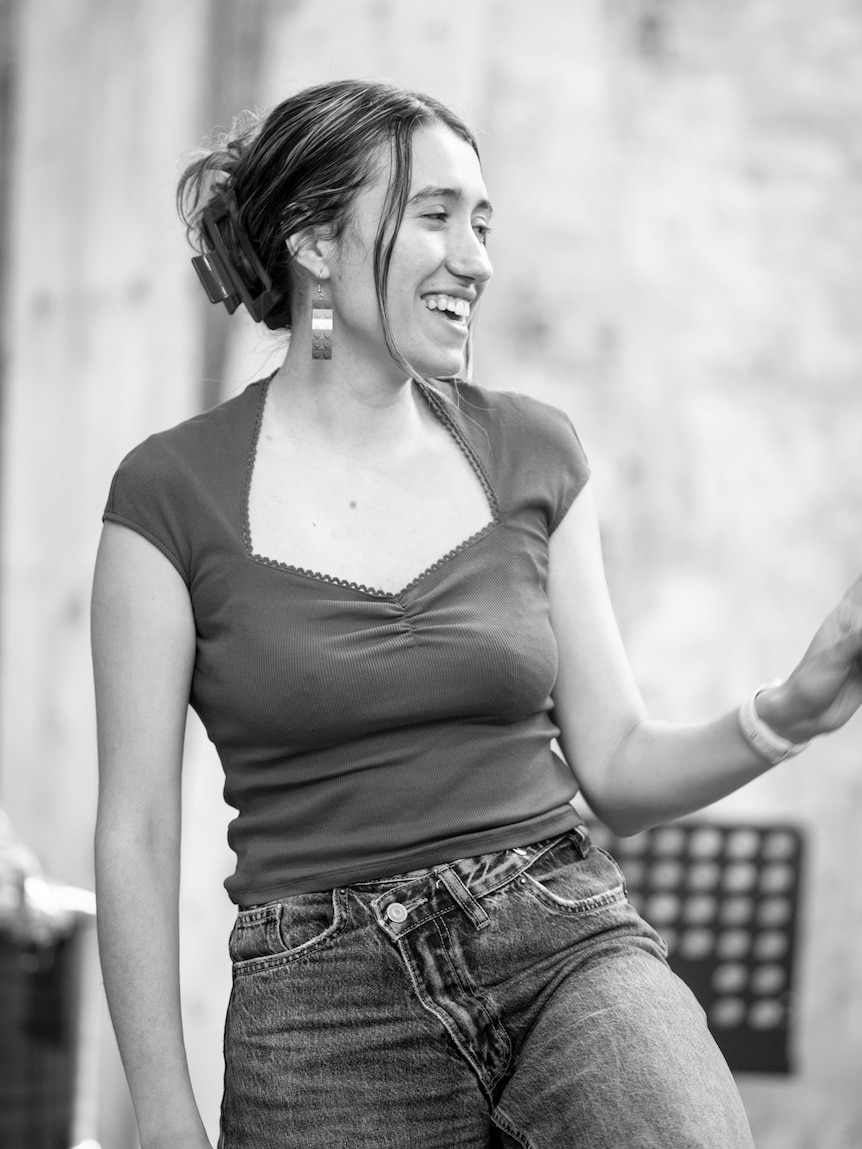
Thanos’s first gig as director was for a Sydney University production of Edward Albee’s The Goat, or Who is Sylvia? in 2018. (Supplied: Belvoir St Theatre/Brett Boardman)
Nor is Thanos immune. She acknowledges it’s something she, too, does “all the time”.
“I think every artist at present is in a position of trying to decide what battles they want to fight, what things they want to talk about with their art, what things they want to talk about publicly,” she says.
“It’s a challenging moral quandary for all artists, I think, at the moment, and all people who engage in the humanities in any way.”
However, A Mirror’s message is not just specific to the arts. “It’s also about telling the truth in general,” Thanos says.
“What does it mean to tell the truth in a science lab right now? What does it mean to tell the truth in the defence forces right now? [Or] to be that person inside of a bureaucratic institution that ultimately stands up and says … we’re not doing the things that we say or purport to stand for.”
A story about love and connection
Thanos’s next project, The River at the STC, couldn’t be more different.
“It’s almost the total flip side of A Mirror,” she says.
“When I read A Mirror, I knew that it was absolutely the kind of work that I want to do. I’ve always directed very highly political work — black comedy, satire.
“In many ways The River is very funny, but it’s deeply human and it’s about love … It’s about what it means to try to find connection.”
As the play’s first female director, Thanos says she brings “a very different lens” to a story about “heteronormative relationships between men and women”.
“The gender politics that sit inside of romantic relationships [are interesting to me].”
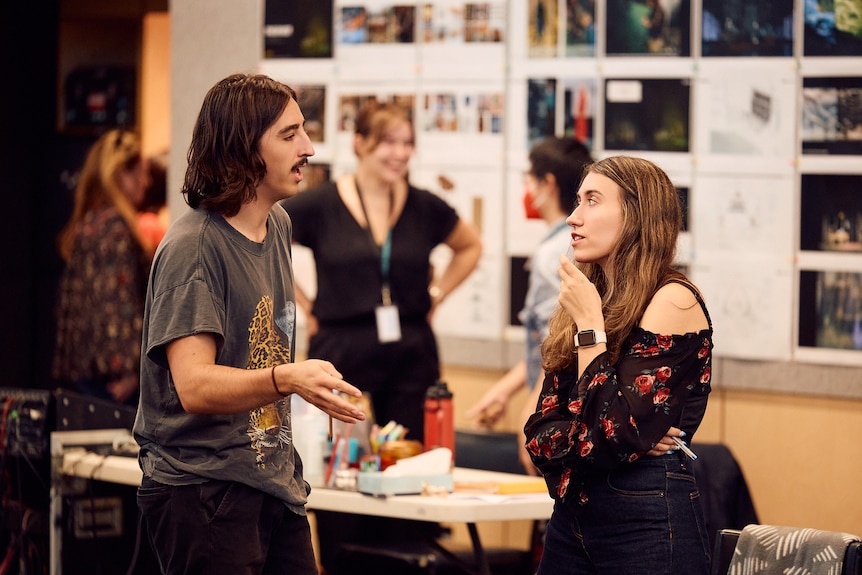
“You use the same skills to lead a company or … a group of actors as you do to lead any kind of business,” says Thanos, pictured here with directing secondment Henry Kent. (Supplied: STC/Daniel Boud)
The play opens as The Man (Leslie) brings his new girlfriend, The Woman (Otto), to a cabin in the woods for a romantic weekend — of trout fishing.
Demetriades plays The Other Woman, who also puts in an appearance.
Thanos says it’s a set-up that provokes different reactions in men and women.
“When I first read the play, I was like, ‘how would I feel if I went to a house with a man in the woods and he was my new boyfriend and … I realised while I was there that I didn’t really know who he was?'”
She says while a male director might centre the character of The Man, as a woman, she was naturally drawn to the female characters’ perspectives.
“My way of … developing the moments of disconnect between the couples in the show comes from … me putting myself into the shoes of the women.
“The design reflects that; the staging reflects that. Even the casting to some degree reflects that.”
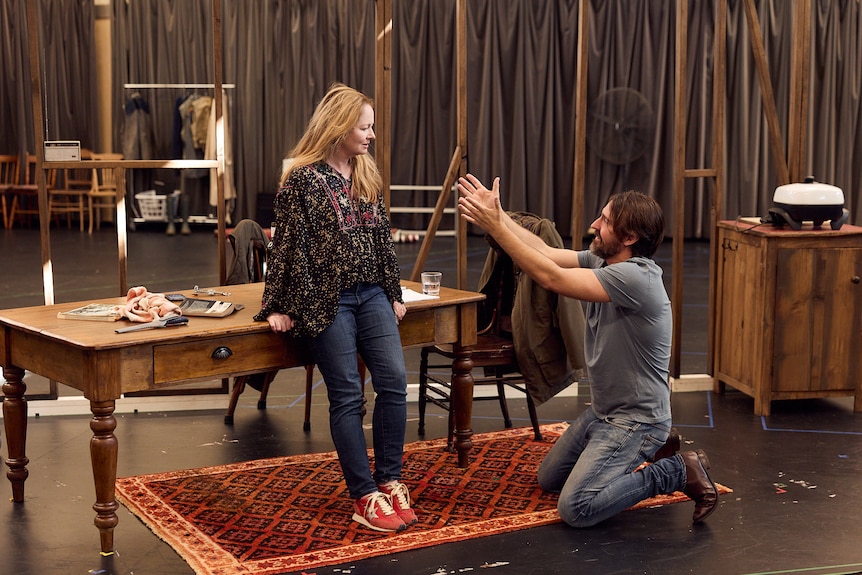
Miranda Otto and Ewen Leslie in The River rehearsal room. “Everyone is so invested,” Thanos says of the cast. (Supplied: STC/Daniel Boud)
By casting she is referring to Otto, whose presence on the bill as the show’s star further disrupts the play’s traditional gender power dynamics.
“[In] the previous iterations of the project, The Man, the male character, has always been the most famous person in that room,” Thanos observes.
That was Dominic West in a much-lauded performance in the play’s premiere at London’s Royal Court Theatre in 2012 and Hugh Jackman in its Broadway premiere in 2014. (Both productions were directed by British theatre-maker Ian Rickson.)
The audience goes into the show with different expectations when it’s a female star selling tickets and her face on the marketing material, Thanos says.
“With Miranda’s profile, it helps to immediately reframe [the narrative] from her perspective … before you’ve even seen the show.”
Despite all this, Thanos says, The River is ultimately a story about “heartbreak and love” that resonates beyond gender binaries.
“It just feels so universal to me, and that’s an exciting prospect as someone who often does relatively divisive political work.”
Combining work with activism
Thanos’s politics play out off the stage, as well.
She describes herself as “passionate about social justice issues” and has worked with humanitarian organisation Plan International on projects amplifying young people’s voices and advancing gender equality.
“I believe in an equal and fair society, and I feel sad that it feels like that’s slipping backwards every single day,” she says.
Why 150-year-old fairy tales still resonate with modern audiences
Working on A Mirror has made her keenly aware of the issue of freedom of expression, and how it is becoming curtailed.
“Encouraging more dialogue between people is something that I feel incredibly passionate about at the moment because I feel like it’s slipping away from us, our capacity to sit in the same room as somebody we disagree with and be OK with it,” she says.
Climate justice is another issue close to her heart.
“[It’s an] that issue plagues most people under the age of 40 every day — or should, if it doesn’t,” she says.
“When I think about the future, I genuinely don’t know what it looks like. I don’t know how long we’re going to be able to even make theatre.”
She says that while the #MeToo and Black Lives Matter movements helped make the theatre industry more equitable, there is still more to be done.
Few opportunities exist for young people from disadvantaged backgrounds to enter the industry, for example.
“I feel so keenly aware of the privilege that’s allowed me to make my career in theatre possible,” she says.
Everyday misogyny
While Thanos says she is “supported by a lot of wonderful mentors”, she still deals with sexism as a young female director.
“I experience forms of misogyny almost every day, and that’s not a criticism of any one particular person or group or company … but more that we’re still facing a big societal problem where we don’t see that young women can always be leaders,” she says.
How Australian theatre companies are responding to #MeToo
“The idea that our leadership abilities are lesser is somehow still pervasive in a quiet way … I don’t think anyone would ever say that to your face, but I have no doubt that conversations happen … that seek to scrutinise young women in positions of power way more than anybody else.
“And when you add on any other kind of diversity to that, it just doubles it and makes it even worse.”
Thanos says she feels privileged to work at companies like Belvoir St and STC that prioritise diverse storytelling — “because not every theatre company around the world is doing that right now”.
A Mirror is at the Belvoir St Theatre, Sydney, until March 22; The River is at the Drama Theatre at the Sydney Opera House from March 30 – May 16.