
It was just over 10 years ago that the Abbott government intervened in what was an international humanitarian disaster of epic proportions and offered to permanently resettle 12,000 refugees from Syria, and begin air strikes on Islamic State targets all within the same week.
Then prime minister Tony Abbott was forced to increase Australia’s humanitarian intake in response to the conflict because of overwhelming community support. State leaders, the Shorten-led opposition and the Greens demanded Australia help deal with the biggest refugee crisis to face the globe since World War II.
Iran war live updates: For the latest news on the Middle East crisis, read our blog.
The political environment a decade ago was, of course, markedly different. Public anxiety around migration was not as combustible as it is now. Nor was the issue fundamental to the culture wars we are seeing play out now.
But what is unfolding in Iran is having much greater consequences than we could have imagined a few weeks ago. The human fallout is profound. In addition to the reports of injuries and deaths, we are seeing a huge number of people displaced because of the conflict.
That number is more than 3 million people, according to the United Nations, with concerns mounting over a worsening humanitarian crisis.
Bombing risks galvanising Iranians’ support for regime
The UN High Commissioner for Refugees (UNHCR), Barham Salih, said last week that as many as 3.2 million people, representing between 600,000 and 1 million Iranian households, had been forcibly displaced since the war began on February 28.
Recent reporting from the BBC points to a growing flow of Iranians heading into Türkiye as the conflict escalates. If it continues, that will only grow.
As this has been unfolding, the Australian government has moved quickly to announce that it will send defence equipment and personnel to the region to aid the defence of countries like the United Arab Emirates (UAE).
Will it show the same urgency when it comes to offering help for the human fallout of this conflict? Does the same principle that led Australia to support the defence effort also extend to offering more humanitarian assistance?
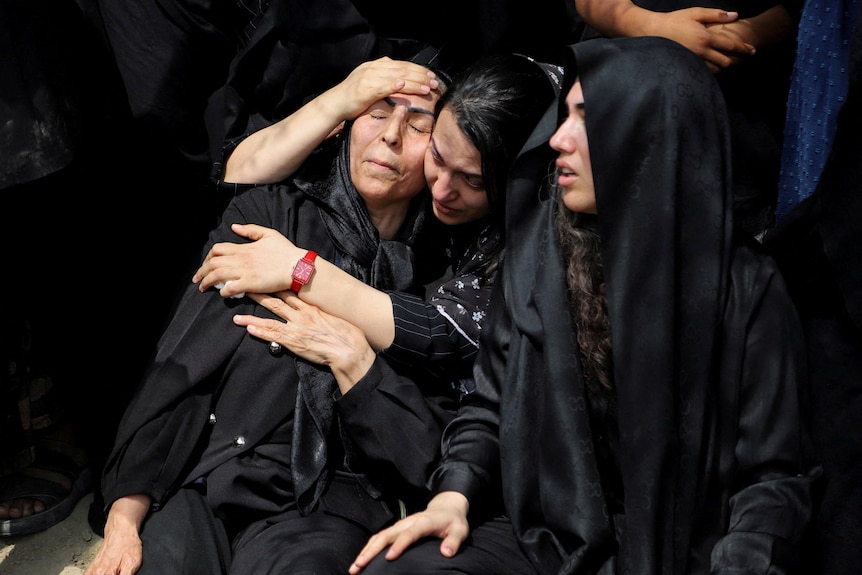
Women grieve for the girls killed following a reported strike on a school in Iran, but how will Australia react to the escalating humanitarian crisis? (Reuters: WANA/Amirhossein Khorgooei/ISNA)
Asylum dilemma
Last week, Australia, with its international reputation for harsh border and refugee policies, decided to offer seven members of the Iranian women’s football team asylum in Australia, with the government confirming all but a few members of the delegation were individually offered refuge as they embarked on their journey home.
Iranian women’s footballers choose to return home
One woman subsequently charged her mind. Then, yesterday, three more members of the team decided to return to Iran after being granted humanitarian visas.
A fifth member withdrew their asylum claim and left the country overnight.
In a statement, Home Affairs Minister Tony Burke said they were given repeated opportunities to discuss their options, but chose to rejoin the team and return to Iran.
The Australian effort to give these women the chance to stay in Australia, and in doing so, offer them safety, was widely supported by almost every political leader in Australia. US President Donald Trump even managed to weave himself into the narrative, waking the prime minister with a 2am phone call, urging Prime Minister Anthony Albanese to keep the women here.
Yet just days after we saw images of the women signing documents that formalised their asylum and safety, they have made the heartbreaking decision to go back to Iran. Most of us will never know the diabolical dilemma these women faced in seeking safety in Australia.
It didn’t take long for Iran’s state-sanctioned news outlet to publish a photo of the returned players, stating the women faced ”unprecedented threats and pressure by Australian authorities and anti-revolutionary groups”.
How community united to help Iran’s footballers
The return of the women represents a propaganda win for the brutal Iranian regime. It also offers an insight into the hardline, oppressive reality of life for its people, where persecution, fear and coercion are faced around the clock.
The Iranian regime is expert at crushing dissent amongst its own people. That same fervour is now playing out across the Middle East, with Iran proving a much more formidable force than perhaps the US expected.
Loading The Iran threat
Speaking on ABC Insiders yesterday morning, new One Nation MP Barnaby Joyce was clear about the serious threat Iran poses:
“You can’t have a totalitarian theocracy with nuclear weapons when it is embellished in their national purpose to destroy Israel, to destroy America, that is very dangerous people, not the Iranians are dangerous obviously, we’ve seen that with the soccer players. But if you get theocratic totalitarianism that says we are gonna destroy the United States, destroy Israel, there’s no temperance in what they do.”
He also pointed to the actions of Iranian agents on Australian soil: “We’ve actually even had them try and do terrorist attacks in Australia. Remember that, they’ve had a crack here.”
Loading…
Last August, ASIO director-general Mike Burgess confirmed Iran was behind at least two antisemitic attacks in Australia.
The Iranian conflict is having huge ramifications around the world and with it, the global economy. While the Albanese government has been focused on how to manage the domestic impact of issues like fuel, energy prices and how volatile oil stocks will hit inflation, the conflict shows no signs of ending soon.
Despite some concerns that we are inserting ourselves into a conflict without a clear purpose or fixed end date, Labor politicians have proved adept at holding the government line.
While Australia’s government MPs remained silent, populist podcaster slash patron saint of the anti-woke bro sphere, Joe Rogan took to Trump for breaking a promise to his voters over the assault on Iran.
Political analysis that matters
“But it just seems so insane based on what he ran on,” Rogan said. “I mean, this is why a lot of people feel betrayed, right? He ran on no more wars and these stupid, senseless wars, and then we have one that we can’t even really clearly define why we did it.”
This is a sentiment that was shared by new Nationals leader Matt Canavan before he unexpectedly became leader last week. It was also a sentiment shared by Liberal frontbencher Andrew Hastie, before the Coalition had received its briefing, and he too swung back into line, adhering to shadow cabinet convention, or in plain terms, proving to his colleagues he can be trusted to stick to the rules.
But the initial instincts of both men — to question the wisdom of a war that the US and Israel appear to have underestimated in both scale and volatility — reflect a growing view among sensible people around the world. In this era of populism, a politician expressing wariness or caution is the kind of common sense voters want.
Patricia Karvelas is host of ABC News Afternoon Briefing at 4pm weekdays on ABC News Channel, co-host of the weekly Party Room podcast with Fran Kelly and host of politics and news podcast Politics Now.
Loading…