
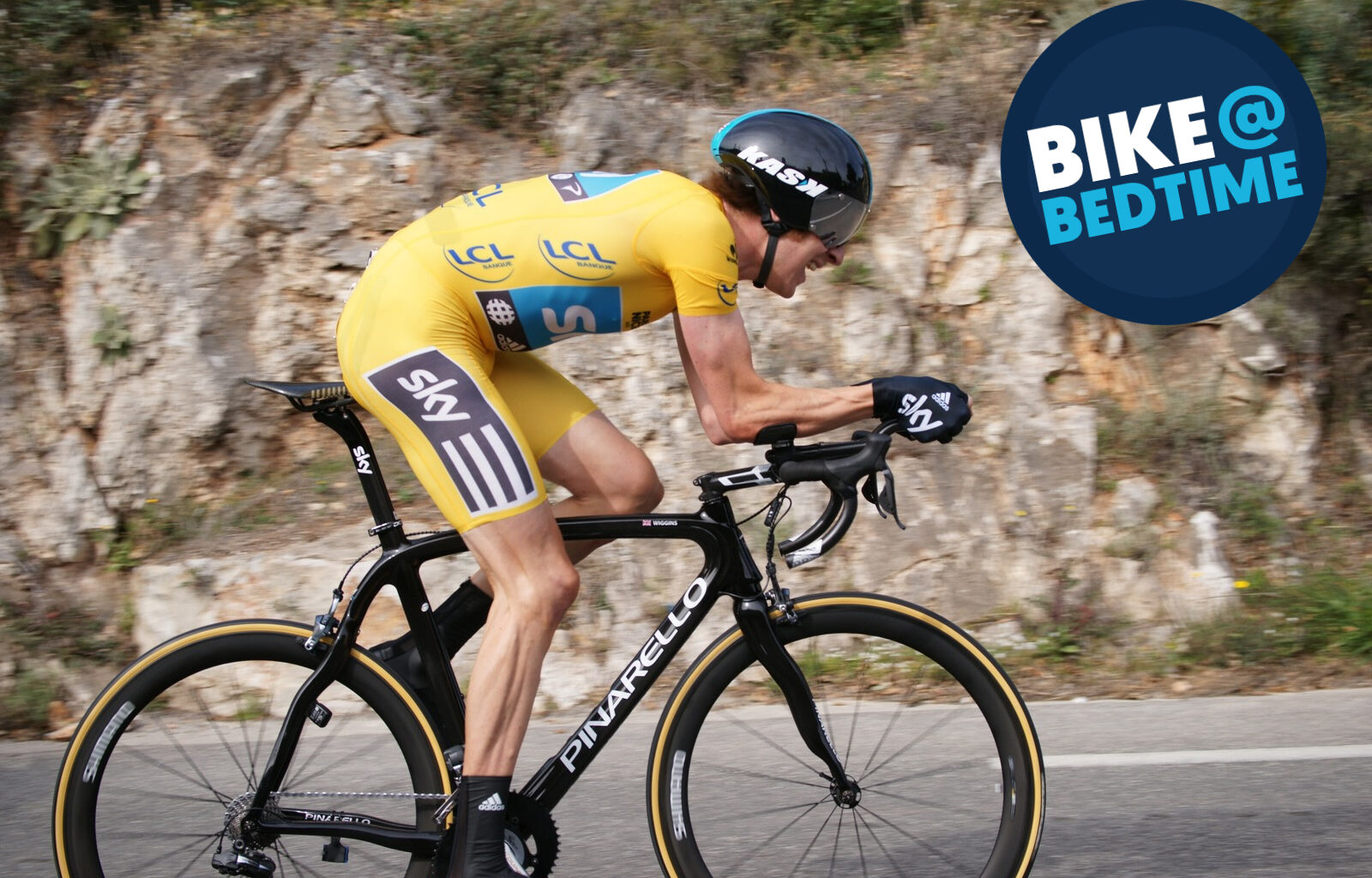
In 2012, Bradley Wiggins famously became the first-ever British winner of the Tour de France, and he was spectacularly successful elsewhere that year too, winning the Tour de Romandie, the Critérium du Dauphiné, and time trial gold in the Olympics, but his first win of the year came in Paris-Nice in March. This is the bike he rode to victory on the final day.
Paris-Nice is the UCI WorldTour’s first stage race in Europe each season, starting a day ahead of Italy’s Tirreno-Adriatico, and it’s traditionally seen as a good early-season marker of the form of any big-name riders competing.
Bradley Wiggins (Team Sky) finished second in the opening time trial in 2012, but went into the race lead the following day, and took that lead all the way to the finish, becoming the first British winner since Tom Simpson way back in 1967.
Going into the final stage, Wiggins’ lead was just six seconds over Lieuwe Westra, so although he was favourite for the win, it was by no means a foregone conclusion. That final stage was a mountain time trial from Nice to Col d’Èze – just 6 miles at an average gradient of 4.7% – hence Wiggins’ decision to ride a road bike with clip-on time trial bars and wear a skinsuit and Kask Bambino TT helmet.
At the heart of things, Wiggins was riding a Pinarello Dogma frameset. The most eyecatching features were the wavy fork legs and seatstays, which were said to help absorb road vibrations and improve comfort without sacrificing lateral stiffness. These deep curves have evolved to be far more subtle in recent years. They’re much more toned down these days – more part of the design language and brand identity than anything more dramatic.
The down tube was asymmetric to take account of the higher forces on the driveside of the frame compared to the non-driveside. Although disc brakes add a further level of complication these days, Pinarello has stuck with asymmetry.
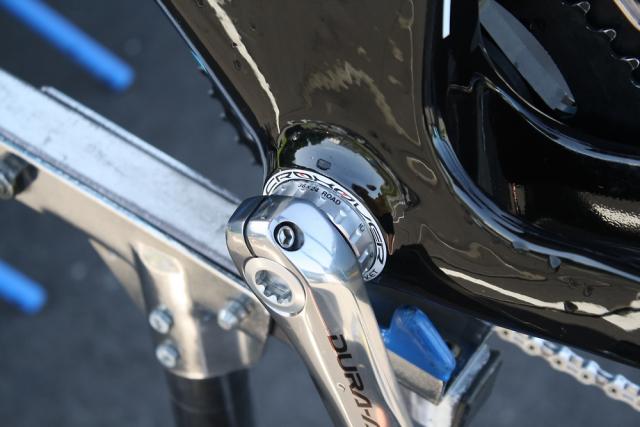 Team SkyPinarello threaded bottom bracket, Tour de France 2012 (Image Credit: Farrelly Atkinson)
Team Sky (which has evolved into Ineos Grenadiers, of course) has been using Pinarello bikes since its launch in 2010, and it has always used Shimano Dura-Ace Di2 groupsets too. Shimano officially announced the launch of the 11-speed 9070 Series Dura-Ace Di2 in June 2012, and Team Sky was involved in the development programme, but Wiggins was still on the 7970 Series 10-speed for Paris-Nice.
In fact, Wiggins stuck with the 10-speed version for the whole of the Tour de France too, save for the final stage into Paris when he rode the newer groupset (you’ve got to keep the sponsors happy). It looks like Team Sky preferred to use equipment with a proven track record, and the Mavic neutral service support didn’t yet cater for the 11-speed groupset. Needless to say, Wiggins’ bike was equipped with rim brakes. Shimano first introduced hydraulic disc brakes into its Dura-Ace tier with the R9100 series in 2016 and the UCI didn’t fully authorise them (on a permanent basis) in road racing until 2018.
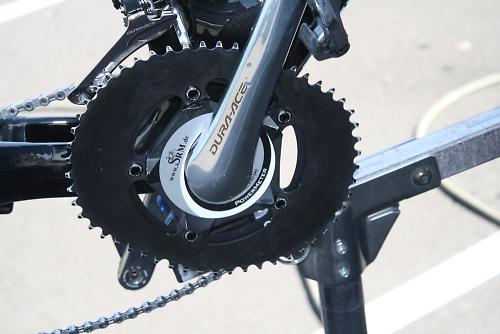 Bradley Wiggins Shimano cranks, O.Symetric chainring, SRM power meter (Image Credit: Farrelly Atkinson)
One notable departure from the Shimano theme came in the shape of Wiggins’ O.Symetric chainrings. The idea is that the design increases cycling efficiency and power output by reducing the impact of dead spots in the pedal stroke. The shape is intended to make it easier to pedal through the top and bottom of the stroke and harder during the high-power phase. More power, though? Most people aren’t convinced. Wiggins reverted to round rings later in his career, although teammate Chris Froome remained a fan.
The power meter wasn’t from Shimano either. The Japanese brand didn’t announce its first integrated power meter until 2016, with availability the following year. Back in 2012, Germany’s SRM still ruled the roost.
Shimano was the wheel sponsor, although Team Sky was known for going elsewhere in search of those famous marginal gains. These look like legitimate Shimano wheels, but the team was spotted around this time with rims from Hed and hubs from Chris King and Tune.
Wiggins used a handlebar and stem from Shimano’s Pro brand, with clip-on aero bars for a more efficient position when riding against the clock in the mountain time trial on the final day of Paris-Nice 2012. It doesn’t look like he went for a shorter-than-normal stem to bring the bars closer – that’s a lengthy beast he has on there – presumably to maintain his normal road bike position when not using the extensions.
One other feature of that front end that is unusual: Wiggins has no handlebar tape on the drops. His race strategy was to ride with his hands on the aerobars when in the saddle and on the hoods for the rest of the time (he barely rose out of the saddle). Even so, there are marginal gains and there are marginal gains. Maybe it was just to show off the Pro logos on the ends of the bars.
While the rest of Team Sky used Shimano’s SPD-SL pedal system, Wiggins favoured the lightness and additional float provided by Speedplay Zero Nanograms (although you can’t see them in this picture) and that’s the tail end of a Fizik Arione saddle you can see, a model that was relaunched in updated versions last month. He had upgraded it to a yellow version for his Tour de France win later in the year (below).
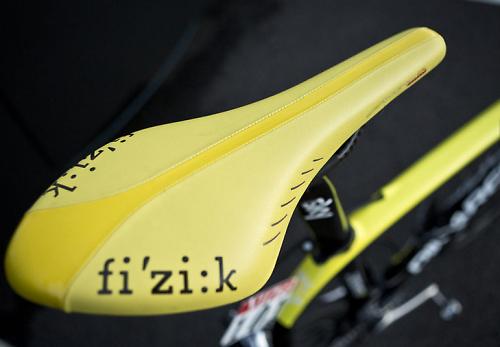 Bradley Wiggins’ yellow Fizik Arione saddle for Tour de France win, 2012 (Image Credit: Farrelly Atkinson)
Although Lieuwe Westra went hard for the victory and led at the checkpoint, Wiggins won Stage 8 of the 2012 Paris-Nice by two seconds to secure the overall title, his first victory in what was to become the most successful season of an illustrious career. All told, this is a bike that reflects the philosophy that defines Team Sky in that era: proven equipment, carefully chosen details, and just enough experimentation to chase marginal gains on the way to a historic win.