
By Research Fellow, Tushar Joshi
One thing about any war between countries, or even a small fight in your street, is that it gives people a strange, almost sadistic thrill, until they are affected by it themselves. From a distance, war looks dramatic, strategic, even necessary. Up close, it is more like disruption, fear and uncertainty. That is exactly what I have felt since the regional escalation unfolded in the Middle East, marked by joint strikes by the United States and Israel against Iran, followed by Iran’s retaliatory actions targeting Israel and US military bases in Gulf countries. Until recently, I was witnessing it through the lens of an analyst. Then I became, in a small but personal way, part of its consequences.
I am a PhD student in International Relations at the University of Melbourne, currently on a visiting fellowship at Lund University in Sweden. My academic bread and butter is to analyse why states behave the way they do. I was supposed to return to Melbourne on 28 February. Then news of military escalation broke. Shortly after, I received a notification that my Qatar Airways flight from Copenhagen to Melbourne via Doha had been cancelled.
At first, I thought it was not a big deal. Flight cancellations and delays are part of international travel. But as the day unfolded and reports came in about the death of Iran’s Supreme Leader, Ali Khamenei, the gravity of the situation began to sink in. It was not only about one cancelled flight. It was the realisation that the most frequently used airspace connecting Europe to Australia, the Middle East corridor, had been shut down indefinitely.
The uncertainty of not knowing when I would be able to return to Melbourne hit me harder than I expected. Already being in a panicked state of mind, refreshing news websites, scrolling through social media to check for alternative routes did not put me at ease. As someone who studies international politics for a living, I have often analysed crises in abstract terms. This time, I was trapped in one of its logistical ripples.
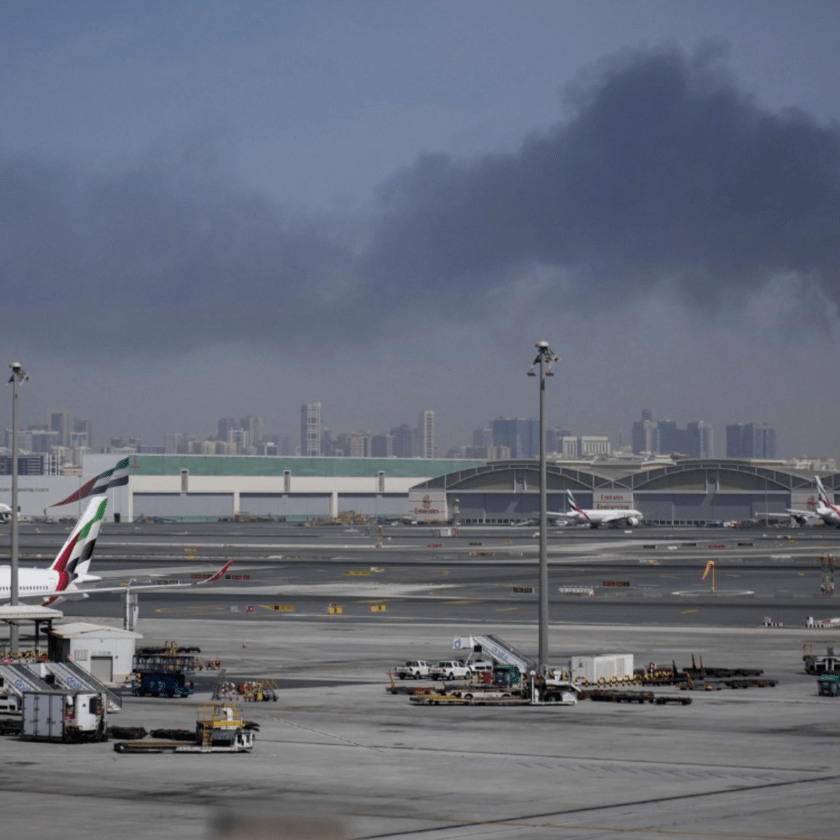
Ironically, the realisation that I was not alone somewhat eased my anxiety. Major hub airports in Doha and Dubai were filled with stranded passengers. Watching families stuck in transit, with children sleeping on luggage trolleys, I realised my situation of still being in my apartment in Sweden was far more comfortable than being stuck in a crowded airport. Yet for the first time, the feeling of what it means to be suspended in uncertainty, and what the families of those stranded must be going through hit me.
To make matters worse, it was shocking to see certain social media accounts not wasting a second in generating and circulating AI-generated content in their rush for views by sensationalising the crisis beyond recognition. Imagine how a parent would feel seeing the Burj Khalifa engulfed in flames, knowing that their son or daughter is studying in that region and not realising that it was a fabricated video. War already produces enough fear; manufacturing it for views is morally indefensible.
By Monday morning, I had been given the alternative options to fly home. But unfortunately, most were far beyond my fellowship budget. Airlines were charging extraordinary fares for the few remaining non-Middle Eastern routes. Finally, finding something affordable, I did reach Melbourne with a delay of one week. I am among one of the fortunate ones.
But what about those who are not? Media suggests that more than 100,000 Australians were stranded across the Middle East, uncertain about when they could return home. Think of migrant labourers whose livelihoods depend on jobs in Gulf countries. Think of the families dependent on remittances sent by those people. Think of business owners watching contracts collapse. The consequences of war extend far beyond battlefields and far beyond airspace closures, they extend to surged oil prices, internet shutdowns and broken supply chains.
Meanwhile, ordinary people are paying the price for decisions made by powerful elites who rush to justify their position on the conflict. Supporters of the United States and Israel argue that pre-emptive strikes were necessary to prevent Iran from developing nuclear weapons. Supporters of Iran’s regime insist that attacking a sovereign state without provocation cannot be justified.
This war has also shown how lived experiences shape reactions differently. The killing of Khamenei, for some Shia Muslims, particularly Iranian women who felt oppressed under strict regime, was a moment of relief. Yet, in other parts of the world, sections of the Shia community gathered in mourning. This shows that even shared religious identity does not produce a uniform reaction.
For my Iranian neighbour in my apartment block in Sweden, her reaction about Khamenei’s death, was a sheer relief. She spoke about restrictions on women and why she left Iran to build a different life. Yet her relief was mixed with anxiety. Her family remains in Iran. Internet shutdowns made communication difficult. She worried constantly about their safety. Despite what she is going through, every day since she heard about my flight cancellation, she has been checking on me and taking time out to talk things through over a cup of tea.
What has changed for me is simple. I would say that one should not treat a meme about missiles flying over cities as harmless humour. It is also wrong to assume that a war far away affects only those within its borders. I have seen how quickly its effects travel, through closed skies, rising prices, anxious phone calls and sleepless nights. As the former under Secretary General of the United Nations, Dr Shashi Tharoor once said, “Isn’t it better to have one place where all… countries in the world can get together, bore each other sometimes with their words rather than bore holes into each other on the battlefield?”. People may smile at that phrase. But unless you are caught, even briefly, in the shadow of war, you do not really understand it. War looks great, if you are not in it.
Tushar Joshi is a PhD candidate at the University of Melbourne and the Research Associate at the Australia India Institute. His research focuses on the domestic drivers shaping India’s foreign policy. Image credits: AP – Dubai International Airport closed.