
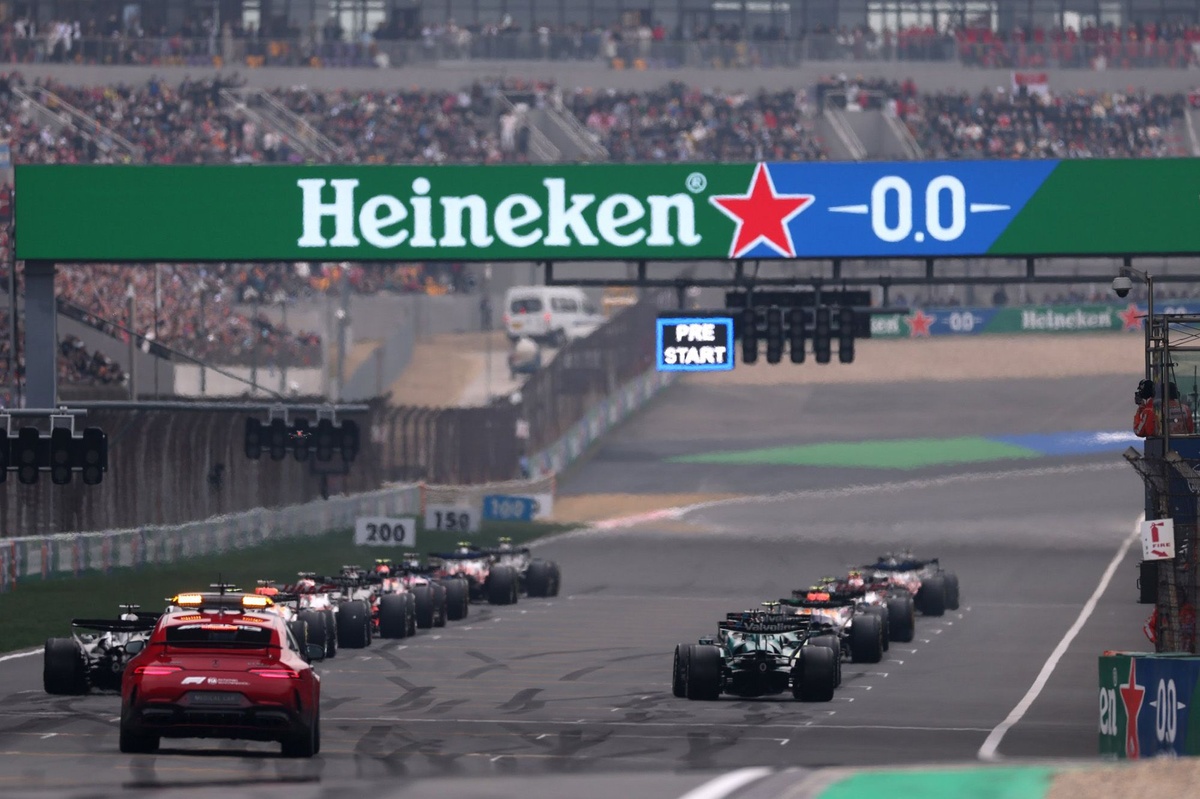
Before the F1 season kicked off, there was a brief brouhaha over the starting procedure as around half the grid belatedly realised that the removal of a key hybrid power element from the technical package was going to put them at a disadvantage. Boo hoo, you might say – that was certainly Ferrari’s POV, having seen the problem coming, planned for it, and therefore naturally felt disinclined to agree with changes to help the Johnny-come-lately crowd.
Teams instinctively guard competitive advantage, but this remains a safety issue. When 22 Formula 1 cars launch, massive quantities of energy are being unleashed (or not, as the case may be). And when cars collide at different closing speeds, that energy has to go somewhere. This is not conjecture, it’s a basic tenet of physics: energy doesn’t just disappear, it changes form.
Over two grands prix and a sprint race so far, we’ve seen several examples of cars being slow away from the grid, and others having to swerve to avoid them. This despite a change to the starting procedure giving drivers a five-second grace period to spool up their turbos before the lights go on.
Read Also:
Max Verstappen hasn’t had a clean getaway in any of the races thus far. And while in Melbourne it was because he arrived on the grid with a depleted battery, in China he twice suffered the same problem as Liam Lawson had in Australia: a brief drop into anti-stall mode.
In Albert Park, you’ll recall, only Franco Colapinto’s remarkable reflexes averted a very nasty accident as he guided his Alpine between Lawson’s stricken car and the pitwall.
The danger is that the risks associated with the start are being overlooked because of another attention-grabbing existential issue, the quality of the racing in F1’s new ‘Mario Kart’ era. On Saturday in China there was a stark example of what can go wrong – but because it happened long after the F1 sprint and qualifying, when many of the denizens of the press room had packed up and gone, and the TV pundits were in the paddock blathering to camera or availing themselves of the free Heineken bar, it went largely unnoticed.
At the start of the Porsche Carrera Cup Asia race, polesitter Naquib Azlan’s car stuttered away from the line and the entire field had to swerve in avoidance, a process which became sketchier as the back-of-the-grid cars arrived on the scene at ever-higher closing speeds. The resulting collision destroyed three cars, including Azlan’s, while 60-year-old gentleman driver Francis Tjia smote the Armco at the pit exit head-on.
This being an area where cars aren’t expected to meet the barrier at that angle and velocity, there was no cushioning layer of tyres or Tecpro. Marshals had to cut a hole in the wrecked 911’s roof to extract Tjia, who was then taken to hospital via helicopter, where he was described as “conscious and talking” in a terse statement from the race organiser, which added “his injuries are not life-threatening”.
Tjia will no doubt have been delighted by this outpouring of empathy.
There is, of course, a caveat, in that the F1 grid is graced by the 22 best drivers in the world, while the Porsche Carrera Cup’s consists of a smattering of professionals, followed by sundry dentists, plastic surgeons, and others whose net worth exceeds their talent at the wheel. But this doesn’t diminish the risks associated with an F1 start, it merely frames the participants as better equipped to mitigate them.
Safety in F1 is a continuous learning process. Sometimes it takes an accident to illustrate a risk which has been sitting there, unnoticed
A few years ago this author interviewed the astronaut Mike Massimino, who had been on two space shuttle missions to service the Hubble telescope either side of the catastrophic destruction of Columbia upon re-entry in 2003. Naturally, the conversation turned to his views and feelings on the risks associated with going into space and back again, given previous events.
His take was that the fate of Columbia was a consequence of so much focus being put on mitigating the risks of launch, given the previous loss of Challenger in 1986. This had diverted attention from the risks of re-entry; complacency had crept in.
Safety in F1 is a continuous learning process. Sometimes it takes an accident to illustrate a risk which has been sitting there, unnoticed. But grand prix history is redolent with examples of avoidable startline accidents.
In terms of the dangers associated with very different closing speeds, the 1982 Canadian Grand Prix is a prime example. There, polesitter Dider Pironi stalled his Ferrari fractionally before the start signal and was struck by the Osella of Riccardo Paletti, who had launched from 23rd on the grid and was unsighted by others ahead. As with the Porsche Cup crash in China, those setting off from the back arrived at the rear of the troubled car that much faster, and had less time to react.
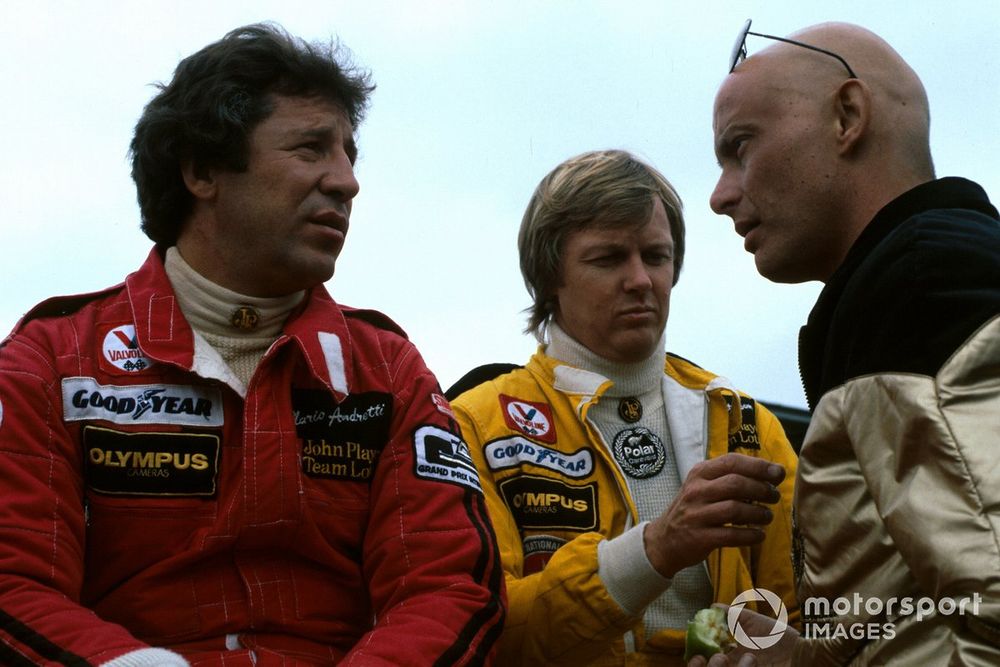
Mario Andretti, Ronnie Peterson, Lotus, and Gunnar Nilsson
Photo by: Sutton Images
The 1978 Italian Grand Prix, where Ronnie Peterson, like Paletti, suffered fatal injuries, is another case in point. The trigger for that was the start signal being given prematurely, before the cars at the back of the grid had stopped on their marks, which wouldn’t happen in the modern era; but the result was a first-corner tangle exacerbated by the midfield and backmarkers arriving at high speed. Given the current circumstances, this could still happen.
But for now, all the oxygen appears to be taken up by the debate surrounding the effect of the 2026 regulations on the racing – and what, if anything, can be done to make overtaking a function of racecraft rather than software-arbited energy management.
There are also vested interests in not changing the present state of affairs, since the inevitable result would be Mercedes dominating every race from pole position – whereas at the moment Ferrari’s elastic-band launches at least provide a few laps’ worth of action, even if it is the much-derided ‘yo-yo racing’. The commercial rights holder claims the spectacle as a win after years of turgid midfield DRS trains and races determined by tyre degradation.
Will it continue to do so if a tragedy forces it into crisis communications mode?
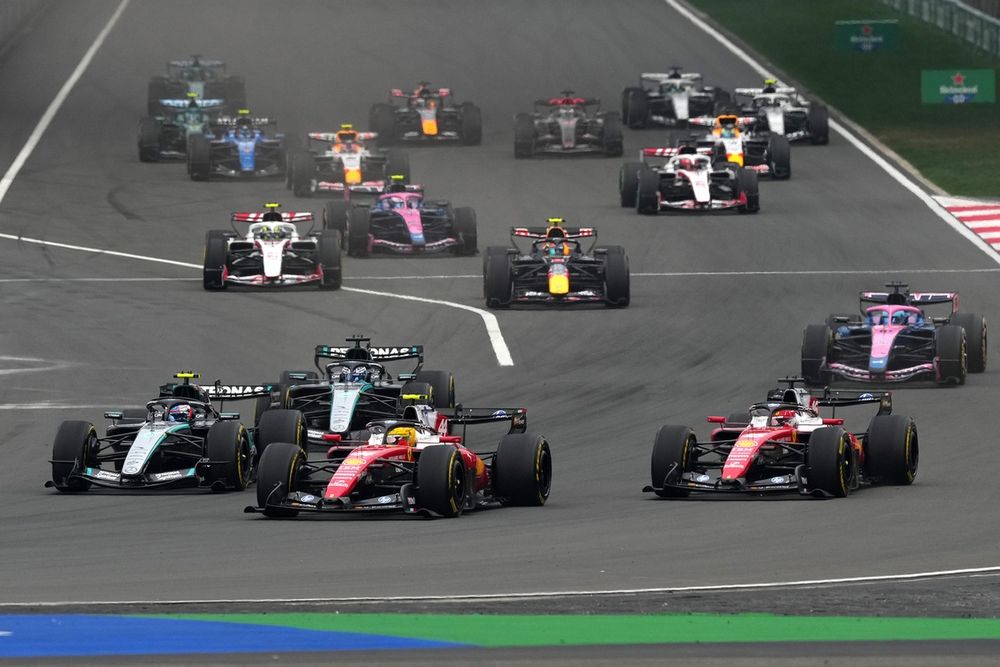
Start action
Photo by: Alex Bierens de Haan / Getty Images
We want to hear from you!
Let us know what you would like to see from us in the future.
– The Autosport.com Team