
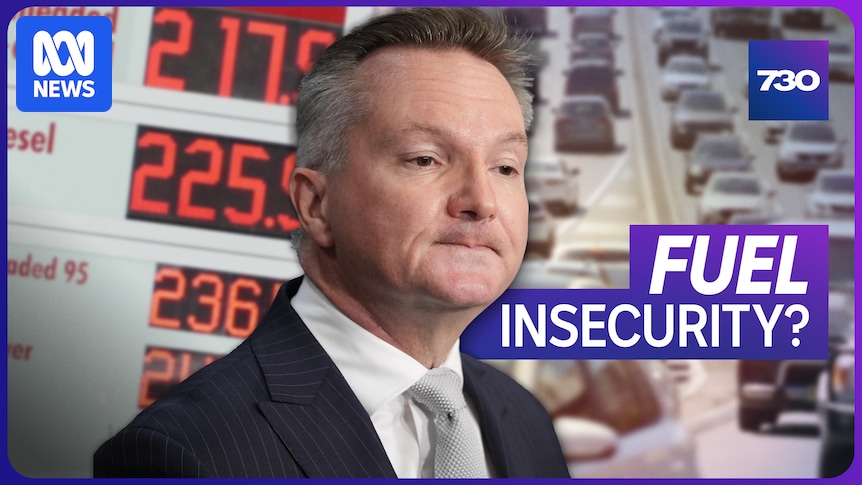
SARAH FERGUSON, PRESENTER: Chris Bowen, welcome to 7.30.
CHRIS BOWEN, ENERGY MINISTER: Great pleasure, Sarah.
SARAH FERGUSON: So today you officially enabled fuel companies in Australia to release an extra 762 million litres of petrol and diesel from their reserves. How quickly will that fuel reach the people who need it?
CHRIS BOWEN: So we did take the not straightforward decision to for the first time access our strategic reserve of petrol and diesel to help with the situation caused by a massive increase in demand.
I’ve signed the instrument, it’s now the law of the land, and we have worked very closely with companies over the weekend for them to give us an undertaking of that petrol and diesel will flow to regional areas in particular.
There will be some time for it to flow through. There’s a very complicated supply chain. There aren’t trucks sitting around refineries just waiting to deliver diesel and petrol, but it is going to have an impact. Some companies have said it will start to have an impact in coming days to some degree, but there will be some time before it’s all released and all through the system.
But it was the right thing to do through strategic reserve, which we set up in 2022 is for a rainy day, and this is the circumstance to call on that and to try and deal with some of those very concerning unacceptable shortages in rural and regional areas in particular.
SARAH FERGUSON: Isn’t that the reserve that was put in place by the previous Coalition government?
CHRIS BOWEN: I signed the regulation to bring it in. The previous government didn’t do that. It was passed in a bipartisan fashion through parliament as bipartisan legislation, but it had not been implemented until we came to office.
Until then, Sarah it had been the policy of the government, of the Liberal government to hold our reserves in Texas and Louisiana. And while it will take some time for the fuel to flow from Geelong and Litton in Brisbane, it’ll be a lot faster than if we had kept with the previous government’s approach of keeping our reserves in Texas and Louisiana.
SARAH FERGUSON: Nonetheless. I’m just going to stick with that point that it was an endeavour of the previous government, but let’s move on. There’s a lot of panic around at the moment. Is it your position that we do not have a supply problem for fuel in Australia?
CHRIS BOWEN: Well, they’re the facts. Every ship that we’ve expected has arrived and that’s why I completely understand people’s concerns and I completely understand what people would say. How can we not have any supply problem but there be shortages. I completely understand that, particularly for those Australians in rural and regional Australia who are seeing empty service stations.
But what I say is let’s be clear on the facts and everyone is better off if we do that. Every ship we have expected to arrive has arrived. We continue to talk to the refineries about that and plan for the future.
The refineries are working well. As the figures I released yesterday show in Australia, we have 2.7 billion litres of diesel, one and a half billion litres of petrol, and we have that in Australia at the moment. What we do have is a hundred percent increase in demand in just a few days.
Any commodity, any commodity, whether it be petrol, diesel or anything else, is going to run short in some areas if you get that big spike in usage, not actually people using petrol, but people buying petrol.
And that’s why, while I understand people watch the news and see ships being blown up in the Strait of Hormuz and worry about it, let’s deal with the facts.
Others are scaremongering, others are playing politics. We are just dealing with the facts, working with the industry, providing whatever support we can.
SARAH FERGUSON: Now you announced last week that you would temporarily raise the allowed level of sulphur in fuel again to enable more fuel to get into the market. Has that happened yet?
CHRIS BOWEN: Yes. This is a process which would normally take around 18 months under the legislation to work through. We’ve done it in about three or four days. I’ve signed the regulation earlier today.
This is a government working very quickly. This was first raised with us by Ampol on Wednesday as a potential that they could supply about an extra a hundred million litres a month. We worked that through carefully, I made the announcement quickly, but carefully the next day and subsequently a process which would normally take 18 months and I’ve seen some political commentary, some carping from the Opposition, but really they should have just been better briefed because it has been implemented and would normally take a process of up to 18 months, been turned around in three or four days.
SARAH FERGUSON: So what impact will these two decisions on supply have on people currently paying up to or even more, I haven’t seen the very latest numbers but paying $2 70 a litre for diesel.
CHRIS BOWEN: Well, obviously the more supply, the more downward pressure on prices. I’m not doing these things making a particular claim about prices or price impacts.
We are doing them to ensure the supply of diesel and petrol to rural and regional Australia in particular where there are real and unacceptable shortages.
As I said, about a hundred million litres a month from the sulphur move and as you said, 762 million litres in total from the strategic stockpile are reserved.
That’s the total, obviously putting that amount of petrol and diesel into the market will help primarily with supply. It will also help with prices or downward pressure on prices.
But the biggest impact on the price of petrol as previous ministers have said, and they’ve been right and I will say is always going to be the global oil price that is elevated at the moment and will continue to be elevated for the foreseeable future.
SARAH FERGUSON: So what will happen to the diesel price if there is no resolution to the crisis blocking the Strait of Hormuz?
CHRIS BOWEN: Well, the situation is the same for diesel and petrol, that the biggest impact on price will be the global oil price and that global oil price will remain higher than anyone would like it while the global uncertainty remains,
I mean we did participate in the International Energy Agency release of 400 million barrels. I can tell you that now 412 million barrels have been released by International Energy Agency members including us. So that’s going to have some good impact.
That’s the biggest coordinated effort ever in the history of the International Energy Agency since it was formed 50 years ago. So that’s going to counterbalance some of the pressures, but the pressures will remain and the uncertainty will continue to cause the oil price to be higher than anyone would like.
SARAH FERGUSON: So I know that you have to be very careful about panic. It’s one of the biggest problems you face at the moment. Nonetheless, people need to prepare for the future. What sort of prices could we see if oil stays at the level it’s at or goes up further?
CHRIS BOWEN: Well, obviously, as you said correctly, Sarah, petrol and diesel are very expensive at the moment by any standard.
We are going to see that continued pressure in the system. Obviously, we all want to see the situation resolved in the Middle East as quickly as possible. That’s the preferred outcome on many levels, for many reasons, not least to which is it would see the oil price return to more normal levels.
I don’t think we’ve yet seen the full impact of the IEA decision flow through. Obviously that’s only just happened. Countries like Australia and others have released a lot of oil, petrol and diesel back into the market from strategic reserves. That was designed to put down and pressure on prices. I think we will see some of that, but obviously it’s in very difficult circumstances.
SARAH FERGUSON: You made it clear that the situation, obviously in the Strait of Hormuz is having a direct impact on the situation in Australia. Why won’t the Albanese Government then, why did they make a decision not to send naval assets to the coalition that President Trump wants to build to accompany tankers through the Strait of Hormuz?
CHRIS BOWEN: Well, we haven’t received a request, Sarah, but also, we have focused on supporting our friend and ally, the United Arab Emirates with the E-7. There’s a contingent of 85 defence personnel associated with that. It’s no small undertaking. I can tell you the E-7 is already up and running doing this job.
SARAH FERGUSON: That’s a different question, if I may.
CHRIS BOWEN: Well, it’s a related question if I may Sarah.
SARAH FERGUSON: That is for protecting the defensive capability of the United Arab Emirates. This is a question about the coalition to secure supply, tanker supply through the Strait of Hormuz.
CHRIS BOWEN: But it’s related, Sarah, because we got the request for the E-7and could dispatch it pretty quickly. We’ve not received a request for a ship, and an Australian ship would take weeks to steam to the Middle East to prepare and get there and play a role.
And obviously we are better placed to support things like supporting the UAE with many thousands of Australians in the UAE as we speak, and to support that defensive, entirely defensive action by sending the E-7. That is how we can best participate in our judgement at this point in the dispute in the Middle East.
SARAH FERGUSON: Chris Bowen, thank you very much indeed for joining us.
CHRIS BOWEN: Great pleasure Sarah.