
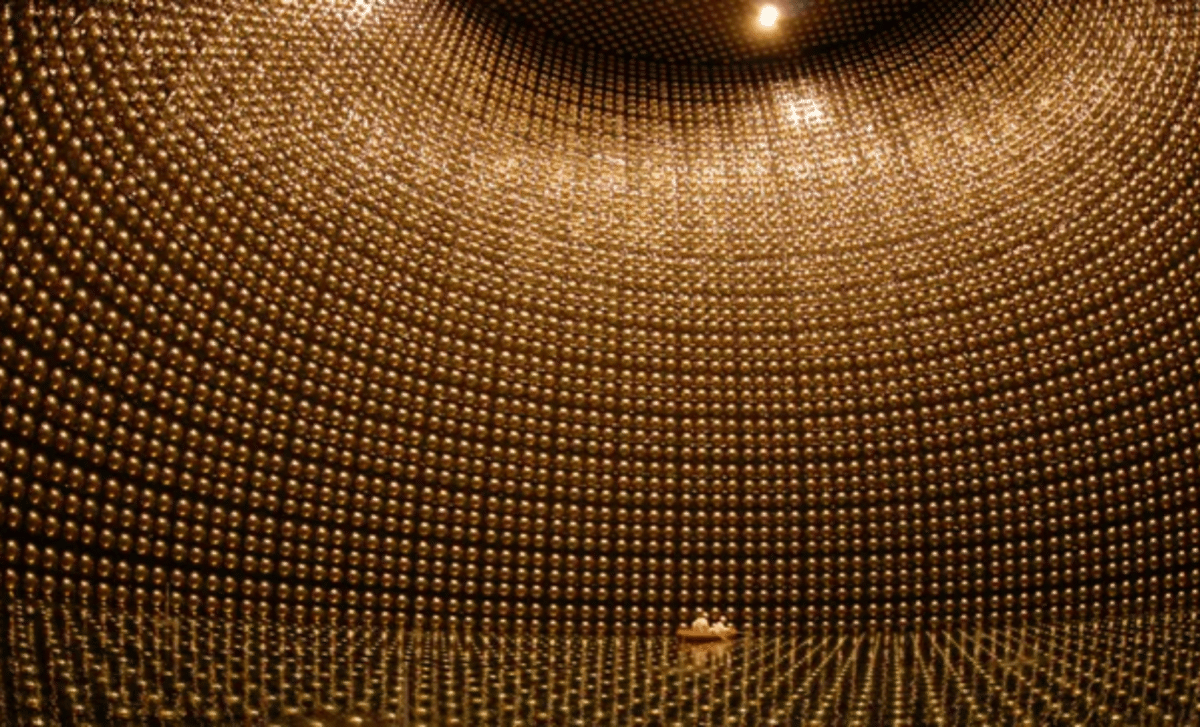
Scientists are on the verge of detecting neutrinos, particles produced in supernova explosions from stars that perished billions of years ago. The Super-Kamiokande detector, a state-of-the-art telescope buried deep underground in Japan, is primed to catch a glimpse of these elusive particles, known as “ghost particles.” The discovery could unlock the mysteries of the universe’s earliest supernovas and even trace stellar events that occurred before Earth was born. According to a study published in The Conversation, this advancement could revolutionize how we understand the life cycle of stars and the history of the cosmos.
The Super-Kamiokande Telescope: A Gateway to the Past
At the heart of this monumental discovery lies the Super-Kamiokande telescope, one of the most sophisticated neutrino detectors in existence. Located in a cavern 1,000 feet below the surface in Japan, this massive facility is equipped with thousands of sensors designed to detect subatomic particles. What makes neutrinos so fascinating is their ability to pass through matter without interacting, allowing them to travel vast distances across the universe, untouched and unseen.
The Super-Kamiokande detector has undergone significant upgrades in recent years, making it more sensitive and capable of detecting the faintest traces of neutrinos from long-dead stars. According to a study published in The Conversation, these particles, often referred to as “ghosts,” are produced in the violent explosions of massive stars, known as supernovas. When a star dies in a supernova, it releases an enormous amount of energy, with 99% of that energy escaping as neutrinos, while only 1% is emitted as visible light. The ability to detect these neutrinos would provide a unique window into stellar death, an event that typically occurs far beyond the reach of traditional telescopes.
Ghost Particles and Their Journey Through Space
Neutrinos are an extraordinary class of particles because they barely interact with matter. Despite their abundance, billions of them pass through every square inch of the Earth every second, these particles remain nearly invisible to detection. For years, scientists could only theorize about the information these particles carry. But now, with the enhanced capabilities of Super-Kamiokande, the dream of observing these particles is becoming a reality.
What makes this discovery so significant is the age of the neutrinos the telescope will be able to detect. Some of them may have been traveling through space for over 10 billion years, originating from supernova explosions long before Earth even existed. By capturing these “ghosts,” scientists could peer back in time, studying stellar events that predate the formation of our planet and offering unparalleled insight into the evolution of the universe.
The Science Behind Detecting Supernova Neutrinos
Understanding how neutrinos are created during a supernova is crucial to comprehending their potential to unlock the secrets of the universe. A supernova occurs when a massive star reaches the end of its life cycle and undergoes a dramatic collapse. The core of the star implodes, causing a massive explosion that releases energy in all directions. As the outer layers of the star are blown apart, neutrinos are created in enormous quantities.
Because neutrinos interact so weakly with matter, they can pass through entire planets without being absorbed or deflected. This makes them ideal messengers of information about stellar events that would otherwise be impossible to observe. The challenge for scientists has always been creating instruments sensitive enough to detect these elusive particles.
The Super-Kamiokande telescope is poised to meet this challenge. With its vast array of detectors and underground location, it minimizes interference from cosmic rays and other background radiation, giving it a unique ability to isolate the faint signals of neutrinos from distant supernovas. If successful, this mission would mark a historic moment in astronomy, allowing researchers to observe the “ghostly glow” of stars that died billions of years ago.