
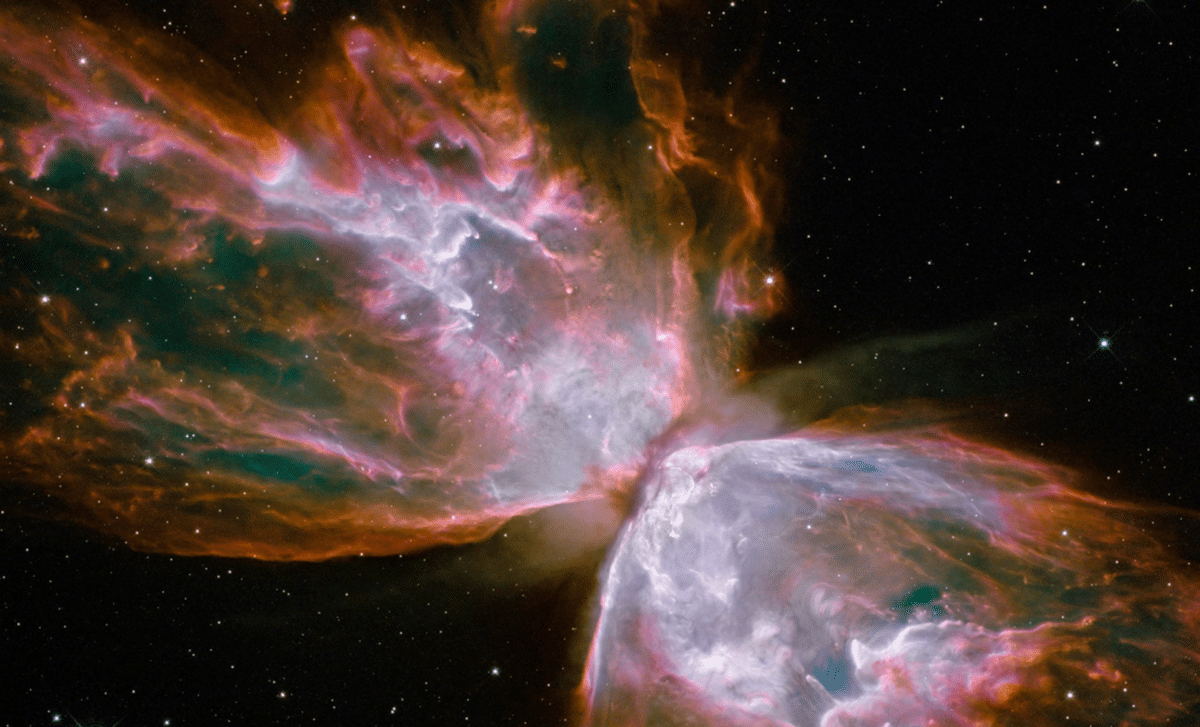
For the first time, astronomers have discovered dry ice (carbon dioxide ice) in a planetary nebula, shedding new light on the complex chemistry occurring in the universe’s most dynamic environments. This groundbreaking discovery was made using the James Webb Space Telescope (JWST), with results published on the arXiv pre-print server on February 25, 2026. The team, led by Charmi Bhatt of the University of Western Ontario, has opened an entirely new chapter in the study of the interstellar medium and the chemical processes occurring in dying stars.
A New Frontier in Astronomical Research
The detection of dry ice in the planetary nebula NGC 6302 is a milestone that changes our understanding of how ice forms and behaves in extreme environments. NGC 6302, located 3,400 light-years away in the constellation Scorpius, has long been a subject of intrigue due to its complex structure and rich chemical composition. Known as the Butterfly Nebula, its unique shape and vibrant features have drawn astronomers eager to uncover the secrets of its gas and dust-filled environment.
Planetary nebulae, like NGC 6302, represent the final stages in a star’s life cycle before it transitions into a white dwarf. These nebulae are primarily composed of gas and dust ejected by the star, creating an intricate web of chemicals that provide insight into the cosmos’ elemental makeup. The discovery of carbon dioxide ice in this setting challenges previous assumptions about the fragility of ices in such hostile environments, where ultraviolet radiation typically destroys molecular ices like CO2.
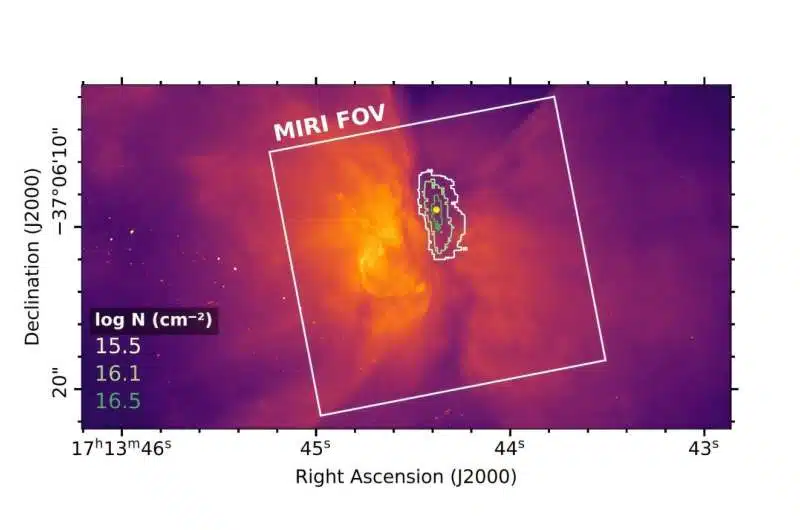 Location of carbon dioxide ice in NGC 6302. The image shows HST/WFC3 observations featuring filter F656N, which traces hydrogen-alpha emission. The JWST MIRI mosaic is indicated by the white frame. Contours show the column density of gas-phase carbon dioxide, with corresponding log N values (cm−2) provided in the lower left. Credit: arXiv (2026). DOI: 10.48550/arxiv.2602.22366
Unveiling the Mystery with JWST
The pivotal observations that led to this discovery were made using JWST’s Mid-Infrared Instrument (MIRI), a state-of-the-art tool designed to capture high-resolution images and spectroscopic data in the infrared spectrum. The research team focused on the central star, torus, and innermost region of NGC 6302’s bipolar lobes, utilizing MIRI’s medium-resolution spectrometer (MRS) to examine the nebula’s chemical components in unprecedented detail.
“This work utilizes JWST MIRI/MRS observations of NGC 6302 covering the central star, torus, and innermost region of the bipolar lobes,” the paper states.
The observations revealed clear absorption features in the 14.8–15.2 µm range that correspond to gas-phase carbon dioxide, marking the first detection of dry ice in a planetary nebula. The team also identified two key absorption bands between 14.9–15.15 µm and 15.2–15.3 µm, which correspond to the distinctive signatures of carbon dioxide ice.
Why This Discovery Matters
The detection of CO2 ice in NGC 6302 is not only a breakthrough in planetary nebula research, but it also holds significant implications for understanding the chemistry of the universe. While molecular ices like water and carbon dioxide are commonly found in dense, cold environments such as molecular clouds and protoplanetary disks, planetary nebulae are much more hostile. The intense ultraviolet radiation that characterizes these regions typically destroys fragile ice species, making the presence of dry ice in such an environment an extraordinary find.
This means that the ice in NGC 6302 could have formed under different, previously unknown conditions compared to those found in other, cooler parts of the universe.
A Peek Into the Chemical Landscape of Dying Stars
The discovery of carbon dioxide ice also contributes to a growing body of knowledge about the chemical processes at play in dying stars. Previous research in NGC 6302 had already identified other complex molecules, such as methyl cation (CH3+), which is central to organic chemistry. The nebula’s ability to support such diverse chemical species suggests that its environment is a rich laboratory for studying the formation of complex molecules, potentially even the building blocks of life.
In particular, the team’s findings, available on arXiv, indicate that the gas-to-ice ratio in NGC 6302 differs significantly from those observed in younger stellar objects (YSOs), suggesting that the mechanisms for ice formation and processing are distinct in evolved stellar environments. This provides important insights into the diverse chemical pathways that can occur in different stages of stellar evolution.