
[This story contains MAJOR spoilers from the season one finale of Scarpetta, “Bridge of Time, Part Two.”]
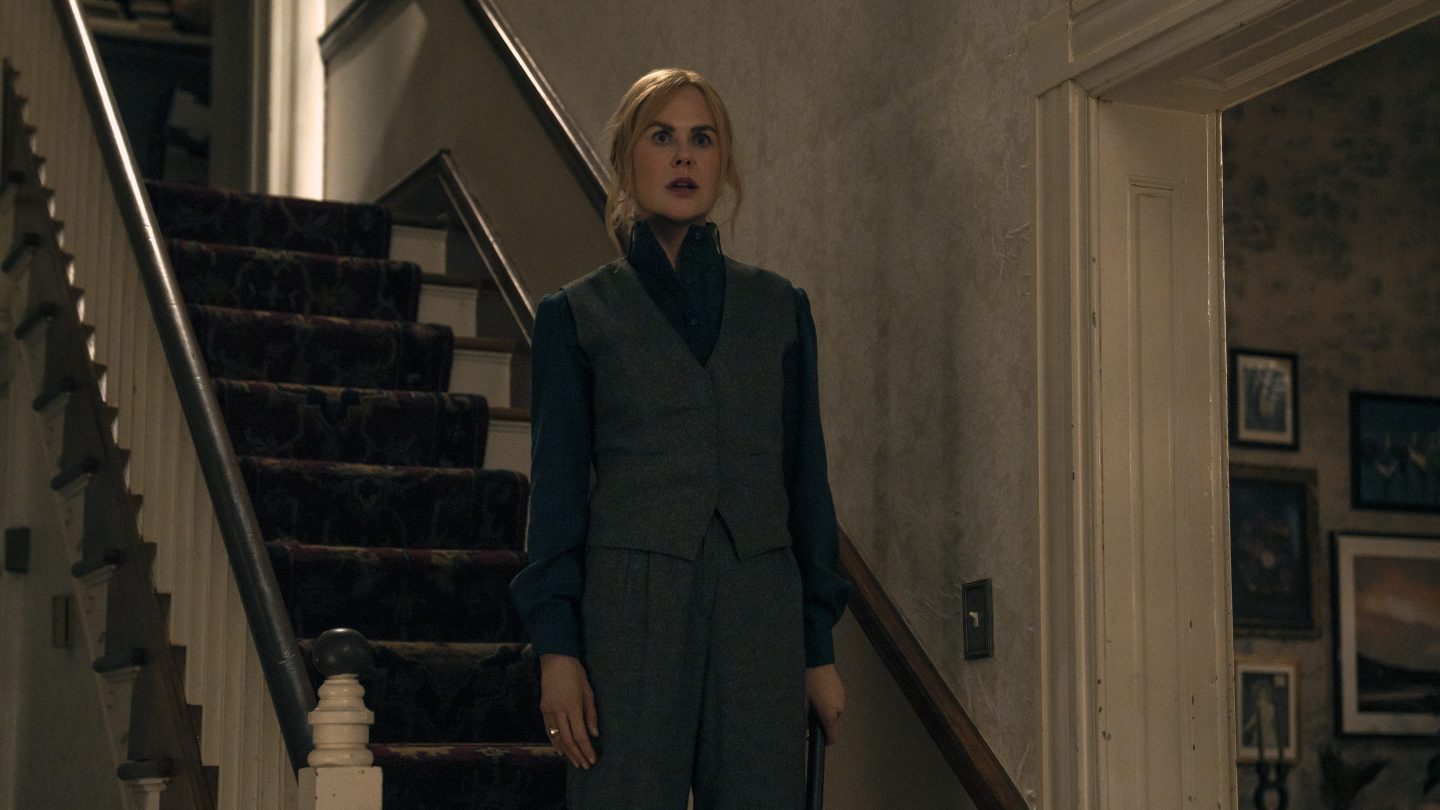
Dr. Kay Scarpetta (Nicole Kidman) has just become the kind of cold-blooded killer that she has spent her entire life trying to bring to justice.
In Prime Video’s adaptation of Patricia Cornwell’s bestselling crime novels, Kay returns to the Commonwealth of Virginia to reassume the role of Chief Medical Examiner, the same office she had once occupied in her early 30s. Ambitiously told across two timelines, the eight-episode first season, adapting Cornwell’s Postmortem and Autopsy, finds Kay investigating a new female-targeting serial killer while wrestling with the guilt over a big secret that cast a dark cloud over her first major case with a similar MO decades earlier. (Kidman plays the protagonist in the present day, while Rosy McEwen plays her in the late ’90s.)
The seventh episode finally reveals the dark secret that has bonded Kay with her detective brother-in-law Pete Marino (played by Bobby Cannavale in the present day, and Cannavale’s real-life son Jacob Lumet in the past). In the ’90s, Kay correctly deduced that the elusive serial killer was Roy McCorckle, a 9-1-1 dispatcher who had answered all of the calls of his future female murder victims. Without any back-up, Kay went to visit Roy’s home, where she found a screaming woman gagged and bound on his bed. In the ensuing confrontation, Roy attempted to strangle Kay to death, but she managed to kill him in self-defense.
However, before any other officers could arrive on the scene, Pete made the rash decision to cover up Kay’s involvement by shooting the serial killer’s body a couple more times. Kay is then forced not only to conduct an autopsy on the same man she killed, but also to lie about her findings. “In the past, Kay does what her instinct tells her to do. She hears a woman screaming and she goes into help,” showrunner Liz Sarnoff tells The Hollywood Reporter. “It’s actually Marino who makes the decision to take the blame for it and traps her in a situation she doesn’t want to be in. She would’ve probably more likely just been honest about it. But once he does that, it starts a cycle of events that they then have to lie about for 25 years.”
That long-buried secret ultimately puts a strain on all of Kay’s familial relationships in the present. Pete, who has always had feelings for Kay, opts to move out of their shared house and stay in a hotel with his wife, Kay’s flighty sister Dorothy (Jamie Lee Curtis). Kay’s niece, Lucy (Ariana DeBose), turns her back on her aunt after Kay disapproved of the way Lucy was grieving the death of her wife Janet (Janet Montgomery) with an AI bot. Meanwhile, Kay’s FBI profiler husband, Benton Wesley (Simon Baker), who has been struggling with demons of his own, asks Kay for a divorce after she refuses to apologize for lying to him and then dismisses his worst fears about himself.
“By the end of the last episode, every single person has walked away from her. She’s entirely alone when the killer comes to get her,” Sarnoff adds. Kay is last seen with blood splattered all over her face after beating to death the present-day serial killer, Officer August Ryan (David Hornsby) — who broke into her house to thwart her investigation — with a baseball bat. To complicate matters further, a shadowy figure then opens the front door to Kay’s residence, catching her in the throes of a crime of passion in the season’s final moments.
In September 2024, Prime Video officially picked up the TV adaptation of Scarpetta with an order for two eight-episode seasons. After wrapping filming last March on the first season, Sarnoff reveals to THR that her writers room has already penned seven episodes for next season, which just began production this week in Nashville. (Filming will continue into the summer, with the series likely to return around this time next year.)
Below, Sarnoff opens up about her personal connection to Scarpetta, how she developed the messy love triangles between the fundamentally broken characters at the heart of the series — and her plans for next season, which will adapt Cornwell’s Cruel and Unusual and The Body Farm.
***
Scarpetta was put into development and officially announced without a showrunner already attached in 2021, and you immediately had your agent reach out to put your hat in the ring. What was your pitch? How do you think your take on this adaptation differed from other writers who have tried unsuccessfully to tackle this material?
As Patricia always said, she liked that I had actually read the books. I had a real emotional connection to these books. I read them with my mother in the ’90s. It was a series we would read to each other; we would send the books back and forth. There were no big female bosses back then [in fiction] or anything like that, and she was a really fully realized character. She was everything that a woman is, but also did this insane job [as a medical examiner] and then solved crimes. So I pitched my love to them for the series of books, and my desire to stay loyal to it and not screw it up too much, hopefully. It took a while, but I think I really sold it when I came up with the idea to do the show in two time periods.
Why did you choose to tell the show across two different timelines?
[Like Kay] I remember myself in my 30s. I was just starting out in this business, but at the same time I was doing Deadwood and I thought I was an old, seasoned pro. I look back on that time now, and I’m like, “Wow, I didn’t know anything.” Now I’m doing it again 25 years later, and it’s a very different experience. Patricia had started putting out books that were in a later time period, and I thought to really do this right, you want to see the character talking to herself in both timelines. Because there was so much material, it felt like the right way to do this show was to put as much in as you could and try to find a way to mete it out over eight episodes.

Past Kay (Rosy McEwen) and past Marino (Jake Cannavale).
Connie Chornuk / Prime © Amazon Content Services LLC
Whereas Kay and Dorothy’s father died of leukemia in the novels, the show reveals that Kay watched her father die by a gunshot wound in front of her — and Dorothy watched the aftermath through a glass window. Why did you choose to make that key change to their backstory?
In the writers room, we came up with the idea of doing these flashbacks for each character, and we looked at it as the moment they all broke. When I talked to Patricia about the death, I said, “For a TV show, we want to make it visually dramatic.” Him dying in a backroom of leukemia and her caring for him didn’t feel like it was going to play, so we came up with the idea of there being a robbery and Kay seeing it. When we see her as a kid over the body and then cut to a scene with her as an adult with a million bodies around her, you start to understand she’s never gotten out of that moment, in the way traumatic moments stay with us.
Dorothy is not as affected by the events — she’s a different persona — and I got the idea that seeing it through the window gave her a degree of removal that created her personality. She’s still doing the same thing. She goes out that night, and she has sex with that guy. And now, her trauma is that anytime anything gets serious or real or too emotional, she goes out and has sex and fucks it up. So it made sense to me that it was the same incident, but how you receive the incident is everything.
Jamie was only supposed to executive produce Scarpetta, but Nicole confirmed to me that she basically forced Jamie’s hand to play Dorothy. In retrospect, I don’t think anyone else could have played the way Dorothy shimmies around the dead bodies at the Medical Examiner’s office quite like Jamie did. Did you work with her at all to find the distinctive look and physicality of the character?
We definitely talked about the look a lot. The look in the books is always pretty outrageous, but once Jamie realized she was doing it, she was very clear about how she wanted to come off and what she wanted to wear. A show like this is so lucky to have a character like that, because otherwise it’s unrelentingly dark. So it was really a joy to have those scenes, and nobody knew until their first scene together what they were going to be like together. That’s always a crapshoot on set. And from the first second they started arguing, we were all in heaven.
How did you think about evolving the sisterly relationship between Kay and Dorothy then?
Lucy is a big part of that. It’s very hard because she’s not Kay’s child, and Dorothy buggers off to do what she wants to do when she wants to do it. Although Kay’s not the real parent and that’s where Dorothy rules, Kay has a lot of opinions about [how Lucy is grieving]. Kay feels a real obligation to Lucy because, in her head, [Lucy] wouldn’t want to be raised by Dorothy. I don’t think anybody would really want to be raised by Dorothy. Kay didn’t even want to be raised by her own mother. Kay’s trying to be this other thing, and at the same time, she has enormous resentment [toward Dorothy] because she has this massive career and didn’t have children herself, and now she’s still responsible.
Whose idea was it to cast two generations of Cannavales to play Pete?
Once we were talking to Bobby and we realized Jake existed, it was a no-brainer. (Laughs.) Casting doubles is hard, and we double a lot of people in the show. We were very lucky with Rosy [McEwen], because the physical similarities are so strong, but Bobby and Jake really are the same. So once we saw him in the part, we were like, “This is perfect,” because he really will become Bobby one day.
Kay Scarpetta (Nicole Kidman) in the season one finale.
Connie Chornuk / Prime © Amazon Content Services LLC
Having all of the characters of this dysfunctional family under one roof really feels like the ultimate pressure cooker — especially when you add in the additional complication that Dorothy’s husband Pete was in love with Kay, but Kay fell quickly for Benton. How did you think about building out this love square of sorts?
Triangles are always the best thing to have in a show. Lost [one of Sarnoff’s most notable writing credits] lived and died on its love triangles. I knew it would help us to have a lot of them. Even Lucy-Dorothy-Kay are a love triangle, so it was just about spinning the triangles a little bit. Also, it’s about different kinds of love. There is a real love between Kay and Marino, and the journey for them is to figure out exactly what that is. Sometimes it’s friendship, but it feels like more — or it feels more comfortable than maybe your marriage in that moment. But the reality is, that’s a friendship. That’s why it feels so good. So [the show’s] about them figuring out who they are with each other. Kay and Benton, at the point we meet them, have been together a long time and faced a lot of demons together. Marino is also happier in his life. Kay and Benton are way more tortured, which is why they seem like a good couple. You just don’t know. It’s that thing that we all experience in life, like, “Wait, is this person right for me?” And if they stay in your life long enough, you continue to wrestle with it.
You created little cracks in both marriages this season, but Kay and Benton’s union seems to be on really thin ice by the end of the season. Does Benton really want a divorce?
In that [finale] scene where he says, “I want a divorce,” he tries to open himself to her, and she won’t listen to it. I think the dismissiveness with which she takes this genuine confession from him — in the moment, he’s like, “I’m not even a person [to you], so I want out.” I don’t think he goes into that scene thinking, “I’m going to ask for a divorce.” I think he goes into that scene thinking, “I’m going to tell her the truth about me, and maybe she’ll tell me the truth about her.” Instead, she says, “I don’t want to hear any of this,” and that’s the thing that turns him.
The flashbacks to child Benton are pretty disturbing. His mother gave him a book called Why They Kill: Characteristics of Sexual Homicide as a child, and he holds on to a photo of a murdered woman from that book almost like a security blanket when he needs to self-soothe.
I think it was the moment where he broke, where his trauma was really settled on him. For Benton, this was his mother saying to him, “There’s something wrong with you.” You don’t show a book like that to an 11-year-old and tell them that they might be a psychopath, but she was a crazy shrink and did it. She filled him with doubt about his insides, and that has stayed with him [until] the scene in the truck where he’s saying, “I have these urges and I want to do these things. I don’t know that I can trust myself, because my mother thought I was a psychopath.” So it all connected, and the fun part now of season two is going to be to start that process with Hunter [Parrish], younger Benton.
Where did the idea of Lucy’s dead wife Janet coming back to life as an AI bot come from?
That comes from [Cornwell’s] book Autopsy. In the book, her wife and son died, I think, of COVID, but I thought it was too weighty to give her a dead kid. I felt like you couldn’t move forward from that. So [we killed] the wife, and then we cast Janet Montgomery, who’s a good friend of mine. The thing I love about Janet is her incredible sweetness and humanity, and I thought, If this AI character is actually the most human of them all in their own way and opens up the humanity of the other characters, that’d be cool. That was how we went about writing her.
Nicole Kidman with Jamie Lee Curtis in Scarpetta.
Connie Chornuk/Prime
Out of curiosity, can you confirm that Dorothy and Pete got together on Lucy and Janet’s wedding night?
Oh, yeah. We see them meet, actually, in season two in the past, but that’s the first time they ever get together.
The show mentions they are newlyweds. How long exactly have they been together?
It’s been two years.
The finale reveals that the real Janet died of an aneurysm, and her AI bot is now gone too. Who deleted her code? Did the AI self-destruct?
Lucy thinks it’s either Dorothy or Kay, so she’s holding onto that anger as we head into season two. But we will reveal who it was next season.
The finale also reveals that the killer in the present-day timeline is Officer Ryan. Did you ever consider changing the culprits for the murders in either timeline?
The culprit in the past is the same culprit in the book, and we changed the one in the present. I felt like he was the right guy, from very early on, to turn out to be the murderer in the present, and we could show just enough of him to make that work. The way it works is that his origin story, his flashback, is in episode one because his [villainous] turn comes when he sees [the initial victim] Lori Petersen’s body. That’s the first [crime] scene he’s been to like that, and that starts his journey into darkness. But we don’t know it yet, because that character continues in the past for the rest of the show, and we get to watch his journey now from there.
How early on did you settle on that big, bloody cliffhanger, with Kay beating Ryan to death?
Oh, very early on. Because Benton has been struggling all season to say, “I’m dark inside,” I really wanted to show her how dark she is [herself] so that now what she’s struggling with a little bit in season two is, “I bashed that guy’s head in and he was already dead.”
Since you were already picked up for season two, for continuity purposes, did you guys film an extended take of that final scene to reveal who opened the door?
No.
So who knows about the identity of the person who opened that door?
The writers know. (Laughs.)
Have we met this person before, or is this a completely new character that will be introduced next season?
Oh no, you’ve seen them before.
What else can you say about where the second season will pick up?
Season two picks up pretty soon after the events of episode eight of season one [the finale] in the present day. In the past, it picks up a little bit later. Because we were able to reveal the murder in episode seven, we were able to resolve all that stuff. But because the emotional storytelling is the key to the present, we didn’t want to miss a lot of the aftermath of that. We do two books a season — season one, we did Postmortem and Autopsy, and this year we’re doing Cruel and Unusual and The Body Farm. So the stories definitely start to pick up, and murders happen. Cruel and Unusual, [set] in the past, is a story that involves a prisoner who’s executed, so it gives us a different setting to roll into at the top of the season.
I think [next] season is more, for the present-day characters, what their journey is like without each other to some degree, because they’ve all split. So the question is: Do they end up getting back together? Do those splits hold, and who really is right for whom? It’s an exploration for them more on their own at the top of the season before they’re all brought back together.
Kay Scarpetta (Nicole Kidman) in season one.
Connie Chornuk / Prime © Amazon Content Services LLC
How did you settle on Cruel and Unusual and The Body Farm as the next books for this adaptation?
This show, for me, has been a real labor of love. I learned early on that I have to stay with my instincts and be strong about that. I read the first eight books again, and I thought these two really speak to each other, and it’ll be really interesting if we can make them work together. I didn’t want to get too far into the series — those are actually books four and five of [Cornwell’s] series — so I took a step back from the present day books and thought, “Let’s do a past book with the present-day cast.”
Your take on Scarpetta landed a two-season straight-to-series order at Amazon, which is almost unheard of in today’s TV landscape.
That was [because of] Nicole. (Laughs.)
Well, yes, the pairing of Nicole and Jamie together. Given that Patricia has published nearly 30 books in this series, do you have a multi-season plan beyond the two seasons at hand?
I have no plans. I’m thrilled to be making the second one now. There are so many books. As we shot the first season and worked on it, I wasn’t thinking about what to do for season two. And then I really took a little bit of time to go through the books again and figure out what would be the best way, because the past and the present have to speak to each other in the show — or the show doesn’t work. So it’s important that the cases and the people involved with them have some connections throughout that we can see and understand. I have read all the books, so I do know them, but I reread them all the time. It’s very helpful. To have these books is such a gift, because Patricia writes a fascinating crime story — great clue trail, great murderers.
Do you have a specific number of seasons in mind, or are you just going to take it season by season?
I’ll do it as long as they want to do it.
***
The full first season of Scarpetta is now streaming on Prime Video.