
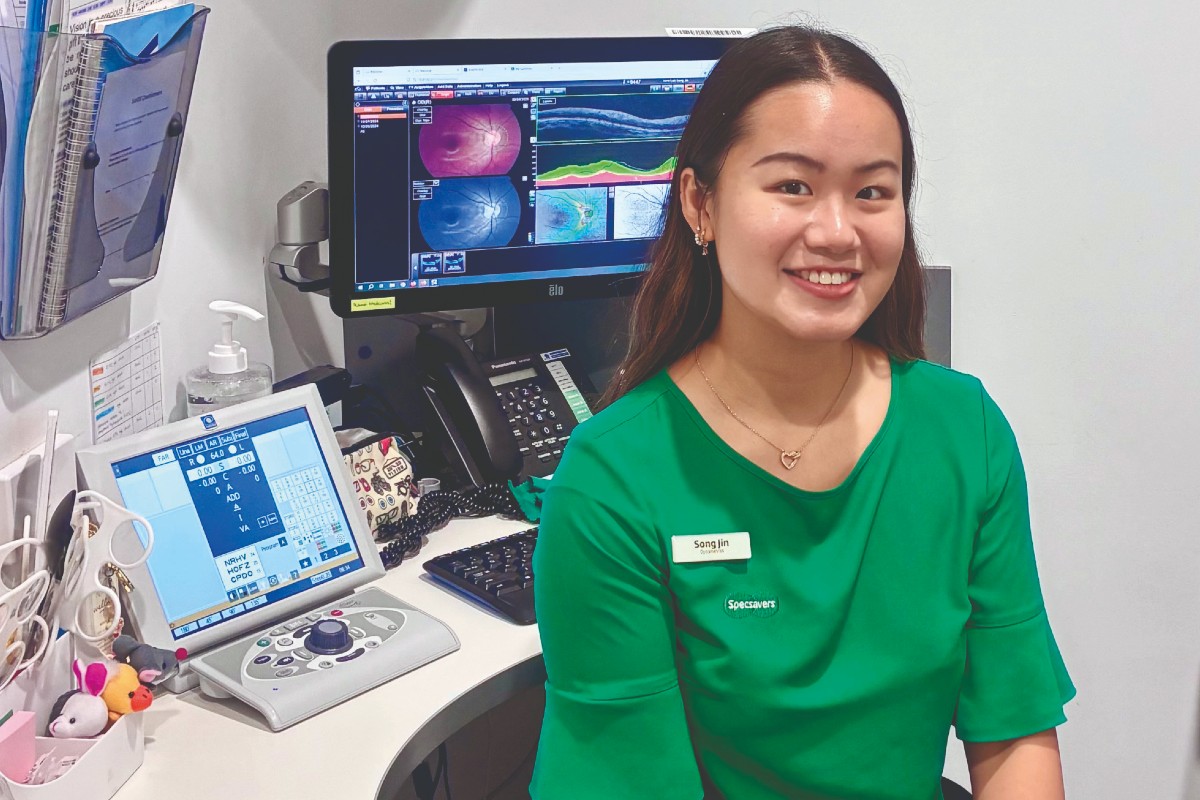
When people decide to work at Specsavers, they’re joining a company with a purpose to change lives through better sight and hearing – hence why more Australians and New Zealanders choose the optometry provider over any other.
As one of the largest employers in the ANZ optometry sector, Insight sits down with an employee each month to hear about their growth trajectory within the company.
Specsavers Stats
Name: Song Jin Loh
Current position: Optometrist
Location: Specsavers Nerang
Years within the business: 5
Why did you pursue an optometry career?
From a young age, I was fascinated by how something as simple as a pair of glasses could completely transform someone’s world. Optometry felt like a natural way to use that fascination to help people see and live better. I pursued optometry because it perfectly combines science, healthcare, and the opportunity to make a real difference in people’s lives.
How did you come to work at Specsavers?
I was drawn to Specsavers for its strong focus on clinical excellence and continuous professional development. The opportunity to work within a supportive, forward-thinking team aligned perfectly with my values as an optometrist.
Why were you nominated for the Dame Mary Perkins Award?
I was nominated by my store director for demonstrating exceptional clinical care and patient advocacy in managing two complex cases in a single day, that required swift decision-making as a graduate optometrist.
What did you do in handling this case?
When a young boy presented with headaches, double vision and swollen hemorrhagic optic nerves, I arranged for an urgent hospital referral, preventing permanent vision loss and addressing what could have been a life-threatening underlying cause. Later that same day, a 60-year-old man presented with what appeared to be a routine red eye. Instead of settling for a simple diagnosis, I conducted a thorough assessment which revealed bilateral optic neuritis, prompting another same-day referral.
What was the outcome?
The prompt referrals led to timely treatment and what distinguished my care I believe, was not diagnostic accuracy which is becoming easier with the fantastic technological advancements we have in optometry, but the compassion and composure with which I supported my patients. It is incredibly rewarding to know that early intervention made such a meaningful difference to their vision.
How did Specsavers’ training and support help you with this patient?
Specsavers’ emphasis on continuous training and especially the mentorship I received throughout my graduate program was especially helpful in building my confidence to act decisively when it mattered most. Having advanced diagnostic equipment like OCT imaging and fundus was invaluable in managing these cases effectively.
What did you learn from helping and supporting the patient?
This experience reminded me how deeply compassion influences patient care. Hearing of the patient’s gratitude, through follow-up calls in the following days, reinforced why empathy is just as important as clinical skill. That human connection is often what patients remember most.
Why are you proud to be a Specsavers optometrist?
I’m proud to work for an organisation that prioritises patient outcomes and empowers optometrists with the tools, support, and autonomy to succeed.