

Madeleine Edwards had never heard of the term vaginismus before, but about six months after giving birth to her baby girl Carmine, she was diagnosed with the condition.
The 31-year-old, who lives in Naarm/Melbourne, says it was a “heavy” diagnosis to receive as she adjusted to motherhood.
According to experts, women and those assigned female at birth who have vaginismus often put up with intense vaginal pain and don’t know it can be treated.
Our expertsPav Nanayakkara, a minimally invasive gynaecological surgeon from Jean Hailes for Women’s HealthJenny Pell, a senior physiotherapist at Melbourne’s Royal Women’s HospitalSarah Ashton, sexual health psychologist and the director and founder of Sexual Health and Intimacy Psychological Services (SHIPS)What is vaginismus?
“Vaginismus is a very common medical condition where the muscles in the vagina contract involuntarily,” says Pav Nanayakkara, an associate professor and minimally invasive gynaecological surgeon from Jean Hailes for Women’s Health.
This involuntary tightening of muscles can occur during sex, the insertion of tampons or medical procedures, Dr Nanayakkara adds.

Pav Nanayakkara says for those experiencing vaginismus, painful muscle tightening can occur any time there is penetration. (Supplied: Jean Hailes for Women’s Health)
Some research suggests it affects between one and six per cent of women, but Dr Nanayakkara thinks it impacts more women than that.
“A lot of patients don’t come forward with it, but we estimate that around five to 10 per cent of people will have it at some point in their lives.”
And although the symptoms are the same, there are two types of vaginismus.
“It can occur primarily, so without any previous trauma, or it can occur secondary to something that’s happened,” Dr Nanayakkara explains.
She says birth trauma is a common cause of secondary vaginismus.
“The body is trying to protect you from whatever it is that was traumatic.”
“[Childbirth] can be a really traumatic experience, and it might be because of severe tearing, a feeling of vulnerability, or not feeling heard [during the birthing process].”
Senior physiotherapist at Melbourne’s Royal Women’s Hospital, Jenny Pell, describes it as a “muscle spasm” — the brain perceiving a threat and at that moment, attempting to protect the body.
Other causes of vaginismus include negative sexual experiences, pelvic surgery, vulval skin issues and infections, Ms Pell says.
“Often being able to realise why the body is reacting in this way can take the fear out of the symptoms and allow physical progress to begin.”
Have you experienced vaginismus? Share with us here.
An isolating experience
During labour, Carmine’s heart rate dropped and Madeleine was advised that her best options were a C-section or an episiotomy (an incision to enlarge the vaginal opening) and forceps, she says.
She chose the latter.
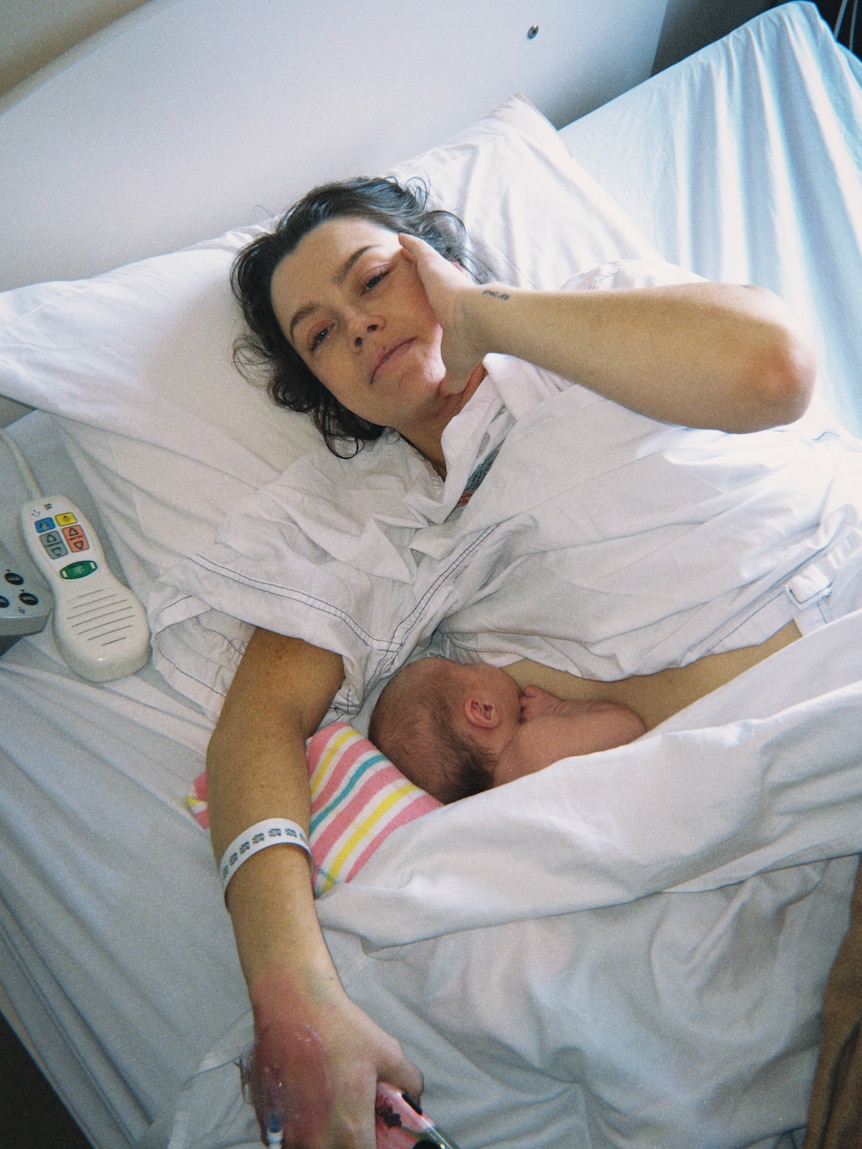
Madeleine Edwards says an infection meant she needed additional surgery after Carmine’s birth. (Supplied: Madeleine Edwards)
It would be the first of three sets of stitches to the episiotomy site in about four months due to a painful series of complications including infection, Madeleine says.
She was then diagnosed with vaginismus during a review appointment a few months after her last operation.
“They were like, ‘[your vagina is] very, very dry. You are tensing up a lot more than you should be when we’re near that area’.”
A few weeks later, a different gynaecologist gave her the same diagnosis. That’s when she remembers feeling validated.
“I was still kind of scared of my vagina.
“No-one in my immediate life could experience that with me and honestly, no one really knew what vaginismus was — me included.”
From trying and failing to have penetrative sex to avoiding touching the entire area in the shower, Madeleine says it didn’t feel like there was an “opening” there.
“You’re meant to be connected to that part of your body [and] feeling the disconnect is very, very sad.”
More women’s health stories:
Don’t ‘push through’
Both Dr Nanayakkara and Ms Pell agree that getting a diagnosis and understanding your symptoms are crucial.
“The worst thing you can do is try to push through it, because then that negative association becomes stronger and it’s harder to break that cycle,” Dr Nanayakkara says.
Ms Pell says she regularly treats women who have experienced symptoms for a long time, without a diagnosis, and have simply tried to “push through” the physical resistance to intercourse and the pain it creates.
“Pushing through is rarely the answer. For most people this makes their symptoms worse and harder to treat.
“I can’t tell you how many times each week I have patients coming to their appointments, feeling alone in their diagnosis and asking if other women also experience these symptoms.”
It’s not just ‘in your head’
Sarah Ashton, a sexual health psychologist, says there’s a misconception that because there’s a psychological element to vaginismus, it’s “in someone’s head” or “not real”.
The director and founder of Sexual Health and Intimacy Psychological Services (SHIPS) says “the pain is real, the experience is real, there’s real distress [and] real impacts on people’s lives.”
The “trauma” that has led to vaginismus isn’t necessarily physical and is not always obvious, Dr Ashton says.
“Common presentations include growing up in a cultural or religious environment that shames or stigmatises sexual activity … their body may still hold this kind of protective response to sex.”
Dr Ashton says patients aren’t just experiencing pain during sex. It’s also likely having an impact on their mental health — as well as their intimate relationships.
“A really common dynamic is someone has vaginismus and then because they experience pain whenever there’s a sexual encounter, their partner might develop erectile difficulties because they feel a sense of anxiety about causing pain.”

Sarah Ashton is also the director and founder of the Institute of Sexual Health Psychology Australia. (Supplied: Sarah Ashton)
Can vaginismus be treated?
Dr Ashton says vaginismus can be treated by a range of professionals including general practitioners (GPs), physiotherapists, gynaecologists, psychologists and sex therapists.
“We work as part of a multidisciplinary team and so we would always make sure that somebody has had other causes explored or ruled out.”
Ms Pell says seeing a GP who can help rule out any other factors is the best place to start.
But for those with vaginismus, Ms Pell says pelvic floor physios can be seen without a referral and have experience assessing and treating the condition.
“Techniques like stretches, massage and heat can assist in relieving tension and can be taught by a physiotherapist as a technique to be used at home to alleviate symptoms.”
Dr Nanayakkara says getting proper medical advice can help “break the cycle”.
“If you recognise that sex is suddenly painful, or putting in a tampon is painful where it wasn’t previously, the first step is probably to seek advice from a health professional.”
If you’ve recently given birth and are unhappy with something that happened, Dr Nanayakkara says debriefing with your obstetrician or midwifery team can help you process any associated trauma.
Stigma and shame
Madeleine Edwards says the support of her partner Matt made the experience easier. (Supplied: Madeleine Edwards)
Madeleine, a former beauty therapist, turned to content creation during the pandemic and has shared her experience with vaginismus on social media.
“You feel like you’re airing out your dirty laundry talking about this stuff,” she says.
But Madeleine says she wants to be “loud and proud” about her experience because she doesn’t want other women to feel shame.
While her relationship with her body is not back to normal, Madeleine says her symptoms have improved a lot.
“You don’t really know how you’re meant to feel, obviously everyone’s going to feel different, but you don’t know when something is normal or abnormal,” she says.
Madeleine wants other women to get treatment and support.
“If I had someone to watch or listen to who had been through something similar, I would feel less alien and less alone.”
This is general information only. For detailed personal advice, you should see a qualified medical practitioner who knows your medical history.
Loading…