

A class action brought by a central west New South Wales community against one of the world’s largest goldminers has commenced in the NSW Supreme Court.
A first directions hearing for the case brought by landowners living around the Cadia gold mine near Orange was held today.
They allege the Newmont-owned mine has contaminated the air, water and soil due to pollution leaving the site.
Speaking outside court, lead plaintiffs Frances Retallack and Guy Fitzhardinge said they were sorry it had come to this.
“We’ve tried to engage with the mine to work together over a number of years,” Dr Fitzhardinge said.
“We just want the pollution stopped.

Frances Retallack and Guy Fitzhardinge say the group wants the alleged pollution to stop. (ABC News)
“If an early resolution leads to that, then so be it.”
Mrs Retallack said she was proud of her central west community and the 40-odd supporters who caught a 4:30am bus to Sydney today.
“It’s taken a lot of courage to stand up to a mine the size of Newmont,” she said.
The group’s barrister, Christopher Withers SC, told the court that the class action had 2,000 members who live within a 17-kilometre radius of the mine site.
He said the alleged contamination came from mine fluids that escaped the site from 2024 and mine dust from about 2019.
Mr Withers told the court one of the factors was the failure of a wall on a tailings dam, which contained mining waste by-products.
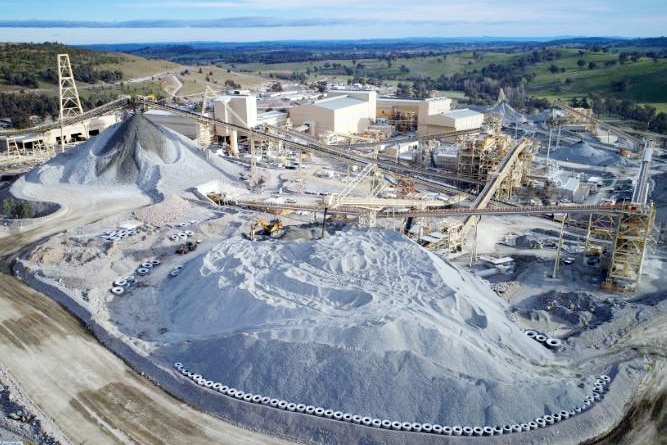
Newmont’s Cadia goldmine, near Orange, is among the largest in the world. (Supplied: Newcrest)
Cadia’s lawyer, Catherine Gleeson SC, told the court that while the defence may not dispute that the tailings dam wall collapsed, but that “the consequences of what happened are likely to be in dispute”.
She said the dispute would include the extent to which the tailings dam material may have travelled and affected adjoining properties.
Groundwater data debate
Mr Withers argued that one of the most “critical pieces of evidence” would be data showing results of groundwater monitoring from “inside and outside the mine from 2018 to 2025”.
But the defence argued that presenting whole databases was “oppressive”.
“It enables the plaintiff to effectively fish around for data that is not necessarily relevant to the case,” Ms Gleeson told the court.
She said if there were an inconsistency between test results over different years, the plaintiff would have an opportunity to ask for the reason.
Justice Richard Cavanagh has adjourned the matter for a further directions hearing on July 16, and told the court that a hearing date would likely be set down for the second half of 2027.
At the hearing’s conclusion, Justice Cavanagh addressed supporters, saying directions hearings were often “skirmishing” as both sides jostled to lay out their arguments.
In a statement, Newmont told the ABC it took its legal and regulatory obligations seriously and was committed to environmental stewardship.
“Newmont Cadia is defending class action proceedings filed in the Supreme Court of NSW. As the matter is now part of a formal court process, it is not appropriate to comment further at this time.”