
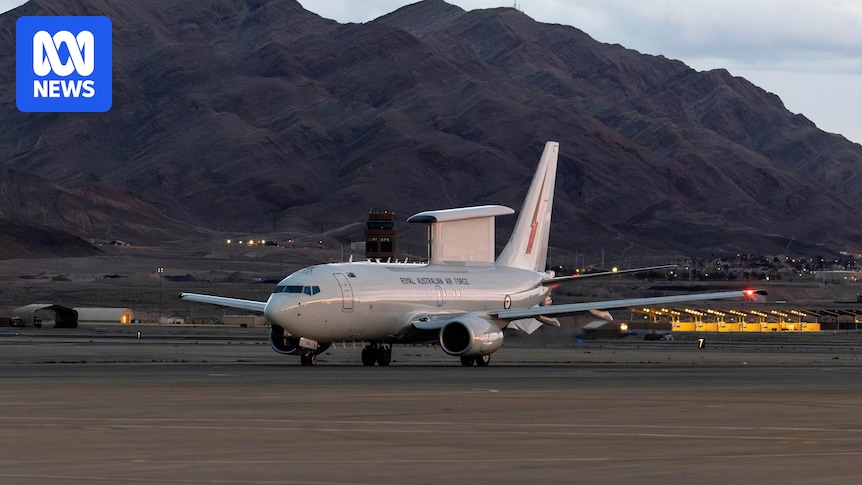
Defence Minister Richard Marles has confirmed intelligence gathered by an Australian surveillance aircraft deployed to support Gulf states can be accessed by the United States, potentially helping pinpoint its strikes on Iran.
Last week, the federal government said it would send a Royal Australian Air Force E-7A Wedgetail surveillance plane to help the United Arab Emirates defend against Iranian attacks.
Eighty-five defence force personnel were deployed alongside the aircraft, and air-to-air missiles will also be sent over to bolster the UAE’s supplies.
Iran war live updates: For the latest news on the Middle East crisis, read our blog.
The plane is equipped with extremely powerful radar systems for tracking airborne and maritime targets, and is capable of monitoring an area larger than Western Australia.
The government has argued it is not taking offensive action against Iran and the deployment is to help protect Australian citizens and other civilians in the region.
Defence experts say the Wedgetail’s speciality is long-range reconnaissance, and it would be particularly useful in identifying the launch sites of Iranian missiles and drones as potential targets.
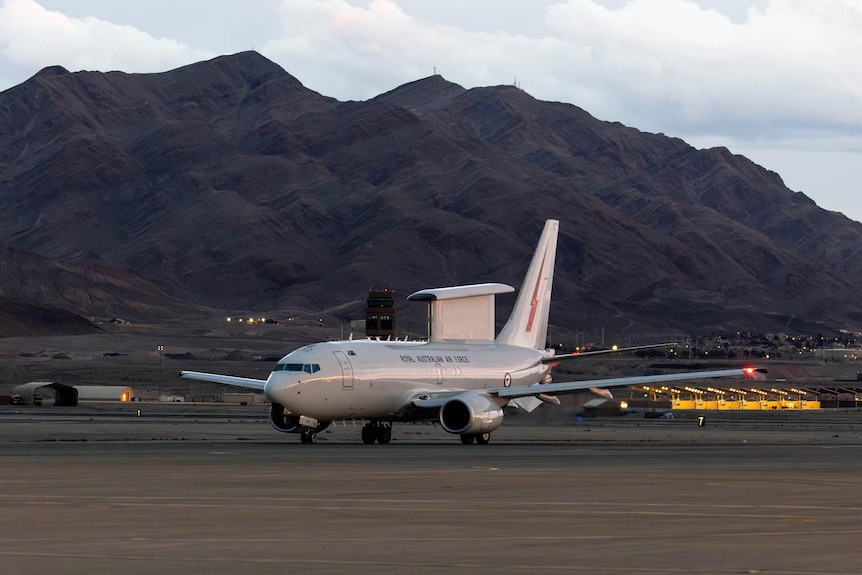
Australia has a fleet of six E-7A Wedgetails. (Supplied: Australian Defence Force)
At a press conference this afternoon, Mr Marles was asked if the intelligence the Australian Wedgetail gathers is available to the US.
Mr Marles said all information gathered by the Wedgetail is sent to the Combined Air Operations Centre in Qatar, a joint military facility through which the US coordinates its air operations in the region.
“That’s really important in terms of coordinating all the integrated defensive measures that can be done for the countries of the Gulf and for the UAE,” he said.
“It wouldn’t make sense to be operating this capability without providing that information in that way in terms of maintaining the defence of those countries and the security of the Australians who are living there.
“But this is fundamentally a defensive mission and fundamentally a defensive capability.”
Iranian ballistic missiles and drones wreak havoc
Greens senator David Shoebridge has been critical of the Wedgetail’s deployment, and argues if the US can access its intelligence, it is not being used in a “defensive-only” capacity.
“Australia’s Wedgetail aircraft is designed to pick up missile and drone launch sites to target counterstrikes and is feeding that into this US command,” he said.
“The targeting information is now being supplied by Australia to the US in their illegal war.
“This is not defensive; it’s critical to US attacks across Iran.”Wedgetail deployed in ‘defensive’ capacity
Malcolm Davis from the Australian Strategic Policy Institute said it makes sense that the Wedgetail would be collecting data on Iranian missile launches, which would then be used by the US.
He argues that this can be considered “defensive”.
“I think the Wedgetail’s information would be provided to the US. That’s perfectly legitimate,” he said.
“In terms of how the Americans use that, it would be defensive in the sense that they would use that information to detect and identify launch sites for Iranian missiles and drones, to be able to go after those launch systems to deny the Iranians the ability to launch attacks on the Gulf states.
US could strike Iran with a copy of its Shahed attack drone
“So it’s defensive, not offensive, because what we’re doing is at the tactical level and the operational level, we are undertaking defensive actions to deny the Iranians the ability to attack the Gulf states.”
Mr Marles said the Wedgetail needs to feed its intelligence through the Combined Air Operations Centre so it can be best used to support the Gulf states.
“It is information which flows through the Combined Air Operations Centre based in Qatar, which America is a part of,” he said.
“That’s because you are talking about a coordinated air defence of the countries of the Gulf.
“And so that is the way in which this capability is operating, but it is there in a defensive capacity.”
Loading…