


March 17, 2026 — 7:30pm
Save
You have reached your maximum number of saved items.
Remove items from your saved list to add more.
Save this article for later
Add articles to your saved list and come back to them anytime.
Got it
AAA
In the opening scene of the hit comedy Bridesmaids, bachelor Ted (Jon Hamm) verbalises a common but often awkward tenet of casual relationships with Annie (Kristen Wiig): the no-sleepover rule.
“I really want you to leave, but I don’t know how to say that without sounding like a dick,” Ted tells Annie with a sheepish smile.
Sleeping together, and then sleeping together, has long been associated with intimacy. But with modern society’s increasing preoccupation with sleep and changing ideas around romance, is the post-coital sleepover on the way out?
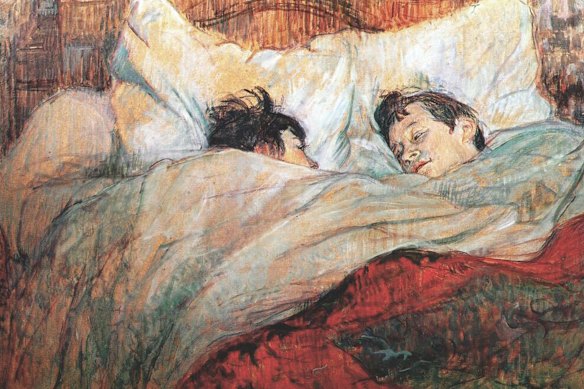 The Bed, by French impressionist painter, Toulouse Lautrec. Toulouse Lautrec, Musée d’Orsay Paris‘If sleep is interrupted, it’s ugly’
Belinda Gavin, 55, is one such single who has done away with the sleepover in her dating life.
Editor’s pick
“I was a snuggler; I’ve been married a couple of times and I love having a partner, but I’m just not for it right now. It could change, but I need my sleep,” the entertainment manager for lifestyle and relationship festival Sxhibition says.
“If my sleep is interrupted, it is ugly.”
With age – and an increasingly busy work schedule – Gavin has become more confident with asserting her need for a good night’s rest, which in her case means an eye mask, retainer and the occasional Hannibal Lecter-esque LED mask.
“I think my mindset changed. Like, I’m not clinging on to somebody in my bed any more … but it has its place. I don’t want someone to get up and run away as soon as we’re done,” she says. “Most guys are cool with it.”
A shift among older adults
Dr Lisa Portolan, an academic and author of Ten Ways to Find Love, has observed the decline of the sleepover first-hand in research, mainly among those 50 and over.
“Children came up a fair bit in terms of, ‘I have to go home to the kids’ [or] ‘I don’t want to introduce someone to them in advance of it being a relationship’.”
Among this demographic, many are also “very set in their habits in terms of, ‘I’ve been sleeping by myself for many years, I don’t want someone in bed throwing off my sleeping habits with snoring or other dysfunctional habits’,” says Portolan.
“Women [in particular] are becoming very independent and have these different rituals that they hold firm to and have no intention of being disrupted by men and boyfriends,” she adds.
“The ’90s and noughties had a bit of a cultural narrative around how the sleepover, post-sex, tended to indicate that there was a deeper intimacy developing.”
Academic Dr Lisa Portolan
Portolan thinks we are seeing a cultural “disaggregation of sex and sleep”, spurred by adjacent trends like “sleep divorce” and awareness of different sleep schedules, temperatures and routines. An increasing number of couples are also opting to live in separate homes.
“The ’90s and noughties had a bit of a cultural narrative around how the sleepover, post-sex, tended to indicate there was a deeper intimacy developing. Whereas, if you just went home, it was just a hook-up. But this idea is coming apart,” she says.
Counsellor and sexologist Tanya Koens has noticed a greater shyness among modern daters to express what they want.
Editor’s pick
“In some groups, there are expectations there will be a stay-over, in others, there aren’t,” she says. “I find what people do – because they’re afraid of being rejected or hurt – is they might just leave to avoid awkwardness and to avoid hurt or pain. But if you have a want or a need, there’s nothing wrong with that.”
Koens agrees with the typical “no-sleepover” boundary in casual relationships, citing the viral romance series Heated Rivalry as an example.
“Ilia and Shane have been hooking up off and on for years, so it’s assumed that somebody’s going to leave until they start to get feelings.
“When Ilia asks Shane to his apartment in Boston, he’s got everything ready and he wants him to stay, and then Shane freaks out because it’s too intimate. It’s all unspoken, but it’s all there.”
Koens adds that sexual “aftercare” – checking in with, and caring for a partner after sex – is important regardless of the nature of a relationship.
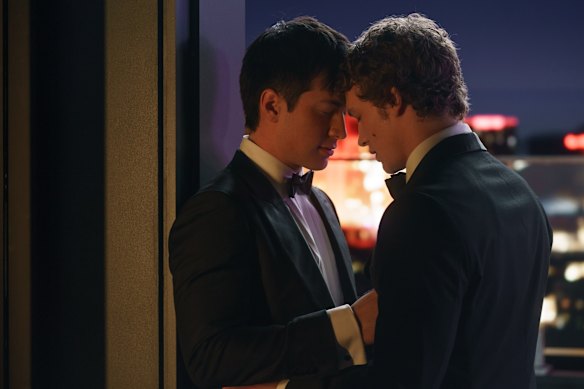 In HBO’s Heated Rivalry, the post-sex sleepover is an indication of the main characters’ relationship deepening.HBOMaking sleep a priority
Sleep Health Foundation chief executive Dr Moira Junge says anxiety around spending the night is common.
“They feel like, ‘it’s weird. I really like this person, but I can’t sleep with them’. It becomes a real pressure,” she says, noting though that our obsession with sleep optimisation means many people today feel empowered to say no to the sleepover.
Editor’s pick
However, Junge wants people to know that sleep issues – including those around sleeping alongside others – can be resolved.
“Sleep is the most highly modifiable element of health, in my view,” she says.
“They can learn some techniques around earplugs or mindfulness, look into cognitive behavioral therapy for insomnia, or the principles of not overthinking sleep.
“There’s always a reason and a solution.”
Make the most of your health, relationships, fitness and nutrition with our Live Well newsletter. Get it in your inbox every Monday.
Save
You have reached your maximum number of saved items.
Remove items from your saved list to add more.
From our partners