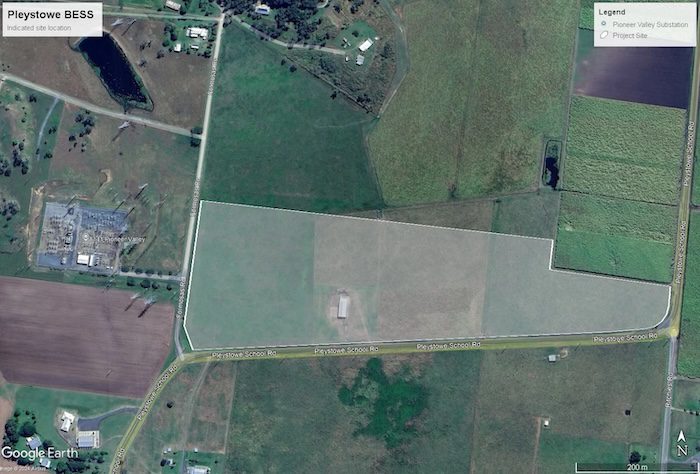
China solar giant Trina has shelved its big battery plans for near Mackay, in Queensland, just days after the project application was called in for reassessment by state planning minister Jarrod Bleijie.
The news, which emerged on Tuesday morning, is bound to send a chill through the renewable energy industry in the state, which has been watching closely to see how the policies of the coal-forward and renewables-averse Queensland LNP government will play out.
Trina Solar’s 200 megawatt (MW), 800 megawatt hour (MWh) Pleystowe battery energy storage system (BESS), was called in last week by Bleijie following formal requests for state inter from Mackay Regional Council Mayor Greg Williamson and LNP member for Mirani, Glen Kelly.
Williamson and Kelly cited strong local opposition and “matters of significant public interest and material deficiencies in the evidentiary basis relied upon to support approval.” Bleijie says he has also received an astonishing 733 public submissions about the project since it was first proposed for further scrutiny in early January.
But less than a week after Bleijie agreed to put the project back under the planning microscope – “to undertake a comprehensive and balanced assessment” – reports have emerged that Trina has decided to shelve the plans.
Trina Solar on Tuesday confirmed with Renew Economy that it has “scrapped” its development application for the Pleystowe BESS but is not walking away from the project entirely and will continue working with the community.
As Renew Economy has reported, the project hit a wall at the local government level, when – after being recommended for approval by council planning staff – it was left in limbo at the end of last year when a meeting of the council failed to make a decision either way on the project.
Once council fails to issue a decision notice for the application within the statutory decision making period or at all under the Planning Act, that application is referred to the Planning and Environment Court. Bleijie’s intervention, however, takes the application process back to square one.
In this case, it might well serve Trina Solar better to scrap the current development application and start over. Given the huge number of public submissions, it may also be that the company needs to go back to the drawing board – and to the community – on this project.
In an emailed statement, a Trina Solar spokesperson said the company would “use this opportunity to further review planning requirements, including compliance with State Code 27, and to continue developing the proposed Community Benefit Agreement with stakeholders.
“Trina Solar remains committed to delivering renewable energy infrastructure that aligns with state policy and provides tangible community benefits,” a company spokesperson said.
But the pattern emerging on the state planning department’s renewables-dominated list of Ministerial Call-Ins suggests something else is at play.
Anthony Gough, the acting director of the Queensland Conservation Council (QCC), says the repeal of the state’s renewable energy target and the former Labor government’s Energy Roadmap has set an atmosphere of uncertainty for industry and investors.
“We welcome the development of a State Code for batteries, as something we had been calling for,” Gough said in an emailed statement on Tuesday
“It’s not appropriate for councils to have to deal with new types of large infrastructure under existing regional plans, and consistency across the state is important,” said Queensland Conservation Council (QCC) acting director, Anthony Gough, in a statement on Tuesday.
But, Gough adds, “it is inconsistent that the LNP is approving and actively championing many other sorts of developments, from new gas and coal exploration leases, to contentious ecotourism projects and Olympic venues, over the top of community and environmental concerns.
“Huge swathes of Queensland are currently on yet another flood watch or clean up. This extreme weather is becoming more extreme due to climate change,” he says.
“The LNP have committed to reducing emissions by 75 per cent by 2035, but seem to be putting roadblocks into the only proven emissions reduction –renewable energy – that is working in Queensland.”
Trina’s Pleystowe BESS was the second big battery project in the Queensland planning pipeline to get a formal call-in notice, following the early March call-in of Potentia Energy’s 300 MW, four-hour Capricorn BESS in Bouldercombe, in Queensland’s Rockhampton region.
That project was sent to Jarrod Bleijie’s Ministerial call-in list in January at the request of Rockhampton deputy mayor Drew Wickerson, again with the backing of the local LNP member, Kelly.
Another project, Iberdrola Australia’s Bundaberg Regional Battery, formerly known as the Gin Gin Battery project, is awaiting a decision on whether it, too, will undergo a full ministerial reassessment, after hitting similar troubles with the Rockhampton Regional Council.
Last year, the Queensland LNP government cancelled two already-approved wind farms – the $1 billion Moonlight Range project and the 1.2GW Forest Wind project – under the retrospective application of strict new planning rules for solar, wind and battery projects introduced at the start of 2025.
Also on Bleijie’s proposed call-in list are two wind and battery projects owned by Cubico Investments – the Middle Creek and Marmadua energy parks – which are both still awaiting a decision.