
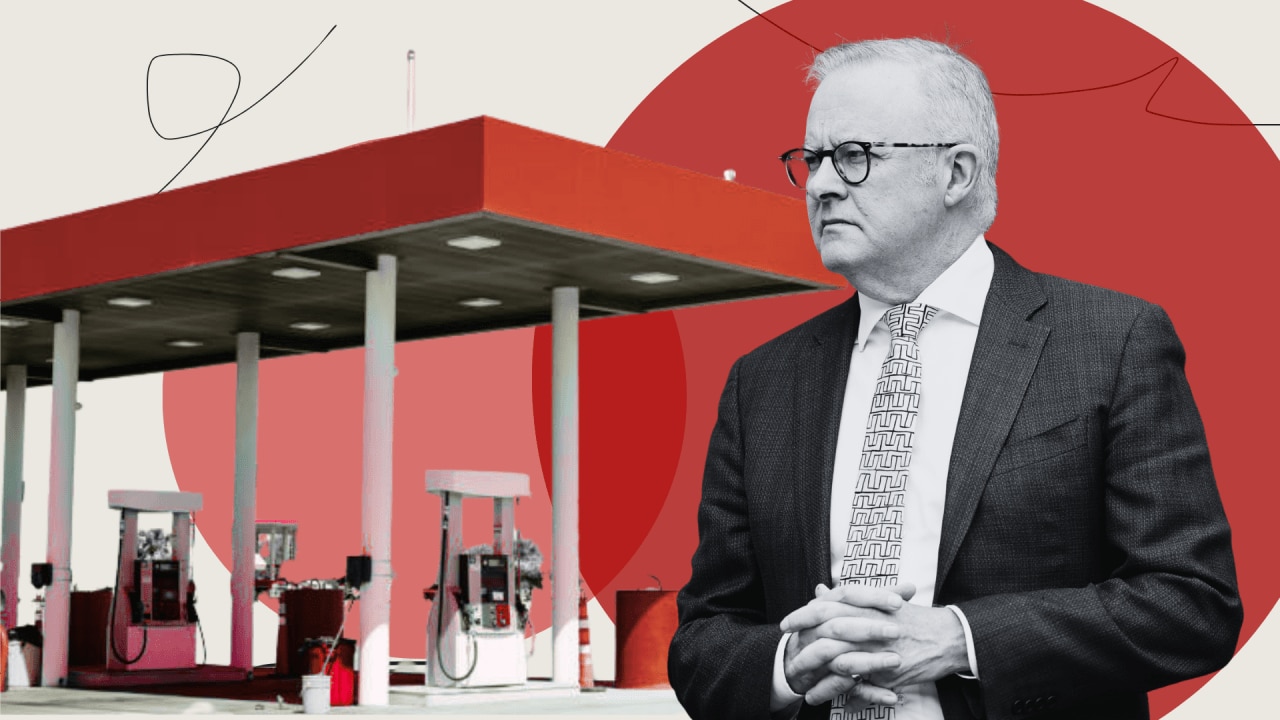
Prime Minister Anthony Albanese will convene a National Cabinet meeting as the government scrambles to respond to mounting fears of fuel shortages triggered by the US-Iran war.
Mr Albanese said state premiers and chief ministers would meet on Thursday to coordinate a national response to the unfolding fuel crisis.
Speaking at the Australian Automotive Dealer Association conference on Wednesday, Mr Albanese said his government was “taking action”.
“We are taking new action now… working closely with industry, states and territories to ensure fuel gets where it is needed most,” he said.
“Tomorrow, from Tasmania, I’ll convene the National Cabinet of all the Premiers and Chief Ministers to ensure that the coordination that’s occurring right across our country.
“We want to make sure that we do everything we can to shield the Australian economy, households and businesses from the worst of global uncertainty.”
The meeting comes after the government insisted there was no issue with fuel supplies before admitting there was a crisis.
Energy Minister Chris Bowen has not ruled out petrol rationing after claiming earlier that there was no issue with fuel reserves.
Mr Bowen has since introduced a series of measures to ease pressure on the fuel market, including temporarily relaxing fuel standards.
The government has also released up to 20 per cent of the baseline fuel reserves under the Minimum Stockholding Obligation.
The move allows the release of up to 762 million litres of petrol and diesel from Australia’s domestic reserves – equivalent to about four days of supply.
Mr Albanese said the government had been working to strengthen fuel security and was now taking further steps to stabilise supply.
“This is why we have been working to build our fuel security over the last four years,” he said.
When Mr Albanese was elected in 2022, the Minimum Stockholding Obligation sought to boost reserves to a mandatory minimum for key fuels of around 32 days.
After four years, the Albanese government has only managed to lift the petrol reserves to 37 days, while there remains just 29 days of jet fuel and 32 days of diesel.
Opposition Leader Angus Taylor accused Mr Bowen of blaming Australians rather than addressing problems in the supply chain.
“Bowen’s response to (the fuel crisis) was, well, this is all Australians’ fault. Blame them,” Mr Taylor told Sky News on Tuesday.
“I mean seriously, he needs to be across where the stocks are and what the holdups are, and in particular, where the shortages are.”
Mr Taylor said the government had been slow to recognise the issue, noting that Mr Bowen initially downplayed the problem before later declaring a national crisis.
“As of Tuesday last week, Chris Bowen told us that it was all fine. All tickety-boo, no problem at all. By Thursday, he was declaring it a national crisis,” he said.
“You’ve got to know where the stocks are, you’ve got to know where the companies are at and you’ve got to work with them to get that product to the customers.”

Mr Taylor said fuel produced domestically should be redirected to Australian consumers instead of being exported.
“We’ve got a refinery, which I helped to underwrite and save, it would have left otherwise, that is exporting a large portion of its fuel,” he said.
“That should be diverted back to Australia … The reason why they’re exporting is because of emissions standards imposed by this (Energy) Minister.”
The dispute comes as tensions in the Middle East threaten oil transport routes, with Iran attacking vessels in the Strait of Hormuz, which transports 20 per cent of global oil.
The crisis has exposed Australia’s heavy reliance on imported fuel, with about 90 per cent of transport fuel sourced from overseas.
In 2000, Australia had eight refineries, but six have since closed – four under the Coalition and two under Labor.
According to the latest data, the country holds around 37 days of petrol and about 30 days of diesel, well below the 90-day IEA oil stockholding requirement.