

March 18, 2026 — 7:41am
Save
You have reached your maximum number of saved items.
Remove items from your saved list to add more.
Save this article for later
Add articles to your saved list and come back to them anytime.
Got it
AAA
Robert Pattinson, the star of The Batman and the Twilight films, is poised to de-throne Timothée Chalamet’s Dune universe anti-hero Paul Atreides in the third and final chapter of director Denis Villeneuve’s film cycle based on the iconic novels of Frank Herbert.
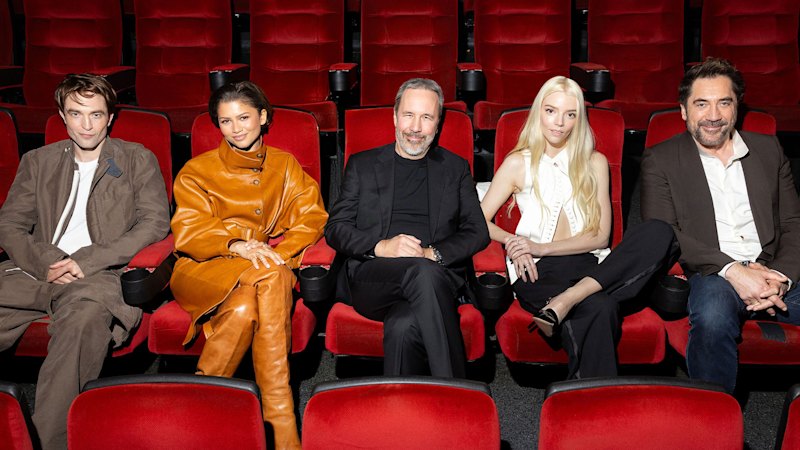
Pattinson joined his Dune: Part Three co-stars Zendaya, Anya Taylor-Joy, Javier Bardem, and Villeneuve at an invitation-only screening of the film’s new trailer in Los Angeles yesterday. The trailer, which includes our first look at Pattinson in character, drops online today.
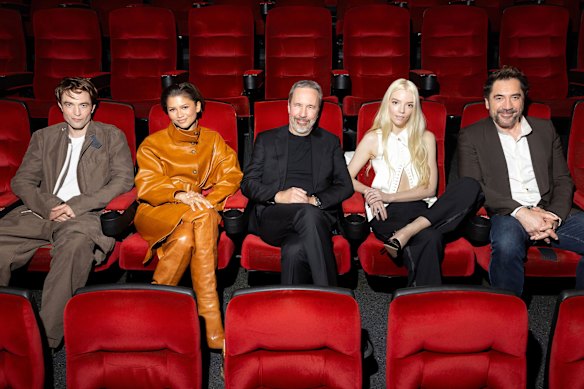 Robert Pattinson, Zendaya, Denis Villeneuve, Anya Taylor-Joy and Javier Bardem at the Dune: Part Three trailer screening.Warner Bros Pictures
In the new film, Pattinson will play Scytale, a rival to Atreides who plots to dethrone him. In the books, Scytale is a hermaphrodite shape-shifter from the xenophobic and isolationist Tleilaxu sect.
“I absolutely adored these movies,” Pattinson said. “It’s such a towering achievement by the cast, so incredible. I just think everybody wants to work with Denis. He’s a master, when you see the scope and scale and ambition of these movies on set. You get why they feel like this on the screen. It’s an extraordinary and amazing experience.”
The new Dune film picks up the story 17 years after the last ended. “It’s a very different movie,” Villeneuve said. “I said to myself, it’s a good idea to come back to this world, not [driven] by nostalgia but by urgency and to go there with a critical eye, and the idea [that we would] not be self-indulgent. It will be a different tone, a different rhythm, a different pace.”
Villeneuve described the first two films, in order, as “a contemplation, a boy exploring a new world, and the second one, a war movie”, and the third chapter as “more action-packed, more dense, more muscular than the two others.”
Much of the new film is shot on old-school 65mm film, a wide high-resolution film with a frame nearly 3.5 times larger than standard 35mm film. It was an unusual decision in the era of digital filmmaking, though Villeneuve kept the visuals of the desert planet Arrakis on the high-resolution digital 1.90:1 widescreen IMAX format.
“I kept the desert in digital because I like the brutality of the digital IMAX,” Villeneuve said. “So the movie is really meant to be an IMAX experience, and to be seen on the biggest screen possible. When you see the result on screen it’s quite unmatchable.”
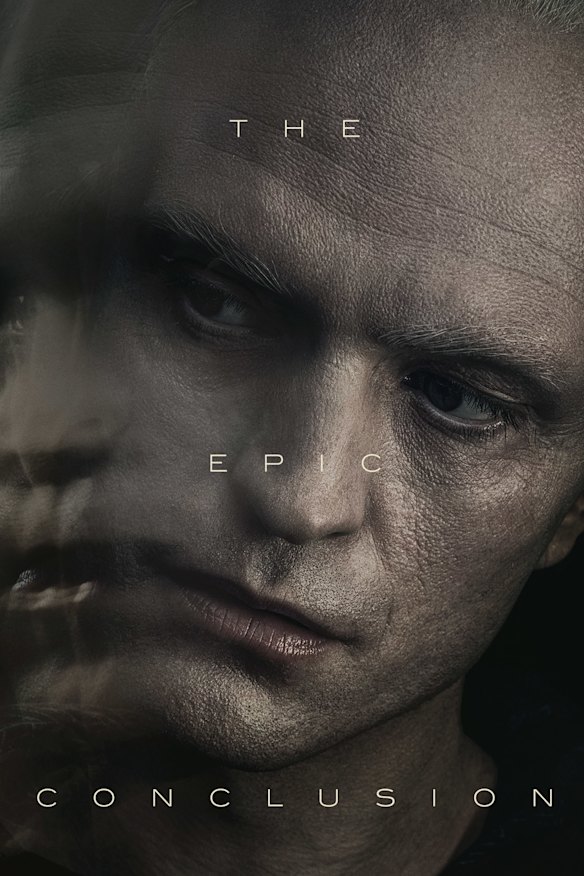 A newly-released poster for Dune: Part Three revealing Robert Pattinson as Scytale.Warner Bros Pictures
The visual departure of the new film is intended to reflect the change which has come to Arrakis and its place in the universe. Linus Sandgren (La La Land, Saltburn, Wuthering Heights) is the cinematographer on the new film, replacing Australian Oscar-winner Greig Fraser, who shot the first two.
“The climate is different, Arrakis is still a desert planet, but there are differences, new planets, and I wanted to approach this with a new pair of eyes,” Villeneuve said.
Herbert’s sprawling literary universe has become one of the most influential literary masterpieces of all time, its creative tendrils touching everything from Star Wars, Game of Thrones and the Warhammer 40,000 game, to Iron Maiden, Alien and singer and songwriter Grimes.
The book series, set on Arrakis, and the battle between noble houses over control of its valuable “spice”, was unfurled in six original novels, published between 1965 and 1985. Villeneuve’s first two films were based on the original tome, Dune. The upcoming Dune: Part Three is based on the 1969 book, Dune Messiah.
Villeneuve describes Dune Messiah as “probably my favourite book of the series. It’s a very dark book, beautiful book. And I will say this, [Dune; Part Three] is my one of my most personal films, if not my most personal film, so it’s a film that is very close to me and, and very contemporary.”
The 58-year-old Quebecois filmmaker says he felt a deep connection to fragile relationship of the film’s two lead characters: Atreides, the scion of House Atreides, and Chani (Zendaya), a fierce Fremen warrior and, eventually, Atreides’ consort.
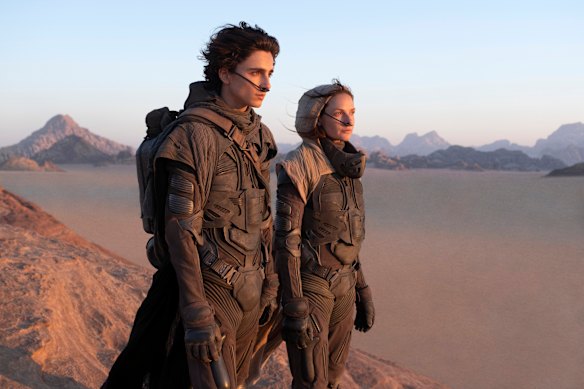 Timothée Chalamet and Rebecca Ferguson in a scene from Dune.Warner Bros Pictures
“They’re struggling, their relationship, the burden and incredible pressure from the world around them,” Villeneuve said. “There’s something about the way their love, their time, the way they are, the way their relationship evolved, that study on the relationship of both characters, that is very personal to me.”
Villeneuve had always intended to turn Dune Messiah into a third film, and the Dune cycle into a film trilogy, but had not intended to produce the third film so quickly after the first two. “As a filmmaker, when you make a series of movies like this, you are in a relationship with the audience [and] I felt a responsibility to finish the story,” he said.
Editor’s pick
“I said to my crew, I’m taking a break, that’s it, but I kept waking up in the middle of the night, and the image of Dune: Part Three, inspired by Dune Messiah, kept coming back. And I said, all right let’s do it.”
Villeneuve added that the film was an affirmation to the power of cinema. “It is an art form that is meant to make you travel, make you experience things that you will not [while] living a regular life, and to make you feel things that will something new in your life,” Villeneuve said.
“[German filmmaker] Wim Wenders said that a great film is a film that that makes you want to kick a ball when you get out of the theatre; it’s the idea that cinema is linked with life,” Villeneuve said.
“As human beings, it’s important to share experiences, our lives right now, we are in our little bubbles all around the world, and I think that the [movie] theatre, like some sport events or concert, bring us together. There’s something beautifully, beautiful and human about that.”
Save
You have reached your maximum number of saved items.
Remove items from your saved list to add more.
 Michael Idato is the culture editor-at-large of The Sydney Morning Herald and The Age.Connect via X or email.From our partners