
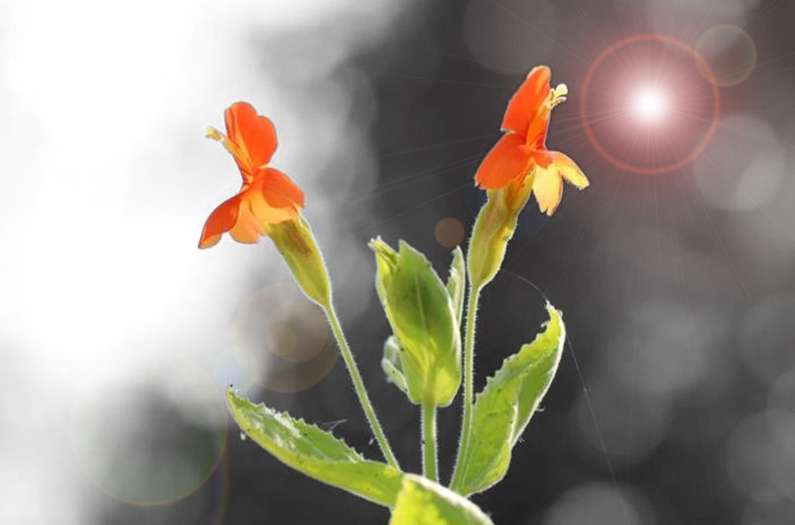
People have been trying all sorts of strategies to help species keep up in a warming world. They have bred hybrid coral from different parts of the world to create heat tolerant variants, worked to protect habitat projected to stay cooler as temperatures rise, even moved migratory birds to help them keep pace with the seasons.
But species aren’t just waiting for humans to help them out. In the latest example, the scarlet monkeyflower, a low-to-the-ground perennial with showy red blooms, has shown it contains the genetic capacity to rapidly evolve in the face of a punishing drought, according to research just published in Science.
The discovery suggests there is hope that at least some species can keep up with the speed at which the climate is changing. And it offers genetic clues that might help guide selection of specific plants within a species that are better suited to a hotter world.
“The concern has been that climate change is happening too fast and its changes are too big for evolution to keep up,” Amy Angert, an ecologist at the University of British Columbia (UBC) and the paper’s senior author. “Our research shows that for monkeyflower, and likely similar wild plants, they can indeed keep pace and ‘rescue’ themselves.”
The new insights arose from a fortunate coincidence. Angert and colleagues began collecting scarlet monkeyflower seeds from different parts of Oregon and California in the early 2000s, at a time when the region was already in the grip of what has been termed a “megadrought.” What they didn’t know at the time is that the most severe episode in that drought would strike from 2012 to 2015, creating the driest conditions California has witnessed in more than 10,000 years.
That gave the scientists a chance to watch evolution unfold in real time, at both the level of entire flower populations and in their DNA. Using seeds collected before 2012 from 55 different monkeyflower populations, the scientists looked for patterns in their DNA that correlated with exposure to drier, hotter conditions. They found 215 sections of DNA where some of the flowers had variations that tracked with their location in these harsher environments. Those genetic differences were linked to rates of photosynthesis and to functioning of the stomata – small pores in leaves that control gas and water movement between the air and the plant.
The scientists then examined seeds collected from 11 monkeyflower populations from different parts of the region between 2010 and 2016, a time spanning the most extreme drought. They found that the drought-linked DNA patterns became more common in three of those populations.
After the drought eased, those three populations bounced back the fastest, suggesting that the increased presence of the DNA variants gave them an advantage.
“Essentially what we found is that the populations that recovered are also the populations that evolved the fastest,” said first author Daniel Anstett, a Cornell University professor who was previously a postdoctoral researcher under Angert at UBC.
The research shows that it’s possible to find genetic clues to a plant’s ability to cope with the kind of extremes expected to become more common in the future, even before one of those episodes arrives. “That’s the crystal ball we can use to predict into the future,” said Anstett. “Identifying the genes involved in this evolution would help us understand what traits allow populations to survive these extended drought periods.”
That, in turn, could aid with conservation management, as people look for versions of a species best suited for a changing climate.
It’s not simple, however. For instance, some groups of the monkeyflower actually saw a decline in the abundance of this “drought hardiness” DNA, suggesting there might also have been some kind of disadvantage to those genes in specific conditions.
Also, not all plants will be able to evolve as quickly as the fast-reproducing monkeyflower. Take slow-growing trees that live for centuries, for example. “Not all species will be able to pull themselves up by their own bootstraps,” said Dr. Angert. “The question becomes, which species are going to be like the monkeyflower, and which species are going to be more like Douglas fir or red cedar?”
Anstett, et. al. “Rapid evolution predicts demographic recovery after extreme drought.” Science. March 12, 2026.
Image based on Scarlet Monkeyflower photo by Easyscape