
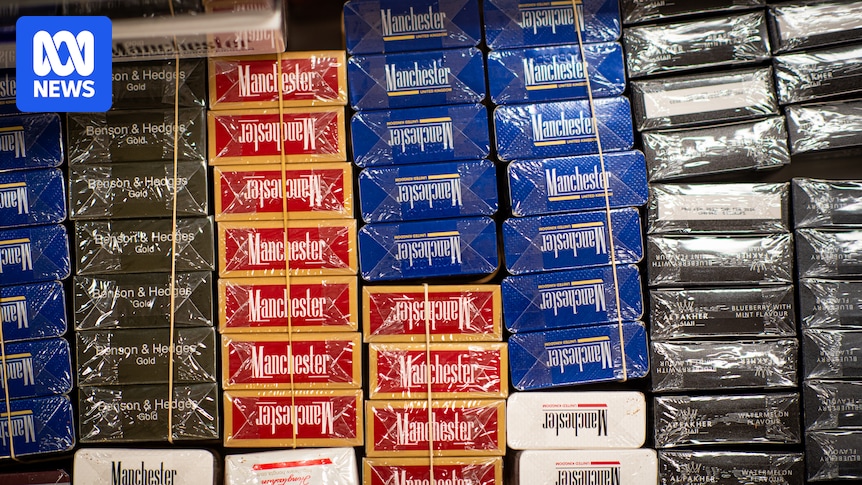
Criminal gangs cashing in on Australia’s illicit tobacco boom will face tougher penalties and expanded police surveillance powers in a fresh crackdown on the black market.
Assistant Minister for Customs Julian Hill will today announce plans to arm investigators with tools like wire taps and stronger asset seizure powers, targeting the organised crime networks behind the multi-billion-dollar trade.
The changes aim to hit criminal syndicates “where it hurts” by stripping profits and making the business of importing and selling illicit tobacco and vapes far riskier.
The ABC understands the proposed crackdown will increase penalties by up to two or three times the current maximum jail terms and raise tobacco offences to the status of “serious crimes”.
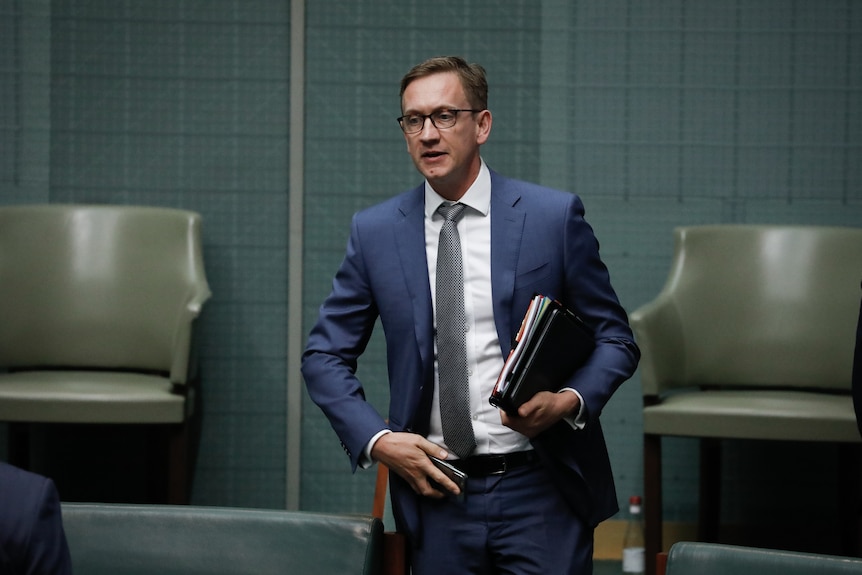
Julian Hill says Australia’s illicit tobacco problem is fuelling organised crime. (ABC News: Matt Roberts)
This would allow police to seize assets such as cars, boats or houses linked to criminals’ “unexplained wealth”.
New offences would also target the large-volume shipments that indicate organised crime involvement, while states and territories are being urged to prioritise shutting illegal shopfronts, penalising landlords and resourcing “street level enforcement”.
The Commonwealth is also turning its attention to emerging issues like online markets and a boom in the unlawful trade of highly addictive nicotine pouches.
Australia has ‘massive problem’ with illegal tobacco
Mr Hill will signal the federal government’s plans in an address at the National Illicit Tobacco and E-cigarette Symposium in Canberra.
According to an advanced copy of the speech, seen by the ABC, Mr Hill warned Australia has a “massive problem” with illicit tobacco, and anyone who denied that was “either deluded or lying”.
“Cheap smokes are everywhere with a now ridiculously ubiquitous retail distribution network,” he said.
“What used to be seen as a health revenue issue, has now morphed into a serious and organised crime crisis.”
More than half of all tobacco products now sold in Australia are illegal, the 2024-25 report by the Illicit Tobacco and E-Cigarette Commissioner released in December has estimated.
Organised crime groups earned between $4.1 billion and $6.9 billion in profit from this trade for that financial year.
The commissioner also found that about 95.7 per cent of all e-cigarette products sold in Australia were illegal, with a market value of about $1.6 billion.
Mr Hill said the illegal trade fuelled violence between crime cartels, hurt legitimate retailers and workers and risked unwinding the “decades of success” in lowering smoking rates in Australia.
“The explosion of this illegal trade has normalised law-breaking for a significant proportion of Australians,” he said.
Mr Hill said a “perfect storm of factors” over the past 10 years had led to the situation Australia now faced, with serious organised crime groups operating like multinational businesses, investing in what they perceive as a “high profit-low risk situation”.
Reducing tobacco excise will make ‘no difference’
The explosion of illegal tobacco sales has deprived the government of an estimated $7.7 billion to $11.8 billion in lost excise revenue.
Mr Hill acknowledged the high rates of excise over the past decade had been “one of the key drivers of growth in the black market,” but said lowering that tax now would not reverse the trend.
Crime gangs use fake plain packaging from China to flood Australian market
“As of now, based on the information available and advice to government, there is no reasonable level of excise reduction that would make any material difference to the ubiquitous illicit supply chains and distribution networks operated by serious and organised crime,” he said.
Mr Hill said it would be “nonsensical” to deny the excise had pushed people toward illegal products, but price was the single most effective lever to encourage people to quit or reduce smoking.
He also argued the excise was always designed to fall naturally as smoking rates declined, implicitly rejecting the idea that governments were greedy in chasing revenue.
Crackdown focus on shopfronts
Mr Hill said Commonwealth agencies were effectively raising the cost of doing business for criminals by seizing assets, intercepting and destroying illicit cigarette and vape products before they crossed Australia’s borders.
But he said the biggest gains were to be made in the “post-border” disruption.
“Australians will rightly think any public official who stands up and talks tough about seizures is not living in the real world unless and until the illegal shops are shut down,” he said.
Mr Hill warned this would only happen if states, territories and the Commonwealth worked together, something he said had “rapidly improved” in the past six months.
He singled out South Australia and Queensland as leading the way with tougher laws and investment in enforcement.
“They are demonstrating that where enforcement occurs in 100 per cent of a geographic area, then retailers see legal trade return rapidly to expected levels,” he said.
He acknowledged that as authorities crack down on shopfronts, more work was underway to combat online sales.
Mr Hill said the government was also concerned about the “rapid growth” in unlawful importation, advertising and supply of “disgusting” nicotine pouches in Australia.
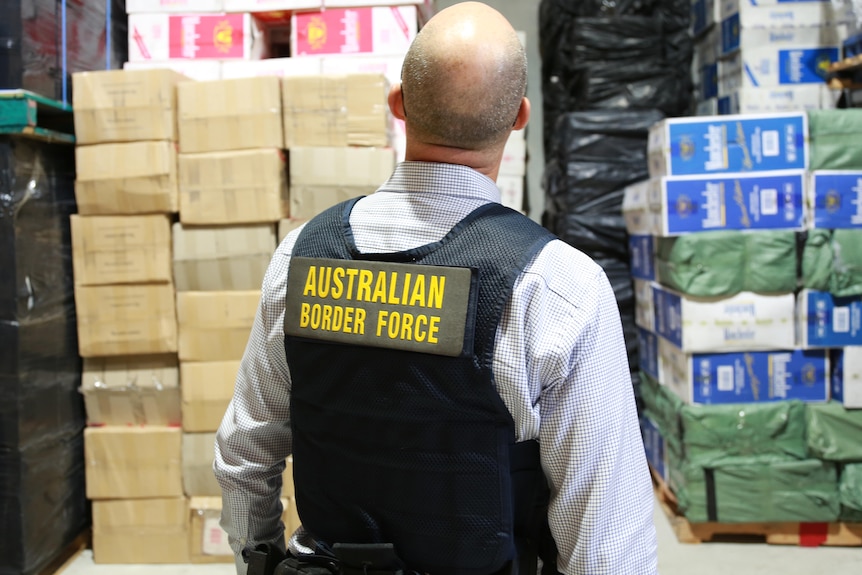
Illegal tobacco accounts for more than half the tobacco sold in the country. (Supplied: Australian Border Force)
“We are actively pursuing options to respond to this growing threat, including reform of product regulation,” he said.
Mr Hill said success would mean fewer shopfronts linked to illicit networks, an end to firebombings, fewer violent incidents and rising prices for illegal vape and cigarette products.
“Progress will not be smooth or linear,” he said.
“In some places, things may get worse before they get better.
“But giving up is not an option, nor is being distracted or seduced by misplaced hopes and false claims about excise reductions.”
Legislation outlining stronger laws and tougher penalties will be unveiled when parliament returns next week.
Enforcement not the ‘one and only’ solution
Rohan Pike, a former Australian Border Force officer, said stronger penalties would be “welcome” provided they were “enforced rigorously and in a sustained way”.
“But putting that as the one and only solution is misplaced,” he said.
Now a consultant on the illicit tobacco trade, Mr Pike said the excise on legal products was a source of ongoing “imbalance in the market” that must be addressed.
“The excise needs to be reviewed; it needs to be adjusted to reduce the incentive for criminals to step into the market,” he said.
Mr Pike said consistency between states and territories was also important and described jurisdictions as being in a “phase of experimentation” with enforcement laws.
“This is going to evolve over time; they will realise the measures are not sufficient and therefore resources and penalties will all need to increase to make a dent in [the illegal market],” he said.
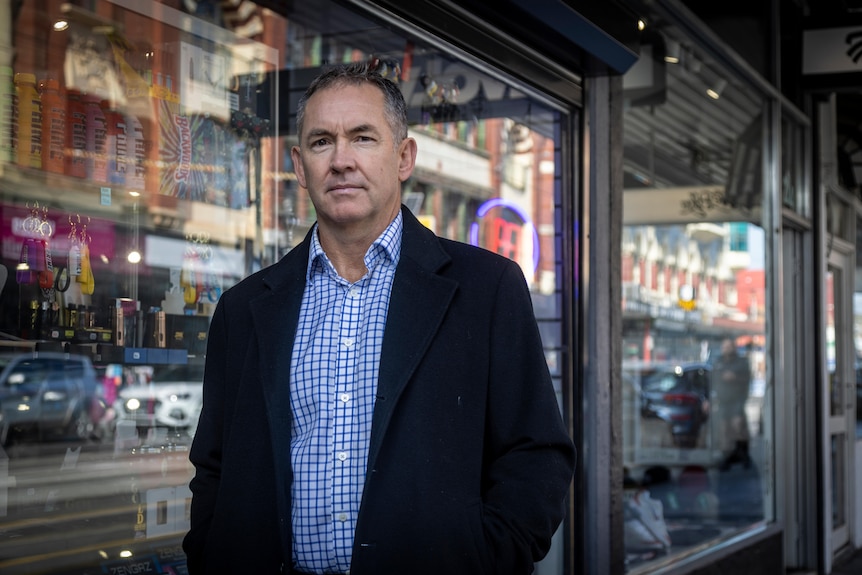
Former ABF officer Rohan Pike says stronger penalties are needed to make illegal tobacco less appealing to criminals. (ABC News: Danielle Bonica)
Mr Pike also advises the Global Institute for Novel Nicotine Products, which is a UK-based organisation representing makers of alternative products like nicotine pouches and heat-not-burn vapes.
He has called for Australia to follow New Zealand, the United Kingdom and other countries in legalising and regulating newer nicotine products as an alternative to cigarettes.
“We need harm minimisation in concert with enforcement measures,” he said.
Prior to Mr Hill’s latest announcement, the Coalition has been critical of the government’s response to the illicit tobacco crisis.
Shadow Home Affairs Minister Jonno Duniam has described Labor’s general approach to date as “all talk and no action”.
“The Albanese government has lost control of the illicit tobacco market, allowing organised crime to grow while also costing the budget billions in lost revenue,” he said.
Senator Duniam said a Senate inquiry into the issue would begin its hearings next month to examine how the government could “better” respond.
“Because at the moment, their soft touch approach is only making things worse,” he said.