
We tracked the age difference between Salman Khan and his lead actress in every film from 1989 to 2026. The numbers are not what you might expect; they are far more telling.
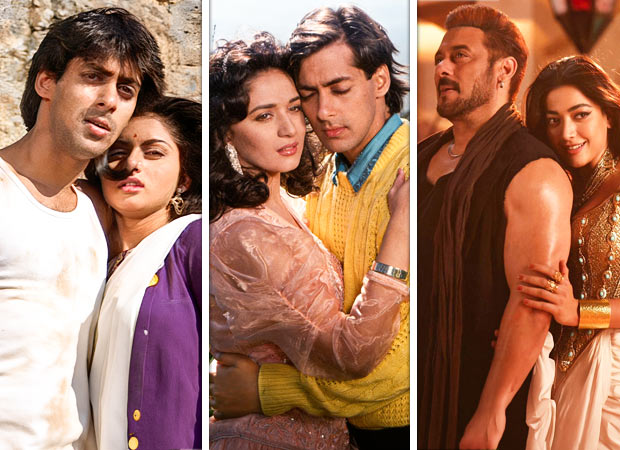
4 years in 1989. 36 years in 2019. 31 years in 2025. Salman Khan’s co-stars tell a story his films never did
In 2019, Salman Khan was 54 years old. His lead actress in Dabangg 3, Saiee Manjrekar, had just turned 18. The age gap between them of 36 years is larger than the entire careers of most working actors in Bollywood today. It is also, by our data, the single largest co-star age gap in Salman Khan’s 37-year filmography. This is the first instalment of Bollywood Hungama’s ongoing data series examining the age gap between Hindi cinema’s biggest stars and their lead actresses; a conversation the industry has long avoided having in numbers. We begin with Salman Khan: 76 films, 37 years, and a gap that tells a story his films never did.
Across all 76 films Bollywood Hungama analysed, the average age gap between Salman Khan and his lead actress is 12.9 years, with the actress being younger in almost every case. Of the 76 films, only two feature an actress older than Salman: Amrita Singh in Suryavanshi (1992), who was 7 years his senior, and Sridevi in Chandramukhi (1993), who was 2 years older. Every other pairing skews younger, sometimes by a year, sometimes by more than three decades.
Decade-by-Decade Breakdown
The decade-by-decade breakdown is where the scale of the shift becomes undeniable. In the 1990s, the average gap was 6.5 years. By the 2010s, that number had tripled to 21.1 years. The gap did not drift upward gradually. It escalated.
Salman Khan launched his career opposite Bhagyashree in Maine Pyar Kiya (1989). She was born in 1969, four years after him. Through the 1990s, most of his co-stars were born in the early-to-mid 1970s. Madhuri Dixit (born 1967) was a near-contemporary. Even Karisma Kapoor, his most frequent co-star of that decade, with six films, was just 9 years younger.
The two exceptions, Amrita Singh in Suryavanshi and Sridevi in Chandramukhi, stand as the only moments in his entire career when Salman played opposite a more senior actress. Both collaborations happened in the same 24-month window, 1992–93. Neither was repeated.
The 2000s are where the data changes character. Between 2000 and 2009, the average gap jumped to 13.7 years; more than double the 1990s figure. The shift was driven by a new wave of co-stars: Dia Mirza (16 years younger, 2002), Priyanka Chopra (17 years, 2004), Sneha Ullal (22 years, 2005), Katrina Kaif (18 years, 2005). The 20-year threshold, once a ceiling, began to feel like a starting point. The most striking data point from this decade is the actress’s birth year trend. In the 1990s, the average birth year of Salman’s lead actress was 1971. In the 2000s, it shifted to 1979. His co-stars were no longer peers; they were, increasingly, the generation after.
Among all 76 films, 16 feature an age gap of 20 years or more, which is 21% of his filmography. Every single one of those 16 films was made after 2005. None existed in the 1990s. The 20-year gap, once impossible to imagine in mainstream Hindi cinema, is now statistically routine for Salman Khan.
To put this in personal terms: when Salman filmed Dabangg 3 in 2019, he was 54 years old. His lead actress, Saiee Manjrekar, was 18. The year Salman was born in 1965, Saiee’s parents were not yet teenagers. When his debut, Maine Pyar Kiya, was released in 1989, Saiee Manjrekar had not yet been born. These are not abstract statistics. They are the lived arithmetic of Bollywood casting in 2019.
It would be lazy analysis to frame this as uniquely Salman’s doing. The age gap phenomenon in Hindi cinema is structural, not individual. Shah Rukh Khan, Aamir Khan, and Akshay Kumar all operate in an industry where the career longevity of male stars is broadly protected, while female stars face an earlier ceiling. Male leads stay active into their 50s and 60s; the industry continues casting them opposite women in their 20s.
What makes Salman’s data distinctive is the scale and the trajectory. The 36-year peak gap in Dabangg 3 has very few parallels in mainstream Hindi cinema history. The linear trend line across his 37-year career rises at 0.57 years per year without a single decade of reversal. And the sheer volume of films means this is not a sample size problem. This is a pattern, documented across an entire career.
The Biggest Gaps in His Filmography
Tags : Age gap, Amrita Singh, Bhagyashree, Chandramukhi, Dabangg 3, Dia Mirza, Features, Karisma Kapoor, Katrina Kaif, Madhuri Dixit, Maine Pyar Kiya, Priyanka Chopra, Priyanka Chopra Jonas, Rashmika Mandanna, Saiee Manjrekar, Salman Khan, Sneha Ullal, Sridevi, Suryavanshi
BOLLYWOOD NEWS – LIVE UPDATES
Catch us for latest Bollywood News, New Bollywood Movies update, Box office collection, New Movies Release , Bollywood News Hindi, Entertainment News, Bollywood Live News Today & Upcoming Movies 2026 and stay updated with latest hindi movies only on Bollywood Hungama.