
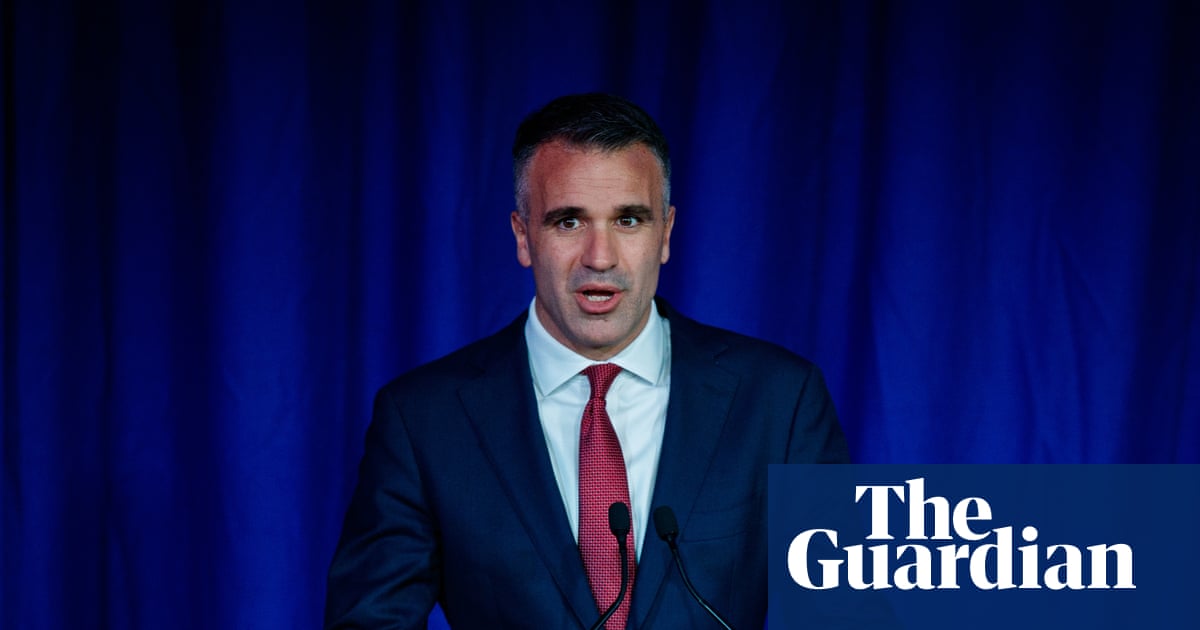
The South Australian premier, Peter Malinauskas, assured gun lobbyists that he had no plans to strengthen firearm laws in the state despite agreeing to a national crackdown after the Bondi beach massacre.
In a letter signed a day before the government entered caretaker mode for the state election on 21 March, Malinauskas told a peak shooters group that SA had some of the strictest gun laws in the country and there was “currently … no plans to amend” them.
The position represents the latest blow to Anthony Albanese’s hopes for uniform nationwide gun control reform, as more states walk back from the national cabinet commitment after 15 people were killed and dozens injured in the 14 December shooting at a Hanukah event at Bondi beach.
The prime minister secured agreement from premiers and chief ministers to pursue stricter gun controls across the country, including caps on the number of firearms a person could own.
At the time, Malinauskas argued South Australia’s firearms laws were the toughest in the country but the government was prepared to further strengthen them.
“While we as a state are already in a position with the strongest firearms laws in the country, we’re not going to allow ourselves to fall behind because others get in front of us,” he said.
Sign up for the Breaking News Australia email
But two months on from Australia’s worst-ever terror attack, and on the eve of a state election, Malinauskas signalled a different position in a letter to the Sporting Shooters’ Association of Australia.
“I can advise that the South Australian government currently has no plans to amend firearm laws,” the premier said in the 21 February letter, seen by Guardian Australia.
“South Australia already has some of the strictest and most comprehensive firearms laws in the country. These laws are designed to protect the broader community while recognising that the overwhelming majority of firearms owners in South Australia are responsible, law-abiding citizens who comply with their obligations.”
SA already limits gun ownership to Australian citizens and permanent residents, and requires licences to be renewed at least every five years – two of the reforms agreed at national cabinet.
Hand guns and rifles handed in during the Australian government gun amnesty in 2017. Photograph: Dean Lewins/AAP
Malinauskas left the door open to future changes but said any consideration of new laws would be “approached carefully, thoughtfully and with genuine consultation”.
“Responsible firearms owners deserve certainty, fairness and respect, and reforms must always be grounded in evidence,” he said.
The premier offered a similar response when Guardian Australia sought clarification this week as to whether a re-elected state Labor government would implement the national cabinet agreement.
“We only have an interest in amending the gun laws to the extent that they are based on evidence and that needs to be thought through very carefully, and that’s our policy,” Malinauskas said.
The federal government was initially hopeful the states and territories would agree to “ambitious” reforms no later than March this year and pass laws through their parliaments no later than 1 July.
“Gun laws are only as strong as the weakest state. Having laws that are national and consistent, is vital to their effectiveness,” the prime minister and the home affairs minister, Tony Burke, said on 19 December as the federal government announced the biggest gun buyback since the Port Arthur massacre.
But after the NSW parliament was recalled before Christmas to pass new gun laws, which included a cap on the number of firearms a person could own, other states and territories have largely gone in their own direction.
The David Crisafulli government this month passed new gun laws in Queensland that restricted ownership to Australian citizens but did not cap firearms per individual.
The Tasmanian government also opposes caps but is under pressure from the Labor opposition – and its own police commissioner – to include them in wider gun control laws set for debate in the state parliament.
Stephen Bendle, convener of the Australian Gun Safety Alliance, was hopeful Malinauskas’ position would shift after Saturday’s election, which Labor is expected to win in a landslide.
“We would be hopeful that South Australia listens to the community and don’t listen to the commercial interests of the gun lobby and make the reforms that they agreed to at national cabinet,” he said.
The Sporting Shooters’ Association of Australia chief executive, Tom Kenyon, said the group welcomed Malinauskas’ commitment to an “evidence-based approach” to gun laws.
“We note that many of the measures proposed by the federal government are already in place in South Australia or have been remedied by recent federal legislation,” said Kenyon, a former state Labor MP who served in parliament with Malinauskas.
“There is no evidence that firearms limits make the public safer. There is no evidence that banning straight-pull, button-release or lever-release firearms will make public safer.”