
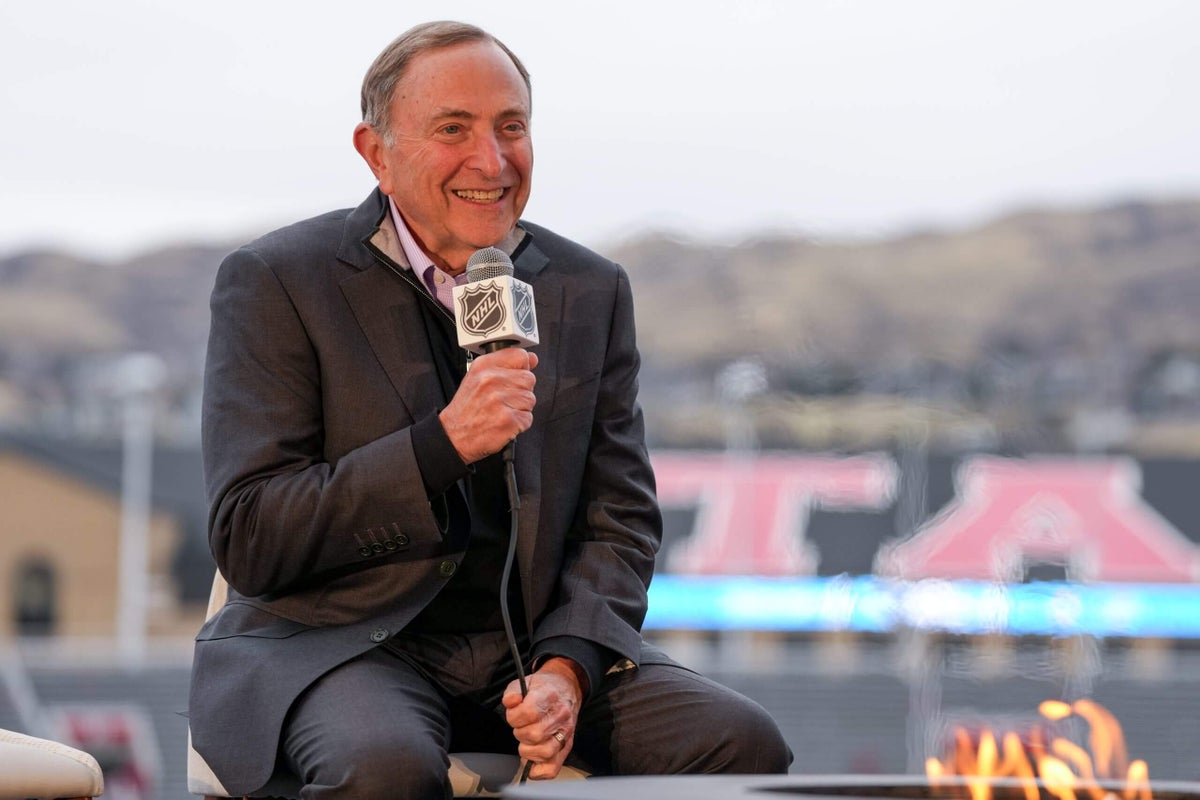
MANALAPAN, Fla. — Heading into Wednesday’s NHL action, the Colorado Avalanche had the most points in the NHL, the Dallas Stars the second-most and the Minnesota Wild were tied for the third-most.
All just so happen to be in the Central Division, and under the current NHL playoff format, two of those three teams will be eliminated by the end of the second round if the season ended today.
NHL commissioner Gary Bettman, the league’s chief decision maker when it comes to, well, everything, has long been the most vocal proponent of the current playoff system, which doesn’t seed teams 1 through 8 in each conference.
After this week’s three-day general manager meetings wrapped up on Wednesday, Bettman maintained his satisfaction with the current format.
“More than comfortable,” Bettman said. “It gives us a sensational first round. Probably the best playoff first round in any sport. We get more games and longer series as a result of the format. And you can always pick at certain situations in any given year and say, ‘Well, I’d like it to be different that year.’ But if you look at the body of work that our playoffs represent over time, what we have now works extraordinarily well.”
Next season, the regular season increases to 84 games. That means teams will play inside their division four times — not like now, where it’s three or four times, three times against teams from the other division in one’s conference and twice in the opposite conference.
But one would think a divisional playoff format makes most sense if it’s like the old days, when you play inside your division six or eight times. Since the schedules are largely balanced now, Bettman was asked whether the regular season has little meaning if the current system allows easier paths to the Stanley Cup for lesser teams.
For instance, the top wild-card team in the West will face the Pacific Division winner in the first round. That’s currently Utah, which has 76 points, 21 points fewer than division leader Colorado, 18 points fewer than Dallas, 14 points fewer than Minnesota … and one point fewer than Pacific leader Anaheim, its current first-round matchup.
Bettman, again, defiantly maintained that the current system is potentially unfair to the top teams in the league.
“If you look at the races for the playoffs, I think it’s virtually impossible to say that the regular season has no meaning,” he said. “To the contrary, every game counts. Going to 84 games, what that really does is balance off divisional play. Every team will play every other twice home and twice away, which I think is good, so we’re not doing any rotation within the division. If anything, I think it makes it more impactful.”
Bettman says the current system creates entertaining first-round matchups.
“It’s about us presenting a terrific game to our fans, and I don’t think there’s any debate that what we’ve been doing under the current format does that,” Bettman said.
Wild president of hockey operations and general manager Bill Guerin has been critical of the current playoff format of late, but does agree that “nothing will guarantee you a first-round victory or a second-round victory just because you’re playing a team that’s beneath you. This is a crazy year, too, because it just happens to be Colorado, Dallas and us. So I guess, just be careful what you wish for, because you’d play a really good hockey team in any system.
“So there’s no perfect system, but in my opinion, the second-best team in the league shouldn’t be playing the third-best team in the league in the first round.”
Spicy exchange on coach’s challenge/goalie interference
A year after the league and GMs spent a big chunk of time on goalie interference/video review, and the hope was that once and for all, a clear standard had been set on the matter, this year’s meetings had a little spice.
It begins with last Saturday afternoon’s controversial goal by the Ottawa Senators, giving them a 2-0 lead over the Ducks, when it was clear that goalie Ville Husso was contacted in the blue paint by Tim Stützle. The goal surprisingly stood. NHL hockey ops top executive Colin Campbell said Tuesday after Day 2 of the meetings that it stood in large part because the Situation Room felt Husso still had the ability to do his job on the play and because the call on the ice from both refs was a good goal. The call on the ice has a huge impact on things.
This play was called NO goalie interefence and even the Senators broadcast was surprised 😭
Thoughts? pic.twitter.com/ZpLUcKGXRo
— B/R Open Ice (@BR_OpenIce) March 14, 2026
But that didn’t dissuade Ducks GM Pat Verbeek from seeking further clarification on Tuesday during the meetings, which we hear got a little testy, and it doesn’t sound like he was very satisfied with what he heard.
It does feel the standard is slipping. Verbeek had the right to be miffed because if that’s a play that happens in a playoff game, what does the Ducks GM tell his video coach to do now? Do you challenge or not and risk the two-minute penalty? That lack of clarity is playing with fire if you’re the league.
That said, a few other GMs, who requested anonymity because it’s a touchy topic, said after the meetings ended Wednesday that while they agreed with Verbeek that the particular play should have been deemed goalie interference and no goal, they felt overall the standard wasn’t in a bad place.
“I think Hockey Operations does a sensational job with video review,’’ Bettman said Wednesday. “And much like supplemental discipline, everyone is going to have an opinion, and when there’s a lot of close calls, it comes down to a judgment call. There are certain things about our game where you cannot get 100 percent certainty to everybody’s satisfaction. But again, if you look at the body of work, I think our video replay system not only has been a leader among the sports (leagues) because all the other systems are modeled on ours, it has held up extraordinarily well.
“Yeah, you’re going to get calls that some people disagree with,’’ he added. “But that’s the way it goes. That’s the beauty of sport.’’
We’ll have to agree to disagree when it comes to goalie interference/video review. That goal on Husso sets a dangerous precedent for teams being encouraged to crash the crease come playoff time. The flip side to that is the league being wary of goalies flopping and trying to sell calls, which is why the league is comfortable with some level of contact, but that particular play screams goalie interference all day long. Especially because the player entered the blue paint to introduce the contact.
And now you have to wonder, does it move the standard? There could be some controversy in this area in the playoffs.
Meanwhile, the goalie interference debate wasn’t the only hot topic. According to league sources, Hurricanes GM Eric Tulsky raised the ire of Bettman when he suggested the standard had slipped on head shots. The commissioner is said to have retorted that it was Tulsky’s team owner Tom Dundon who was making him bring that up. Whatever the case, managers were buzzing about it after the meetings.
Tulsky, as it turns out, was a busy man. Sources inside the room confirmed late Wednesday afternoon that he also raised concerns over the shifting standard of goalie interference/video review in lieu of the Verbeek conversion, seeking clarity on it as well.
These meetings can sometimes produce some spicy moments.
Playoff cap could be non-issue
The league this week introduced to GMs the new playoff cap app that will handle the game-day entry of cap-compliant rosters. It was the final step in formalizing the logistics of how the playoff salary cap will work on game days.
“So we’ve worked on that, and actually it’s going to work a little differently than how it’s in the (CBA) MOU,’’ deputy commissioner Bill Daly said Wednesday. “We’ve been working with the Players’ Association on it, but it’s going to be automated. We have an app and a function, and it’ll be submitted like rosters are for each playoff game at the time rosters are submitted for the playoff game. It will indicate to the general manager or whoever is submitting the roster when there’s an overage (over the cap) or a concern. They probably will know that going in. But it won’t allow them essentially to submit a roster that would be otherwise violating the provisions of the collective agreement.’’
Rather interestingly, Daly also noted that as it stands, there doesn’t appear to be a playoff team as per the current standings that will have any decisions to make. That everyone is under the playoff cap as it is.
“Probably as a result of the LTI changes that we made and the playoff cap, the clubs have positioned themselves in a way where they’re not going to be in violation or in potential violation for any playoff game,’’ said the deputy commissioner.
Which is to say, the changes became a self-fulfilling chain of events as teams didn’t have access to a loophole anymore via LTI and no cap in the playoffs and therefore didn’t make trades that would put them past the threshold. So while the playoff cap is still in place for the first time, the work has already been done in many ways through the trade deadline.
“I can say that virtually with no exception,’’ Daly said of all the playoff teams not having issues being playoff cap compliant. “One club who is likely to make the playoffs, if they activated a bunch of (injured) players who no one expects them to activate, they might have some decisions to make. But at this point, we don’t anticipate any of the playoff clubs having any issues with the playoff cap.’’
While Daly would not say which club he was referring to, our understanding is that it’s the New York Islanders, who currently have the likes of Alexander Romanov, Kyle Palmieri and Semyon Varlamov still out long-term. All three would have to come back for the Isles to have a playoff cap issue, but that’s not expected to happen. Romanov is the only player who might come back.
Russia’s participation in World Cup remains in doubt
Bettman and Daly denied a report out of Czechia that Sweden, Finland and Czechia, which is hosting seven World Cup games at Prague’s O2 Arena, would not participate in the 2028 World Cup if Russia does.
However, Daly said the league is certainly aware of how European countries feel about Russia’s invasion of Ukraine and alluded that if the war continues, Russia will likely not be invited.
“I don’t think we’re out of sync with where the Finns and Swedes and Czechs are with respect to Russian participation,” Daly said. “It’ll be available if certain things happen. And if certain things don’t happen, they’re likely not to participate.”
Russia remains suspended by the IIHF due to the war in Ukraine, but the NHL and NHLPA are not bound by that ban, and the IIHF has no affiliation with this tournament. Bettman says the league continues to monitor the situation.
“We’re going to see how things develop. Time will tell,” Bettman said earlier this week. “There is no immediate need or urgency to make that decision, so let’s see how things play out.”
Bettman supports Department of Player Safety
With criticism being levied at the Department of Player Safety after the five-game suspension recently handed out to Anaheim captain Radko Gudas for kneeing and ending the season of Toronto captain Auston Matthews, Bettman came to the defense of senior vice president of player safety, George Parros.
“George always takes criticism. Most of it unfair,” Bettman said. “He goes through a very detailed process of analyzing any situation that comes before him. He shared the process with the managers as a group, and I believe they were satisfied with how thorough and diligent he was. And briefly, if you look at the precedent, he was certainly within the range. If you look at prior conduct, Gudas hasn’t been suspended in seven years. And kneeing is not an epidemic; I think there have been 18 suspensions over the last 15 years. And so people are going to criticize one way or the other whatever Player Safety does. That’s not something that’s new.
“Actually, the process that we use is something that’s been vetted and negotiated with the Players’ Association, and if they’re unhappy, they always have a right to appeal it to me, which is why I still have the additional decision-making because appeals of his decisions in first instances come to me anyway.”
Daly said the topic didn’t even come up during the last CBA negotiations and that the NHLPA is satisfied with how the department operates.
Who will manage Team USA in World Cup, Olympics?
Now that Doug Armstrong has stepped down from Hockey Canada, Team USA will have to decide, with respect to managing the upcoming World Cup and 2030 Olympics, whether to run it back with Olympic gold medal-winning GM Bill Guerin or choose new leadership.
USA Hockey executive director Pat Kelleher told The Athletic there is no timetable for a decision.
It would seem likely that USA Hockey first offers the job to Guerin, and then it’ll be up to him whether to accept.
One option would be for Guerin to do what Armstrong did with the 4 Nations Face-Off, and that’s oversee another GM (in that case, Don Sweeney) in the 2028 World Cup and then assume the role of GM for the Olympics. If that were the case, some options to be World Cup GM would be Bill Zito, Stan Bowman, Tom Fitzgerald or Chris Drury.
Visors, neck guards and 19-year-olds
• As part of the new CBA, neck guards will be mandatory for the 2026-27 season for every player who has not yet played an NHL game. Others will be grandfathered, but the hope is that, especially after neck guards were mandatory at the recent Olympics, more and more players will give them a try.
Campbell and Stephen Walkom, the NHL’s executive vice president of officiating, said referees next season will strictly enforce proper use of visors and neck guards, a standard that wasn’t applied at the Olympics. As the rule book states, players will first be issued a warning, then a minor penalty if they play another shift with equipment that’s not properly worn.
• General managers debated the past three days about permitting 19-year-old Canadian Hockey League players in the AHL. With CHL players now being allowed to change paths and go to the NCAA, teams want to maintain control of their drafted players. In the previous CBA, the NHL had an agreement with the CHL that drafted players playing in the OHL, WHL and QMJHL cannot play in the AHL. But this issue was reopened in the new CBA, and changes need to be finalized.
Daly alluded to the fact that there will be some type of change. As Campbell indicated Tuesday, it’s determining the number of 19-year-olds that could be assigned (one or a handful) to the AHL and determining the criteria (perhaps first-round picks only, or first- through fourth-rounders).
Daly had a meeting scheduled on Wednesday with CHL president Dan MacKenzie and the three CHL commissioners.
• Bowman, who manages the Edmonton Oilers, reiterated Wednesday that Leon Draisaitl’s lower-body injury will be evaluated at the end of the regular season, and he doesn’t need surgery.